
sales@sztimeast.com
+86-15989541416
Introduction
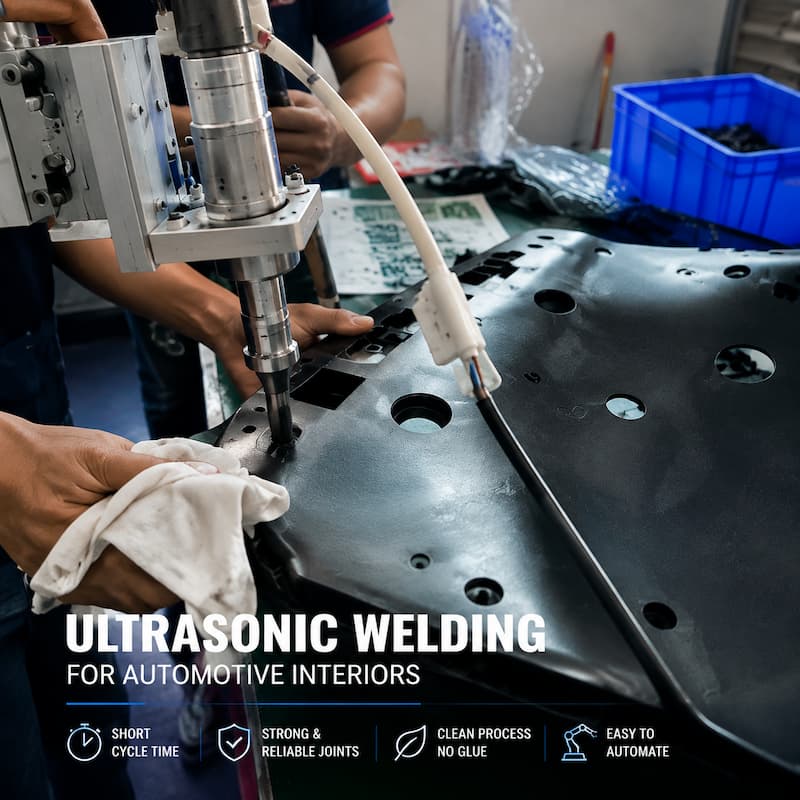
Automotive interiors contain far more plastic assemblies than most drivers ever see.Behind a finished
door panel, center console or dashboard are brackets, air ducts, speaker components, trim retainers,
lighting parts and other plastic components that must be joined quickly and consistently.
For many of these applications, ultrasonic welding provides a fast and clean alternative to screws, adhesives
and other joining methods.However, selecting an ultrasonic welder is only one part of the process. Material
compatibility,joint design, horn access, fixture support and the location of visible surfaces can determine
whether an automotive interior part welds consistently or develops problems such as weak joints, surface
marks or excessive flash.This guide explains where ultrasonic welding is commonly used in automotive
interiors, why manufacturers choose it, and what should be evaluated before developing the welding process.
Automotive interior production combines several demanding requirements: high production volume,
consistent assembly quality, controlled appearance and low cost per part.
Ultrasonic welding is particularly suitable for many thermoplastic interior components because the
joining energy is concentrated at the weld interface.
Unlike adhesives, the process does not require dispensing, curing or additional consumables. Unlike
screws and mechanical fasteners, it may also eliminate additional components and assembly operations.
For a properly designed application, the actual ultrasonic weld can often be completed in a short cycle,
making the process suitable for both standalone welding machines and automated production lines.
Key advantages include:
Fast welding and short production cycles
No glue, solvents or curing process
No additional screws or fasteners
Clean and repeatable plastic joining
Limited heat exposure outside the joint area
Easy integration with automated assembly systems
Process data that can be monitored for production control
These advantages are especially valuable when thousands of identical automotive components must be
produced every shift.
Ultrasonic welding can be used on many interior components, but the welding method is not necessarily
the same for every part.
Automotive door panels often consist of multiple molded components rather than one single plastic part.
Ultrasonic spot welding or ultrasonic staking can be used to attach hidden brackets, retainers, decorative
components and other structures to the back of the panel.
Because the visible side may be a Class-A surface, horn position, welding energy and fixture support
must be carefully evaluated to prevent marks from appearing on the opposite side.
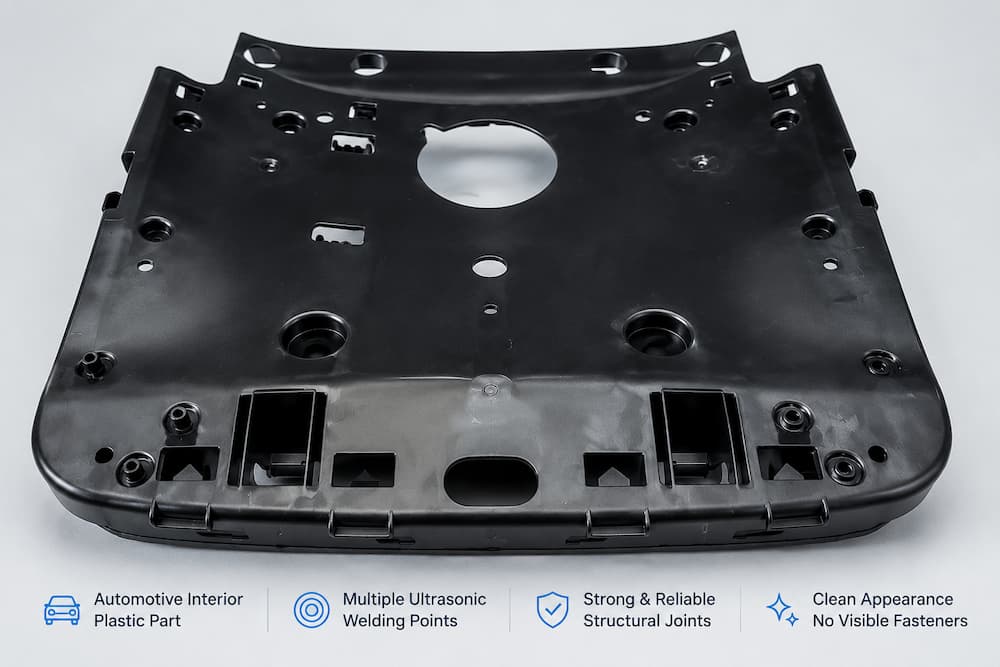
Air vents, air distribution components and smaller HVAC ducts are another important application.
Depending on the component design, ultrasonic welding can create a continuous or localized joint
without adhesives or mechanical fasteners.
For air-handling components where leakage matters, the project should not be evaluated only by
checking whether the two parts remain attached. Weld continuity and leak performance may also
need to be validated.
Center consoles contain numerous plastic housings, internal supports, decorative assemblies and
functional components.Ultrasonic welding is useful when these parts require hidden joints and fast
assembly without exposed screws.Complex geometry can make fixture design particularly important
because the lower component must be supported close to the welding area.
Dashboard and instrument panel assemblies contain many hidden plastic subcomponents.
Depending on the structure, ultrasonic welding can be used for brackets, ducts, retainers and other
secondary assemblies.Large components do not automatically require the entire assembly to be
welded in one ultrasonic operation. Multiple welding points or sequential welding stations may
be a more practical solution.
Speaker grilles and related components often have thin walls, textured surfaces and numerous
attachment points.The welding process therefore needs to balance joint strength with cosmetic protection.
For these applications, controlling horn contact and supporting the part correctly are often as important
as the ultrasonic parameters themselves.
Modern vehicle interiors increasingly integrate switches, sensors, ambient lighting and electronic modules.
Ultrasonic welding can provide a compact joining solution for their plastic housings, but sensitive internal
componentsmust be considered during process development.
Excessive vibration, component movement or unsuitable horn contact can damage electronics even when
the plastic joint itself appears acceptable.
Common automotive interior materials include ABS, PC/ABS, PP, PA and other engineering thermoplastics.
But identifying the material family is only the beginning.
Successful ultrasonic welding depends on factors such as:
Exact resin grade
Filler or reinforcement content
Material compatibility between the two components
Moisture condition
Recycled material content
Wall thickness
Distance between the horn and weld joint
For example, two components described simply as "PP" may behave differently if one contains fillers
or has a different formulation.
This is why welding parameters should not be selected from a generic material table alone.
Whenever possible, the actual molded production parts should be tested before the final welding machine
and tooling are confirmed.
One of the most common mistakes in an ultrasonic welding project is selecting the machine first and
evaluating the joint design later.The ultrasonic system supplies mechanical vibration, but the plastic part
determines where that energy is concentrated.
For conventional plastic-to-plastic ultrasonic welding, an energy director is commonly incorporated into
the joint. This small molded feature helps initiate melting at a controlled location.
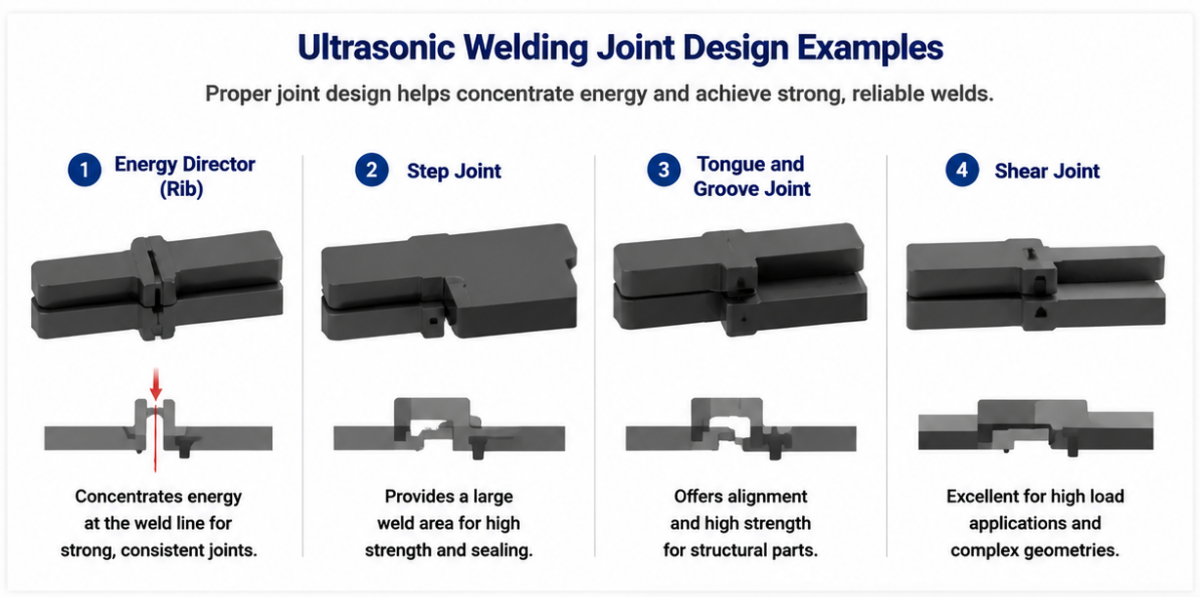
Other joint designs, including step joints, tongue-and-groove structures and shear joints, may be considered
depending on the application.The correct design depends on what the joint needs to achieve.
A hidden structural bracket, for example, has different requirements from an HVAC component that must
control air leakage.
Before tooling is manufactured, the joint should therefore be reviewed for:
Required weld strength
Sealing requirements
Part alignment
Available welding area
Flash control
Molded tolerances
Cosmetic requirements
Horn accessibility
Changing a joint after the injection mold has been finalized can be expensive. Early weldability review
can prevent much larger problems later in the project.
For applications requiring tighter control of weld depth, force and repeatability, a servo ultrasonic
welding system may also be considered.
Automotive interiors create a particular challenge for ultrasonic welding because the customer may
see one side of the component while the welding operation takes place on the other.
A weld can be mechanically strong and still be unacceptable if it creates:
Gloss changes
Surface impressions
Sink marks
Scratches
Stress whitening
Local deformation
Simply reducing welding power is not always the correct solution.
Surface marking can also be related to poor fixture support, excessive local movement, inappropriate
horn contact or a weld location that transfers vibration directly to the visible surface.
The entire horn–part–fixture relationship should therefore be considered during tooling design.
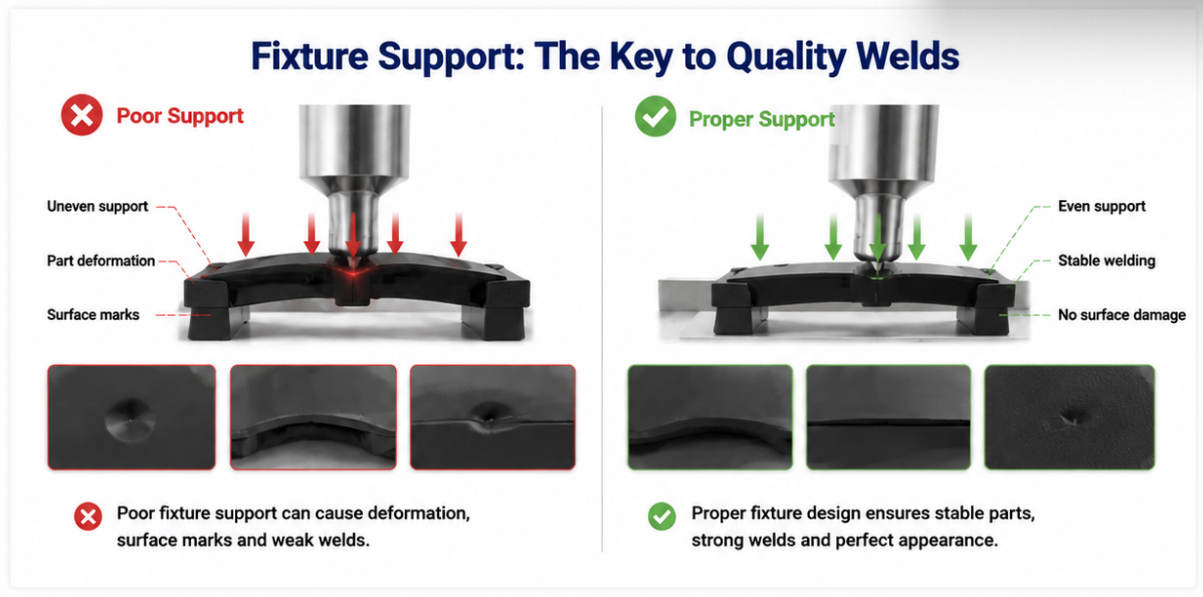
A good ultrasonic horn cannot compensate for a poorly supported part.
During welding, the lower fixture should locate the component accurately and provide sufficient support
around the welding area.If the part flexes or moves, ultrasonic energy can be lost before it reaches the joint.
This may result in inconsistent weld strength, longer weld cycles, surface damage or different results from
one component to another.
Automotive interior parts can be particularly difficult because they often contain curved surfaces, thin ribs and
irregular geometries.
A production fixture should therefore be designed around the actual molded part rather than only its nominal
CAD geometry.
Several problems appear repeatedly during automotive interior projects.
Possible causes include insufficient energy transfer, unsuitable joint geometry, poor fixture support,
part variation or incompatible materials. For a detailed diagnosis, see our weak ultrasonic weld
troubleshooting guide.Increasing weld time or amplitude without identifying the actual cause can
sometimes make the problem worse.
If the opposite side of the weld is cosmetic, excessive vibration or insufficient support can create
visible marks.Tooling and part structure should be investigated before simply changing machine settings.
Flash may result from excessive melting, inappropriate joint geometry or uncontrolled part collapse.
Where appearance or assembly clearance is important, the joint can sometimes incorporate features
designed to contain molten material.
Cracking or Stress Whitening
Sharp corners, molded-in stress, excessive welding energy and unsupported structures can contribute to
cracking or whitening.
The failure location often provides useful information about whether the problem originates from the
weld joint, part design or molding process.
Changes in resin, fillers, moisture, molding conditions and dimensional tolerance can affect welding
behavior.A process that works only within a very narrow parameter range may become unstable during
mass production.The goal should therefore be to establish a practical **process window**, rather than
finding only one parameter combination that produces one acceptable sample.
There is no single ultrasonic frequency that is correct for every automotive interior application.
In general, frequency selection is influenced by part size, geometry, required amplitude and the amount
of ultrasonic energy that must be delivered.
15 kHz systems can be useful for relatively large or difficult-to-weld components where higher amplitude
and power are required.
20 kHz systems are widely used for general plastic welding and cover many medium-sized automotive
applications.
35 kHz systems are often considered for smaller or more delicate components where controlled vibration
and smaller tooling are advantageous.
Frequency should therefore be selected after reviewing the actual component rather than from the industry
name alone.
A large door trim component and a small sensor housing may both be classified as automotive interior parts,
but they can require completely different ultrasonic systems.
The appropriate automation level depends primarily on production volume and the surrounding manufacturing
process.For development, sampling and lower-volume production, a standalone ultrasonic welding machine
may be sufficient.
For higher-volume programs, the welding station can be integrated with:
Automatic part loading
Rotary indexing tables
Multi-station assembly
Part detection
Barcode or QR code identification
Vision inspection
Weld data collection
Leak testing
Automatic OK/NG separation
The important question is not simply how much automation can be added.
It is how much automation the production requirement actually needs.
Over-automation increases equipment cost and complexity, while insufficient automation can create labor,
consistency and cycle-time problems.
A machine should not be approved only because it can join two sample parts.
The welded component needs to satisfy the functional requirement of the actual product.
Depending on the application, validation may include:
Visual inspection
Pull or push testing
Peel testing
Destructive testing
Dimensional inspection
Leak testing
Functional testing
The correct acceptance method should be defined according to the component.
For example, a structural bracket may require destructive strength testing, while an HVAC component
may require leak testing in addition to mechanical inspection.
Production validation should also use representative molded samples rather than ideal prototype pieces
whenever possible.
For a new automotive interior welding project, supplying the following information can significantly improve
equipment selection:
2D or 3D drawings
Photos of the assembled parts
Plastic material and grade
Part dimensions
Welding location
Required joint strength or sealing performance
Cosmetic surface requirements
Target cycle time
Required production capacity
Current assembly method
Automation requirements
Physical samples are particularly valuable.
Sample welding can reveal problems that are difficult to identify from drawings alone, including part flexibility,
unexpected vibration, molded tolerance and surface marking.
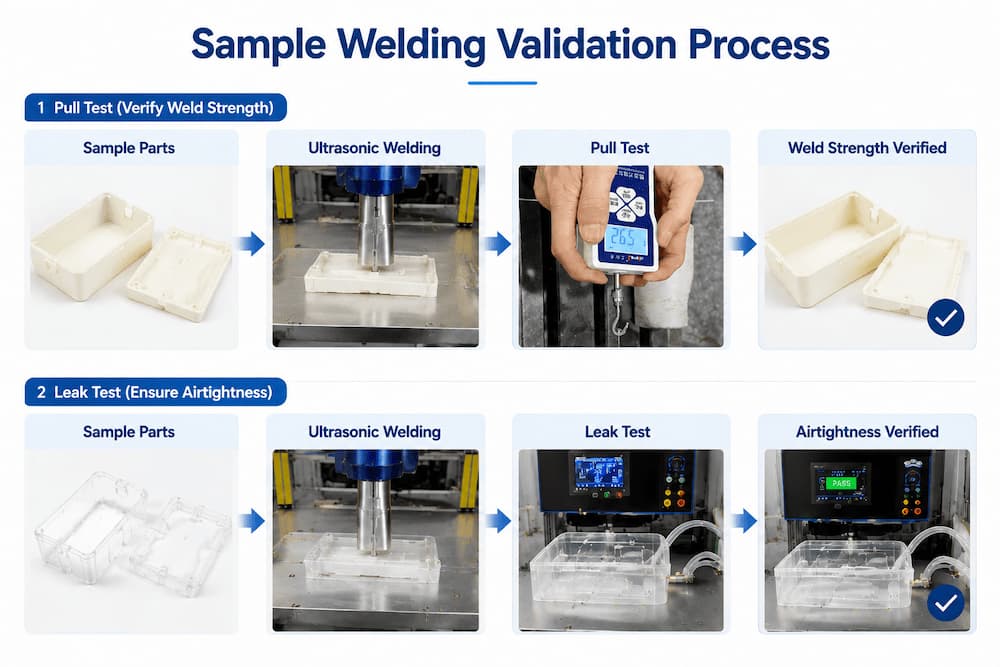
For automotive projects, we recommend sample testing with actual molded parts before finalizing the welding
solution whenever samples are available.
A typical evaluation can include:
Part review → Material review → Joint evaluation → Trial welding → Weld optimization → Strength or
leak testing → Equipment recommendation
This approach helps determine whether the proposed ultrasonic process is suitable before the customer invests in
production tooling and automation.
It can also identify whether the part itself needs a joint or structural modification.
Send Parts for Sample Testing→
A successful automotive interior welding project is not determined by ultrasonic power alone.
The machine, generator, transducer, horn, fixture, plastic material and joint design operate as one system.
When evaluating a solution, consider:
1. Can ultrasonic energy reach the joint efficiently?
2. Are the two materials suitable for ultrasonic joining?
3. Is the joint designed for the required function?
4. Can the fixture support the part without damaging visible surfaces?
5. Can the process tolerate normal production variation?
6. How will weld quality be verified?
7. Does the required automation level match the production target?
Answering these questions before equipment production reduces development risk and makes the transition
from sample welding to mass production much easier.
Need to Test an Automotive Interior Part?
If you are developing an automotive interior plastic component and are not sure whether ultrasonic welding
is suitable, send us your part drawings, material information, welding requirements and production target.
If physical samples are available, we can evaluate the welding area and perform sample welding tests before
recommending the ultrasonic welding machine, horn, fixture or automated solution.
This is especially recommended for projects involving Class-A surfaces, complex plastic assemblies, air ducts,
large interior components or parts with uncertain joint designs.
Phone: +86-15989541416
E-mail: sales@sztimeast.com
Whatsapp:+86-15989541416
Add: Building 5, Huixin Intelligent Industrial Park,Guangming, Shenzhen,China 518107
We chat