
sales@sztimeast.com
+86-15989541416
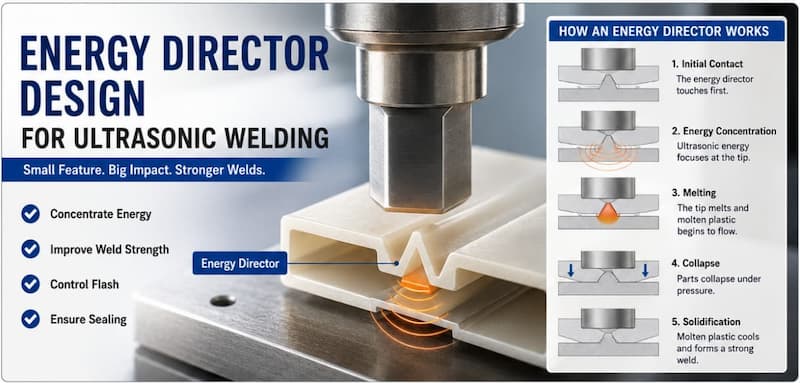
Energy director design is one of the most important factors in ultrasonic plastic welding. Even when
the ultrasonic welding machine, horn and fixture are correctly selected, a poorly designed energy director
can still cause weak welds, excessive flash, leakage, cosmetic defects or unstable production results.
An energy director is a small molded ridge, usually triangular or pointed, placed on the plastic joint
surface. During ultrasonic welding, this small feature concentrates vibration energy into a limited
contact area.
The tip melts first, molten plastic flows across the joint interface, and the two plastic parts bond under
pressure.For many plastic parts, especially housings, caps, covers, filters, electronic components and
medical disposable parts, energy director design directly affects weld strength, sealing quality, appearance
and cycle time.
This guide explains how to design energy directors for ultrasonic welding, including shape, height, angle,
material selection, flash control, sealing requirements and common design mistakes.
An energy director is a small raised feature molded onto one side of a plastic joint. Its main purpose is to
concentrate ultrasonic vibration energy at the exact location where melting should begin.
Without an energy director, two flat plastic surfaces may contact over a large area. This can spread the
ultrasonic energy too widely, causing slow melting, unstable weld strength or incomplete bonding.
With a properly designed energy director, the initial contact area is much smaller. This allows heat to
build quickly at the joint interface, creating faster and more controlled melting.
In ultrasonic welding, the energy director helps control:
Where melting starts
How molten plastic flows
How much collapse occurs
How much flash is generated
How consistent the weld strength becomes
Whether the joint can meet sealing or strength requirements
Ultrasonic welding is not only a machine process. It is a complete system involving plastic material,
part design, joint design, horn design, fixture support and welding parameters.
The energy director is the connection point between part design and welding performance. If the
energy director is not designed correctly, the welding machine may not be able to produce a stable
result, even after repeated parameter adjustment.
A good energy director can help improve:
Weld strength
Sealing performance
Welding consistency
Cycle time
Cosmetic appearance
Flash control
Process repeatability
Production stability
A poor energy director may cause:
Weak welds
Incomplete fusion
Excessive flash
Cracks near the weld area
Burn marks
Part deformation
Leakage
Unstable pull test results
High reject rate in production
For this reason, energy director design should be considered early in product development,
not only after the mold is already finished.
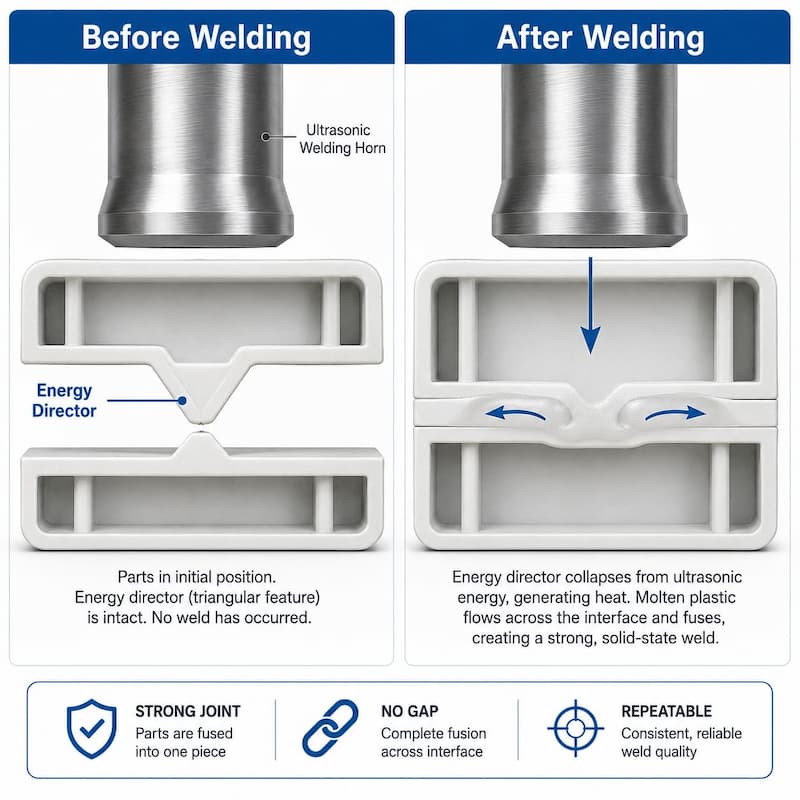
During ultrasonic plastic welding, high-frequency mechanical vibration is transferred from the welding horn
into the upper plastic part.The vibration travels through the plastic and reaches the joint interface.
Because the energy director has a small pointed tip, the contact area is limited. This creates high local stress
and frictional heating at the tip. The energy director melts first, and the molten plastic begins to flow across
the joint surface.
As the welding process continues, the plastic parts move closer together under pressure. This movement is
called collapse. The melted energy director fills the joint area, and after holding pressure is applied, the molten
material cools and solidifies.
The basic process is:
The welding horn contacts the upper plastic part.
Ultrasonic vibration reaches the joint interface.
The energy director tip concentrates energy.
The tip melts first.
Molten plastic flows into the joint area.
The parts collapse to the required distance.
Holding pressure allows the weld to solidify.
A bonded plastic joint is formed.
This is why energy director geometry is so important. The shape and size of the energy director determine
how the welding process starts and how the molten plastic behaves.
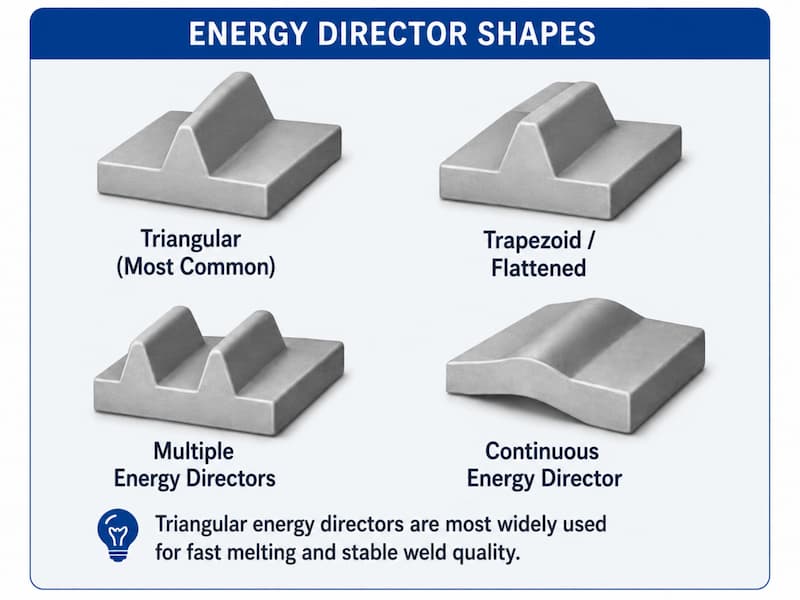
The most common energy director shape is a triangular ridge. It is widely used because the pointed tip
creates a very small initial contact area, allowing fast and controlled melting.
A triangular energy director is the standard choice for many ultrasonic plastic welding applications.
It is suitable for many rigid thermoplastics and is easy to mold.
Typical uses include:
Plastic housings
Covers
Caps
Automotive components
Electronic enclosures
Filter components
Medical plastic parts
The triangular shape usually provides good energy concentration and predictable collapse. It is
often the first design option considered for general ultrasonic welding applications.
A trapezoid or slightly flattened energy director may be used when a very sharp tip is not suitable.
This design may be considered for certain materials, larger parts or applications where molding stability
is more important than extremely fast melting.
However, if the top is too wide, the initial contact area becomes larger, reducing the energy concentration
effect. This may require more welding energy and can make the process less stable.
Some parts use two or more energy directors to increase weld area or improve sealing. This can be useful
for larger joints, rectangular housings or parts requiring higher sealing performance.
However, multiple energy directors should be used carefully. If the design is not balanced, one energy director
may melt before the other, causing uneven collapse, poor sealing or unstable strength.
A continuous energy director follows the full welding path. It is commonly used for sealed plastic parts,
such as containers, filter housings, electronic housings and fluid-related components.
A continuous design helps create a complete weld line. However, the product still needs proper fixture
support and leak testing to confirm the sealing result.
An interrupted energy director may be used when full sealing is not required. It can reduce welding energy,
limit flash or allow gas to escape during welding.
This design is more suitable for mechanical joining rather than airtight or watertight sealing.
Energy director dimensions depend on plastic material, wall thickness, product size, welding frequency,
strength requirement, cosmetic requirement and sealing requirement.
There is no universal size that works for all plastic parts. However, the following values can be used as
general starting points during design.
| Plastic Material | Typical EnergyDirector Height | Typical Included Angle | Welding Notes |
| ABS | 0.25–0.50 mm | 60°–90° | Easy to weld with a stable process window |
| PS | 0.25–0.45 mm | 60°–90° | Good energy transfer and fast melting |
| PC | 0.30–0.60 mm | 60°–90° | Requires good horn contact and fixture support |
| PMMA | 0.25–0.50 mm | 60°–90° | Cosmetic control is important |
PP | 0.40–0.80 mm | 60°–90° | Often needs larger energy input |
PE | 0.50–0.90 mm | 60°–90° | More difficult due to high energy absorption |
| PA / Nylon | 0.40–0.80 mm | 60°–90° | Moisture control is important |
| POM | 0.35–0.70 mm | 60°–90° | Needs stable pressure and accurate alignment |
These values are only starting references. Final dimensions should always be confirmed through sample welding,
cross-section inspection, pull testing, leak testing or functional testing.
For small precision parts, the energy director may need to be smaller. For large parts or difficult-to-weld materials,
it may need to be larger. The final design must match the real product structure and application requirement.
Energy director height controls the amount of material available for melting and bonding.If the energy director
is too low, there may not be enough molten plastic to form a strong weld. This can cause incomplete fusion,
low pull strength or leakage.
If the energy director is too high, too much material may melt. This can cause excessive flash, part deformation,
unstable collapse or poor appearance.
The correct height should provide enough molten material for the weld without creating unnecessary overflow.
In most applications, the energy director height should be designed together with the expected collapse distance.
The welding machine should be able to control how much the joint collapses during welding.
Servo ultrasonic welding machines are especially useful when collapse distance and welding depth need to
be controlled accurately.
The included angle of the energy director affects how quickly the tip melts.
A sharper angle creates a smaller contact point and faster energy concentration. A wider angle creates a larger
contact area and may melt more slowly.
Common energy director angles are usually between 60° and 90°.
A 60° angle can provide strong energy concentration, but it may be more sensitive to molding accuracy and
part handling. A 90° angle is easier to mold and may be more stable for some parts.
The best angle depends on:
Plastic material
Part size
Mold capability
Welding frequency
Cosmetic requirement
Strength requirement
Sealing requirement
For many general plastic parts, a triangular energy director with a 60° to 90° included angle is a practical
starting point.
The base width of the energy director should match its height and the available joint space. If the base is
too narrow, the feature may be difficult to mold or may be damaged during handling. If the base is too wide,
it may create too much molten plastic and increase flash.
The width should also allow stable melt flow. The molten material should fill the joint area instead of being
forced outside the part uncontrolled.
For cosmetic products, the energy director should be positioned away from visible edges whenever possible,
or a flash trap should be added to hide excess material.
The energy director should be located at the intended weld interface. It must have good contact with the mating
part before welding begins.Poor location can cause unstable welding results. For example, if the energy director
is too close to an unsupported wall, the plastic may flex during welding. If it is too close to the outer edge, flash
may become visible. If it is not aligned with the mating surface, only part of the energy director may melt.
Good location design should consider:
Horn contact area
Lower fixture support
Part tolerance
Material flow direction
Flash control
Weld strength requirement
Sealing path
Final appearance
The energy director should not be designed as an isolated detail. It should be part of the complete ultrasonic
welding joint design
In most cases, the energy director is molded onto one of the two plastic parts. Choosing the correct side is important.
The energy director is usually placed on the part that:
Has better dimensional control
Is easier to mold accurately
Allows better melt flow
Has enough wall thickness
Can be supported well by the fixture
Provides a stable welding surface
Helps control cosmetic appearance
For some assemblies, the energy director is placed on the upper part. For others, it is placed on the lower part.
There is no single rule for all products.The decision should be based on part structure, molding feasibility,
welding direction, fixture design and final product requirement.
Energy Director Design for Different Plastic Materials
Different plastics behave differently during ultrasonic welding. Some materials transfer ultrasonic energy efficiently
and melt quickly. Others absorb energy, require more welding force or have a narrower processing window.
ABS
ABS is one of the easier plastics to weld ultrasonically. It usually works well with a standard triangular energy director.
The process window is relatively stable, and good weld strength can often be achieved with proper joint design.
PC
PC can produce strong welds, but it needs good fixture support and stable welding parameters. Poor support may cause
cracking, whitening or uneven welding.
PP
PP is more flexible and absorbs more ultrasonic energy than rigid plastics such as ABS. It often requires a larger energy
director, higher amplitude or longer welding time. Joint design and fixture support are very important.
PE
PE can be more difficult to weld because it absorbs energy and has a softer material behavior. Energy director design
should provide enough material for melting, and welding trials are usually needed to confirm the result.
PA / Nylon
Nylon can be welded ultrasonically, but moisture content can affect welding quality. If the material contains too much
moisture, bubbles, weak welds or inconsistent results may occur. Material conditioning may be required.
POM
POM requires careful control of welding pressure, energy and alignment. A stable energy director and accurate fixture
are important to avoid weak joints or excessive material flow.
Because material behavior varies by grade, filler, color, moisture and additives, sample testing is always necessary before
finalizing the design.
When the main requirement is weld strength, the energy director should provide enough molten material to form
a reliable bond across the joint area.
For strength-focused design, consider:
Sufficient energy director height
Good material flow into the joint
Proper collapse distance
Strong fixture support
Stable horn contact
Enough weld area
Correct welding pressure
Repeatable part dimensions
The goal is not simply to make the energy director larger. A larger energy director may create more molten plastic,
but it can also cause excessive flash, stress, deformation or uneven welding.
A strong weld is usually the result of balanced design: enough energy concentration, enough molten material,
good contact, good support and stable process control.
Weld strength should be confirmed by practical testing, such as tensile pull testing, shear testing, peel testing
or functional testing depending on the application.
For sealed plastic parts, the energy director must create a continuous weld path. Any gap, interruption or
uneven melting may lead to leakage.Sealing applications may include:
Fluid containers
Filter housings
Medical plastic components
Electronic housings
Automotive reservoirs
Waterproof plastic products
Sensor housings
For sealing, the energy director should normally be continuous around the full joint path. The mating surface
must also be flat and well supported.
Important sealing design factors include:
Continuous energy director path
Stable part alignment
Even horn pressure
Proper fixture support
Controlled collapse distance
Flash trap design
Material compatibility
Leak testing after welding
A part may pass a pull test but still fail a leak test. This is because mechanical strength and sealing are not
always the same thing. A small internal channel or unmelted area may be enough to cause leakage.
For sealed products, leak testing after ultrasonic welding or pressure testing should be included during validation.
Some plastic parts require a clean appearance after welding. Examples include consumer products,
visible electronic housings, medical devices and automotive interior components.
In these cases, flash control is very important.
To improve cosmetic appearance:
Keep the energy director away from visible outer edges
Use a flash trap if possible
Avoid oversized energy directors
Control welding energy and collapse
Ensure accurate part alignment
Use proper fixture support
Avoid excessive amplitude
Design enough space for molten plastic flow
If the energy director is too close to the outside edge, molten plastic may be pushed out and become visible flash.
If welding energy is too high, the part may show burn marks, whitening or deformation.
Cosmetic requirements should be considered during the early design stage. It is much harder to hide flash after
the mold has already been made.
Flash is excess molten plastic that flows out of the weld area. Some flash may be acceptable in non-visible areas,
but excessive flash can affect appearance, assembly, sealing or product safety.
Common causes of excessive flash include:
Energy director is too large
Welding energy is too high
Amplitude is too high
Pressure is too high
Collapse distance is too large
No flash trap is designed
Part tolerance is unstable
Fixture support is not enough
Energy director is too close to the edge
Flash control can be improved by reducing unnecessary melt volume, adding a flash trap, improving part alignment
and optimizing welding parameters to prevent flash in ultrasonic welding.
A flash trap is a small space designed to collect molten plastic and keep it away from visible or functional areas.
It is very useful for products with strict appearance requirements.
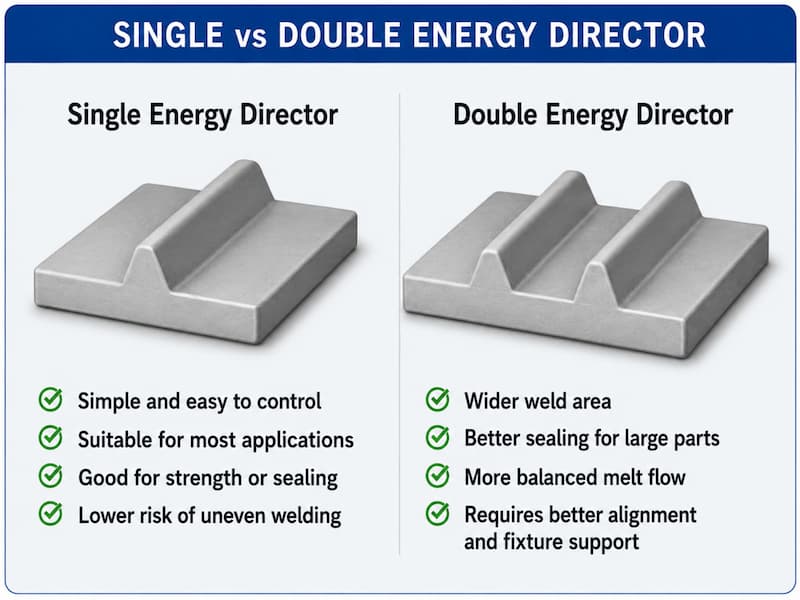
Some plastic parts use a single energy director. Others use double or multiple energy directors.
A single energy director is simpler and easier to control. It is commonly used for general strength applications
and many standard plastic assemblies.A double energy director may be used when:
A wider weld area is needed
Better sealing is required
The part is large
The joint needs more balanced melt flow
The structure requires more bonding area
However, double energy directors can also create challenges. If both ridges do not contact evenly, one may
melt before the other. This can cause uneven collapse or incomplete welding.
For double energy director design, part flatness, molding accuracy and fixture support are especially important.
In many cases, a well-designed single energy director is more stable than a poorly designed double energy director.
Energy director design cannot be separated from fixture design. During ultrasonic welding, the lower fixture must
support the plastic part firmly and accurately.
If the fixture support is poor, ultrasonic energy may be lost through part vibration or movement. The energy director
may not melt evenly, even if its shape is correct.
Good fixture support helps:
Keep the part stable
Maintain proper alignment
Prevent bending or vibration loss
Support the weld area directly
Improve weld strength consistency
Reduce cosmetic defects
Improve sealing performance
If the energy director is located in an area that cannot be supported properly, the welding result may be unstable.
This is why product engineers and welding engineers should review part design and fixture design together.
The welding horn transfers ultrasonic vibration into the plastic part. If horn contact is uneven, the energy director
may melt unevenly.Horn contact problems can cause:
Local over-welding
Local weak welding
Surface marks
Part deformation
Cracks
Unstable weld strength
Uneven collapse
The horn should match the part surface and apply pressure evenly.For complex plastic parts, custom ultrasonic
welding horn design may be required.In many production projects, weld quality problems are not caused by the
energy director alone. They may come from the combination of energy director design, horn contact and fixture support.
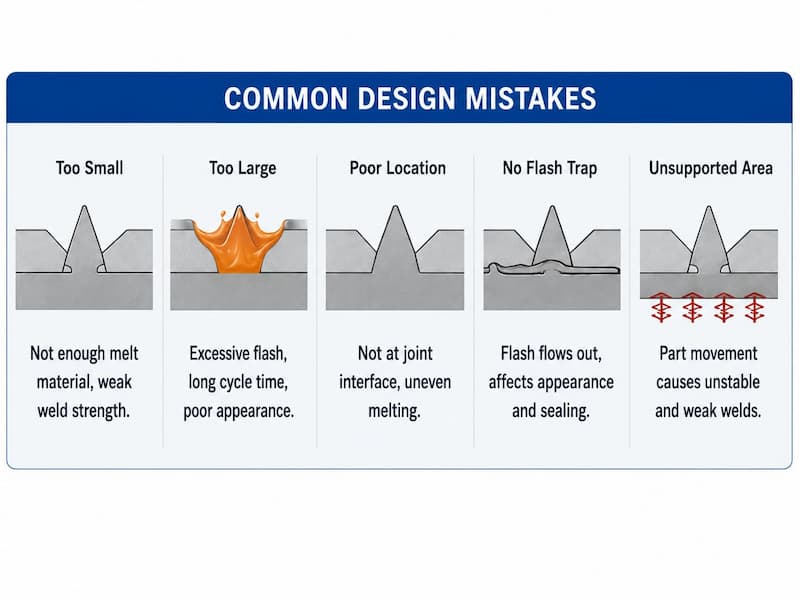
If the energy director is too small, it may not provide enough molten plastic. The weld may look clean but
have low strength or poor sealing.
If the energy director is too large, too much plastic may melt. This can cause flash, deformation, long cycle time
or unstable welding.
If the energy director is not positioned correctly at the joint interface, melting may happen in the wrong area.
This can lead to weak welds and cosmetic defects.
If the design does not include space for molten plastic flow, flash may appear outside the part. This is especially
problematic for visible products.
If the lower fixture cannot support the weld area, the part may move or absorb vibration. This reduces welding
efficiency and causes unstable results.
If the mating surface is not flat or has large tolerance variation, the energy director may contact unevenly.
Some areas may weld before others, causing inconsistent strength.
Different plastic grades behave differently. Even the same material family can weld differently because of
fillers, additives, color masterbatch, moisture or recycled content.
Energy director design should not be confirmed only by appearance. Pull testing, leak testing, cross-section
inspection or functional testing may be required depending on the product.
After the energy director is designed, it should be validated through real welding trials. Computer design alone
cannot fully predict ultrasonic welding performance.
A practical validation process may include:
Confirm plastic material and grade.
Review the joint structure and energy director dimensions.
Check whether the horn can contact the part correctly.
Check whether the fixture can support the weld area.
Weld samples using controlled parameters.
Inspect appearance and flash.
Cut cross-sections to check internal fusion.
Test weld strength by pull, shear or peel testing.
Test sealing by air leak, water leak, vacuum or burst testing if required.
Adjust energy director, parameters, horn or fixture if needed.
Confirm the stable welding window before mass production.
The purpose of validation is not only to find one good sample. The goal is to confirm a repeatable process that
can produce stable parts in real production.
For mass production, energy director design must support repeatability. A design that works for a few samples
may still fail in long-term production if the process window is too narrow.
High-volume production requires attention to:
Mold consistency
Part tolerance
Material batch variation
Horn wear
Fixture wear
Welding parameter stability
Operator handling
Automation positioning
Quality inspection method
If the product has strict quality requirements, automated loading, welding, inspection and sorting can help
reduce human variation.
For example, a production line may combine ultrasonic welding with automatic feeding, rotary indexing,
robot handling, vision inspection, leak testing, laser marking and OK/NG sorting.
In this type of production, the energy director must be designed not only for welding strength, but also for
stable automation and inspection.
Although energy directors are widely used, they are not suitable for every ultrasonic welding application.
In some cases, other joint designs may be better, such as:
Shear joint for stronger sealing
Tongue and groove joint for better alignment
Step joint for appearance control
Interference joint for special assembly needs
Flat contact welding for certain thin parts
Spot welding for local joining
If a product requires very high sealing strength, large weld area or special appearance control, the energy director
may need to be combined with other joint features.This is why ultrasonic welding joint design should always start
from the product function, not only from a standard drawing.
TIMEAST provides ultrasonic plastic welding machines, welding horns, fixtures and custom automation systems
for different plastic parts and production requirements.For projects involving energy director design, TIMEAST
can help customers evaluate:
Plastic material weldability
Energy director shape and size
Joint structure
Welding horn design
Fixture support
Welding frequency selection
Servo or pneumatic welding machine selection
Welding parameter development
Weld strength testing
Leak testing requirements
Automation feasibility
Vision inspection and OK/NG sorting
For simple plastic parts, a standard ultrasonic welding machine may be enough. For complex parts or high-volume production,
a customized welding solution may be required to ensure stable quality.A good ultrasonic welding solution should not only
make the parts stick together. It should create a stable, repeatable and controllable production process.
Q1. What is the purpose of an energy director in ultrasonic welding?
The purpose of an energy director is to concentrate ultrasonic vibration energy at the plastic joint interface.
This allows melting to start quickly and consistently at the desired welding location.
Q2.What is the best shape for an ultrasonic welding energy director?
The most common shape is a triangular ridge. It creates a small initial contact area and allows fast energy concentration.
However, the best shape depends on plastic material, part design, strength requirement and sealing requirement.
Q3.How high should an ultrasonic welding energy director be?
For many plastic parts, the energy director height is commonly between 0.25 mm and 0.90 mm. The exact size
depends on material, wall thickness, product size and welding requirement. Sample testing is always recommended.
Q4.Which plastic part should have the energy director?
The energy director is usually placed on the part that has better dimensional control, better molding stability, enough
wall thickness and better melt flow into the joint area. The decision should be based on the complete part and fixture design.
Q5.Can an energy director improve sealing?
Yes. A continuous energy director can help improve airtight or watertight sealing. However, sealing also depends on
part tolerance, fixture support, welding parameters, material behavior and leak testing.
Q6.Why does the energy director cause too much flash?
Excessive flash may be caused by an oversized energy director, too much welding energy, high amplitude, excessive pressure,
too much collapse distance or lack of a flash trap.
Q7.Can ultrasonic welding work without an energy director?
Yes, in some applications ultrasonic welding can work without an energy director. However, for many rigid plastic parts,
an energy director improves energy concentration, weld consistency and process control.
Q8.How do you know if the energy director design is correct?
The design should be confirmed by sample welding and testing. Useful methods include visual inspection, cross-section
inspection, tensile pull testing, shear testing, peel testing, leak testing and functional testing.
Energy director design plays a critical role in ultrasonic plastic welding. A small molded ridge can determine where
melting starts, how molten plastic flows, how strong the weld becomes and whether the part can meet sealing or
appearance requirements.
A good energy director should be designed according to plastic material, part structure, weld strength, sealing requirement,
flash control and production repeatability. It should also be reviewed together with the welding horn, fixture and process
parameters.For reliable ultrasonic welding, the best approach is not to copy a standard shape blindly. The correct energy
director design should be validated through real welding trials, strength testing, leak testing or functional testing.
When energy director design, tooling and welding parameters work together, ultrasonic welding can produce strong,
clean and repeatable plastic joints for long-term production.
Phone: +86-15989541416
E-mail: sales@sztimeast.com
Whatsapp:+86-15989541416
Add: Building 5, Huixin Intelligent Industrial Park,Guangming, Shenzhen,China 518107
We chat