
sales@sztimeast.com
+86-15989541416
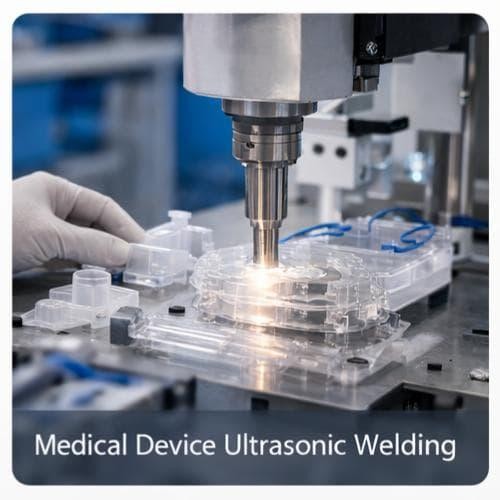
TIMEAST provides ultrasonic welding solutions for medical device components including filters, fluid parts, disposable products and plastic housings. Our customized tooling, fixtures and automation systems ensure clean, precise and reliable assembly for medical manufacturing.
Introduction
Ultrasonic welding is widely used in medical device manufacturing for
clean, precise, and contamination-free plastic assembly.
It is ideal for bonding filters, tubing, housings, and diagnostic components,
ensuring strong, reliable joints without adhesives or particles.
No Contamination – No adhesives or solvents required
High Precision – Suitable for micro and delicate components
Hermetic Sealing – Airtight and leak-proof joints
Cleanroom Compatible – Ideal for sterile production environments
Fast & Repeatable – Consistent quality in high-volume manufacturing
Ultrasonic welding can be applied to a wide range of medical components:
Medical filters and membranes
IV tubing and connectors
Diagnostic cartridges and sensors
Blood and fluid management components
Wearable medical devices
Surgical and disposable products
Medical device production requires strict control over every step of the welding process.
TIMEAST provides:
Application evaluation and feasibility analysis
Precision tooling (fixtures and horns) design
Process optimization for consistent results
Integration with automated production lines
Servo Ultrasonic Welding Machine
Ideal for high-precision medical components requiring stable and controlled welding
20kHz Ultrasonic Welding Machine
Suitable for general medical plastic parts such as housings and filters
Ultrasonic Welding Machine with Soundproof Enclosure
Designed for clean, low-noise and controlled production environments
Q1: What makes ultrasonic welding suitable for medical devices?
A: It creates clean, strong bonds without adhesives, reducing contamination risk.
Q2:Can ultrasonic welding be used in cleanroom environments?
A:Yes, it is widely used in cleanroom production due to minimal particle generation.
Q3: What materials are commonly used?
A: Medical-grade thermoplastics such as PP, PC, and PE.
Q4:Is ultrasonic welding suitable for small components?
A: Yes, it is ideal for precision parts and micro-scale assemblies.
Q5: What are typical cycle times?
A: Cycle times are usually 1–3 seconds per joint depending on material and thickness.
Send us your product drawings and requirements. We provide customized solutions for clean, precise and
high-efficiency production.
Phone: +86-15989541416
E-mail: sales@sztimeast.com
Whatsapp:+86-15989541416
Add: Building 5, Huixin Intelligent Industrial Park,Guangming, Shenzhen,China 518107
We chat