
sales@sztimeast.com
+86-15989541416
Introduction
In ultrasonic plastic welding, fixture design plays a critical role in welding quality, repeatability, and
production efficiency.Many ultrasonic welding problems are not caused by the ultrasonic machine or
welding parameters, but by poor product support, inaccurate positioning, or improper fixture design.
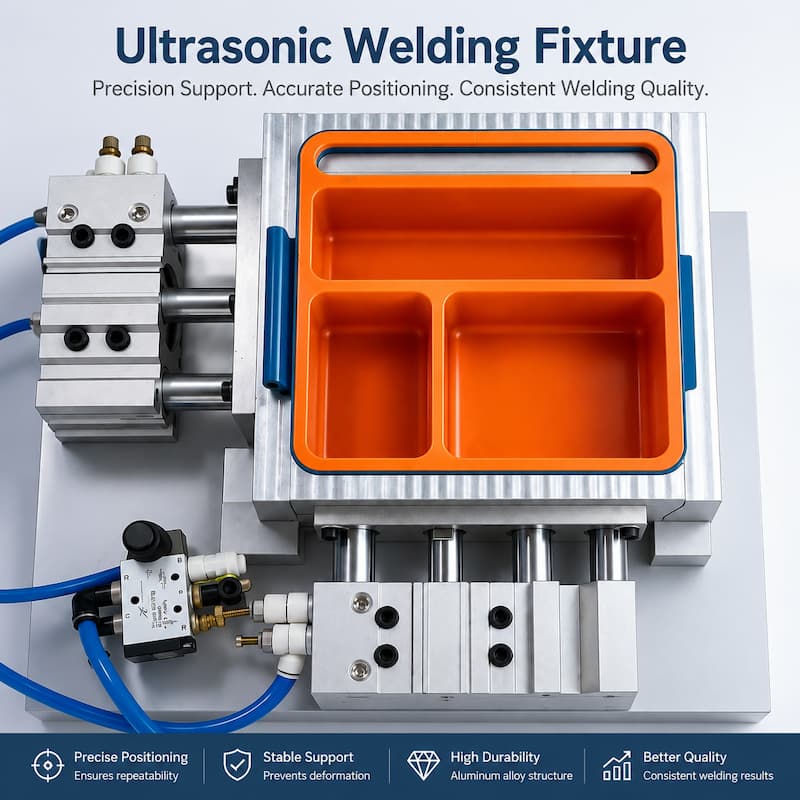
An ultrasonic welding fixture, also known as a welding nest, holding fixture, or tooling fixture, is a
customized tool used to support and position plastic components during the welding process.
A properly designed fixture helps achieve:
Accurate product positioning
Stable welding pressure
Consistent welding strength
Reduced deformation and cosmetic defects
This guide explains the key principles of ultrasonic welding fixture design, focusing on support,
positioning, materials, and common design considerations.
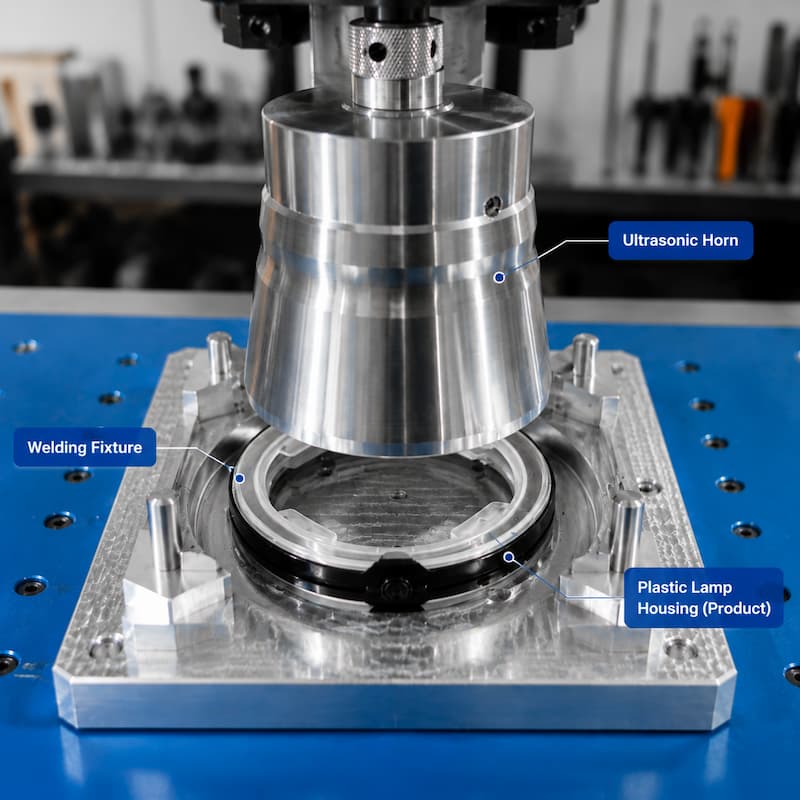
An ultrasonic welding fixture is a customized tooling system that holds the lower plastic
component during ultrasonic welding.
During the welding cycle:
The fixture supports and locates the product.
The ultrasonic horn applies vibration and pressure from above.
The plastic components are welded together through controlled ultrasonic energy.
The main functions of an ultrasonic welding fixture include:
Supporting the product structure
Maintaining accurate alignment
Preventing movement during welding
Improving production repeatability
Unlike standard machine parts, ultrasonic welding fixtures are designed according to each product's:
Geometry
Plastic material
Welding joint structure
Production requirements
A well-designed fixture is not only a holder but also an important part of the complete ultrasonic
welding process.
The ultrasonic horn and fixture work together but perform different functions.
The horn transfers ultrasonic vibration energy to the plastic component.
Its main functions include:
Applying ultrasonic vibration
Delivering welding energy
Contacting the welding area
Controlling energy transmission
Horn design mainly focuses on:
Frequency matching
Amplitude distribution
Contact surface design
For better welding performance, the horn and fixture should be designed as a complete tooling system.
Learn more about ultrasonic welding horn design.
The fixture provides product support and positioning.
Its main functions include:
Holding the lower component
Maintaining product alignment
Supporting welding force
Preventing movement
A properly designed horn cannot achieve stable welding results without a suitable fixture.
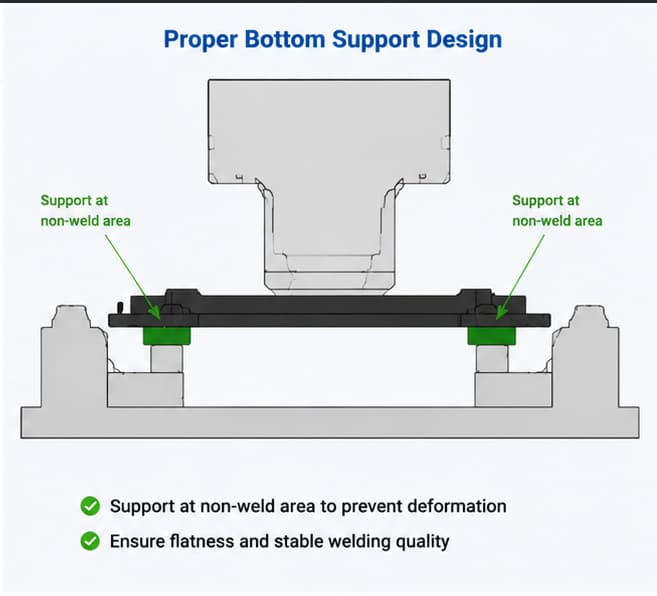
During ultrasonic welding, the horn applies high-frequency vibration and pressure to create a welded joint.
If the fixture does not provide enough support, the plastic part may move, deform, or absorb energy unevenly.
Common problems caused by poor fixture support include:
Uneven Welding Strength
Insufficient support can create uneven pressure distribution, resulting in inconsistent welding strength.
Product Deformation
Thin-wall plastic components may bend or collapse under welding force.
Surface Damage
Incorrect fixture contact areas may leave marks or damage cosmetic surfaces.
Poor Sealing Performance
For airtight products, unstable support may cause incomplete welding and leakage.
Fixture support design depends on product structure and welding requirements.
A full support fixture contacts a larger area of the product.
Advantages:
Better product stability
Reduced deformation
Suitable for thin-wall parts
Suitable for airtight applications
Typical applications:
Plastic housings
Filters
Electronic components
Automotive plastic parts
A local support fixture only supports critical areas.
Advantages:
Lower tooling cost
Easier product loading
Suitable for rigid components
The design principle is to support areas where welding force is transferred while avoiding unnecessary
contact with non-critical surfaces.
Choosing the correct fixture material affects durability, accuracy, and product protection.
Aluminum is commonly used because of:
Easy machining
Good dimensional accuracy
Lightweight structure
It is suitable for most ultrasonic welding applications.
Steel provides:
High wear resistance
Long service life
Better performance for high-volume production
Materials such as POM or UHMW-PE are sometimes used for product contact areas.
Advantages:
Protect product surfaces
Reduce scratching
Suitable for sensitive components
Material selection depends on production volume, product material, and surface requirements.
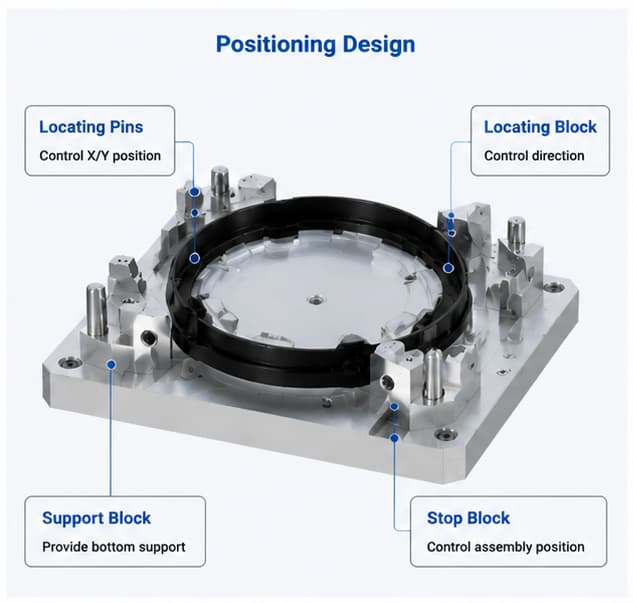
Accurate positioning is essential for ultrasonic welding production.
A reliable fixture should ensure every product is placed in the same position during each welding cycle.
Common positioning methods include:
Product contour support
Locating pins
Mechanical stops
Precision machined locating surfaces
Poor positioning may cause:
Product misalignment
Uneven welding distance
Reduced welding strength
Inconsistent production results
For automated ultrasonic welding systems, fixture repeatability is especially important because
production may involve thousands of welding cycles.
Thin-wall plastic parts require careful fixture design because they are more sensitive to welding pressure.
Common problems include:
Deformation
Cracking
Cosmetic damage
Recommended design considerations:
Increase Support Area
A larger support area helps reduce stress concentration.
Avoid Sharp Contact Edges
Smooth contact surfaces help protect the product.
Control Welding Pressure
Excessive pressure may damage the component before welding is completed.
For products requiring sealing performance, fixture support directly affects welding reliability.
Typical applications include:
Filters
Sensors
Medical plastic components
Electronic housings
Important considerations:
Support Near the Welding Joint
The fixture should provide stable support close to the welding area.
Prevent Product Distortion
Even small deformation can create leakage paths.
Validate Welding Performance
Leak testing and destructive testing should be completed before mass production.
Before production, many manufacturers perform ultrasonic welding sample testing to verify fixture design,
welding parameters, and final product performance.
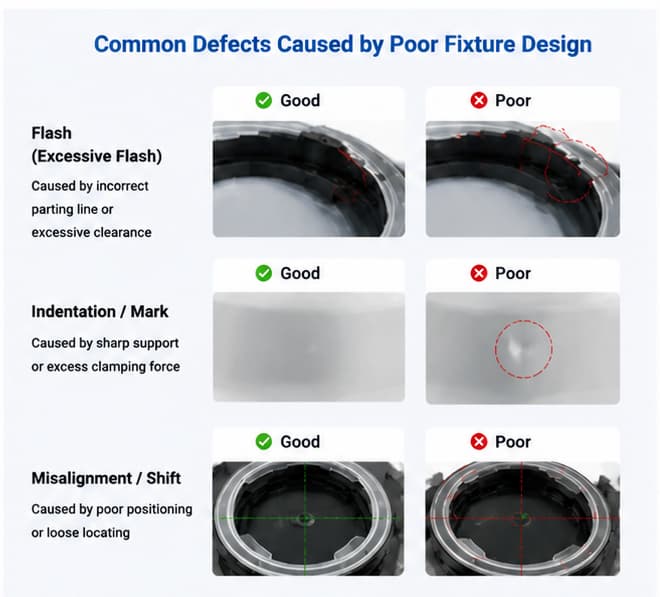
Supporting only a small area may allow deformation during welding.
Incorrect positioning can create unstable welding results.
Plastic parts have manufacturing variations that must be considered during fixture design.
Too much space between the product and fixture allows movement.
Fixture design should consider:
Horn structure
Welding joint design
Plastic material
Required welding strength
The fixture may be the reason when you experience:
Possible causes:
Product movement
Insufficient support
Poor positioning
Frequent Parameter Adjustments
If welding parameters constantly require adjustment, the problem may be mechanical rather than ultrasonic.
Possible causes:
Incorrect contact design
Excessive pressure concentration
Possible causes:
Uneven support
Product deformation
Before mass production, ultrasonic welding fixtures should be tested together with the complete welding system.
Recommended validation includes:
Check:
Loading accuracy
Repeatability
Fixture stability
Evaluate:
Welding strength
Appearance quality
Cycle time
Common methods include:
Pull testing
Section analysis
Burst testing
For special products:
Leak testing
Pressure testing
Environmental testing
Proper validation helps prevent expensive fixture modifications after production begins.
For more examples of customized ultrasonic welding solutions, see ultrasonic welding case studies.
Q1. What is an ultrasonic welding fixture?
A: An ultrasonic welding fixture is a customized tooling system used to support and position plastic parts
during ultrasonic welding.
Q2. Why is fixture support important in ultrasonic welding?
A:Fixture support affects welding stability, product deformation, sealing performance, and repeatability.
Q3. What is the difference between an ultrasonic horn and fixture?
A:The horn transfers ultrasonic energy, while the fixture supports and positions the product.
Q4. What materials are used for ultrasonic welding fixtures?
A:Common materials include aluminum, steel, and engineering plastics depending on application requirements.
The final tooling selection depends on product requirements and production conditions. TIMEAST provides
customized ultrasonic welding tooling solutions for different industrial applications.
Q5. Can one fixture be used for different products?
A:Usually no. Ultrasonic welding fixtures are customized according to product geometry and welding requirements.
Ultrasonic welding fixture design is a key factor in achieving stable and repeatable plastic welding results.
A well-designed fixture provides accurate positioning, reliable support, and consistent pressure transfer
throughout the welding process.
For new ultrasonic welding projects, fixture design should be considered together with horn design,
welding parameters, and automation requirements from the beginning.
A successful ultrasonic welding solution is not only about generating ultrasonic energy — it is about
controlling the complete welding process.
Our engineering team can help evaluate your product structure, welding requirements, and fixture design
before mass production.
Phone: +86-15989541416
E-mail: sales@sztimeast.com
Whatsapp:+86-15989541416
Add: Building 5, Huixin Intelligent Industrial Park,Guangming, Shenzhen,China 518107
We chat