
sales@sztimeast.com
+86-15989541416
Choosing the right ultrasonic welding frequency is one of the most important steps before selecting a welding machine,
horn, fixture or automation system.
15kHz, 20kHz and 35kHz ultrasonic welding machines are all used for plastic assembly, but they are not designed for
the same type of product. A lower frequency usually provides higher amplitude and stronger welding energy, while
a higher frequency provides lower amplitude, better control and a cleaner result on small or delicate parts.
This guide compares 15kHz, 20kHz and 35kHz ultrasonic welding machines, explains their differences, and helps
you choose the right frequency for your plastic part, material, weld area and production requirements.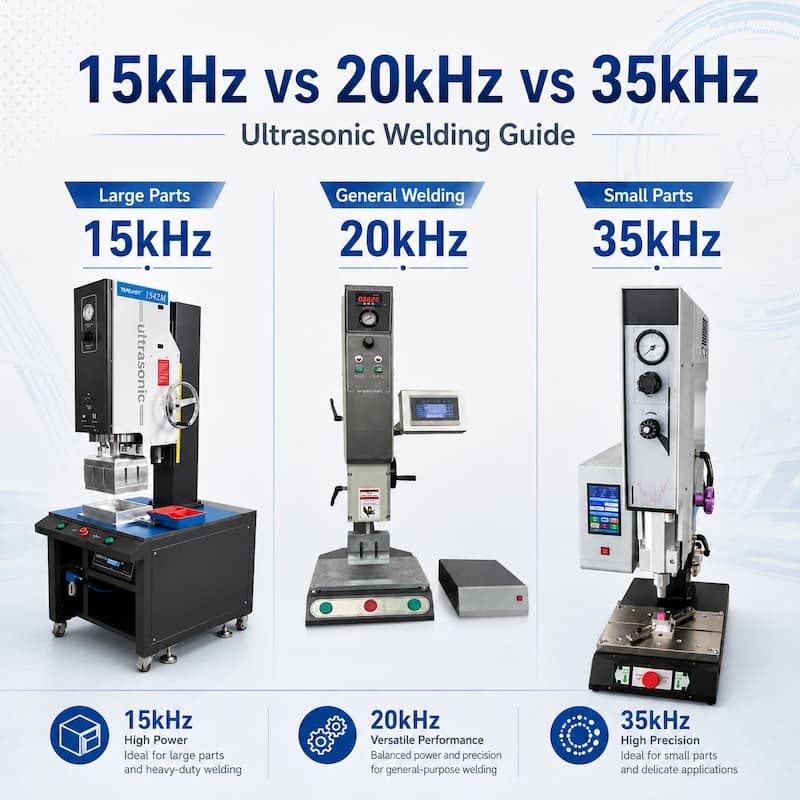
Ultrasonic welding frequency refers to the number of vibration cycles generated by the ultrasonic system per second.
In plastic welding, common industrial frequencies include 15kHz, 20kHz, 30kHz, 35kHz and 40kHz.
Frequency affects several key factors:
Vibration amplitude
Welding energy
Weld strength
Part size compatibility
Cosmetic appearance
Risk of flash, cracking or material damage
Horn and fixture design
In simple terms:
Lower frequency = higher amplitude and stronger energy
Higher frequency = lower amplitude and higher precision
This is why 15kHz is often used for large or thick plastic parts, 20kHz is used for many general plastic welding
applications, and 35kHz is used for smaller, more delicate or precision components.
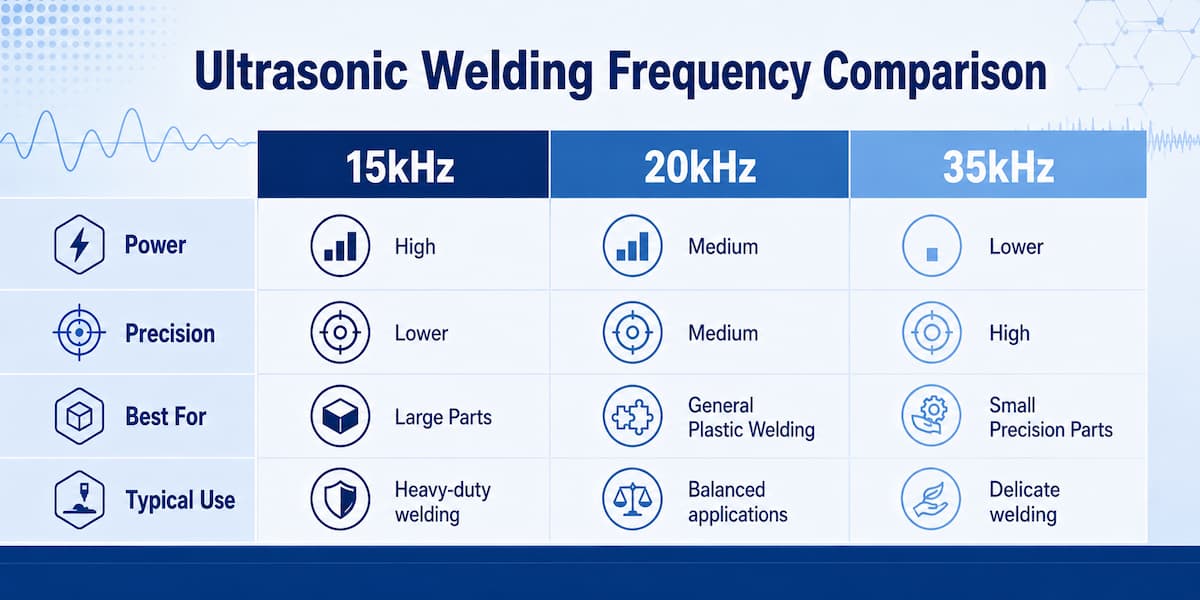
| Frequency | Main Character | Best For | Typical Limitation |
| 15kHz | High amplitude, strong energy | Large parts, thick materials, high-strength joints | Lower precision, more noise, not ideal for delicate parts |
| 20kHz | Balanced power and precision | Medium plastic parts, general industrial welding | May not be enough for very large parts or very delicate parts |
| 35kHz | Low amplitude, high precision | Small parts, electronics, medical parts, precision welding | Lower power, smaller welding area |
There is no single best frequency for every product. The right choice depends on the part size, material, weld area, required
strength, appearance standard and production method.
15kHz ultrasonic welding machines are designed for applications that require strong vibration energy and deeper weld
penetration.Because 15kHz systems have higher amplitude, they are suitable for larger parts, thicker walls and wider
welding areas. They are commonly used when weld strength is more important than fine cosmetic detail.
Automotive plastic parts
Large housings
Industrial plastic components
Thick thermoplastic parts
Structural plastic assemblies
Products requiring strong weld strength
Strong welding energy
Better for large and thick parts
Suitable for high-strength joints
Good for difficult welding areas
Can support larger horns when properly designed
15kHz is not always suitable for small or delicate parts. Because the amplitude is higher, it may create more visible marks,
flash or vibration stress if the product is small, thin or sensitive.
If your product is a large plastic component requiring strong bonding strength, a 15kHz 4200W ultrasonic plastic welding
machine is usually a better direction than a high-frequency system.
20kHz is one of the most widely used ultrasonic welding frequencies for plastic assembly. It offers a practical balance
between welding power and welding control.
For many medium-sized plastic parts, 20kHz provides enough energy for stable welding while maintaining better
precision than 15kHz.
Electronics housings
Automotive interior parts
Consumer plastic products
Plastic containers
Filter components
Packaging components
Medium-sized industrial plastic parts
Balanced power and precision
Suitable for many common plastic parts
Easier machine selection for general applications
Good compatibility with pneumatic and servo welders
Flexible for different horn and fixture designs
20kHz may not be the best option for very large parts that need stronger amplitude, and it may also be too aggressive
for very small, thin or precision components.
For many manufacturers, a 20kHz 3000W ultrasonic welder is the most practical starting point when the part size
and weld area are not extremely large or extremely small.
35kHz ultrasonic welding uses lower amplitude and finer vibration control. It is usually selected for small plastic parts,
delicate components and products with strict appearance requirements.
Because the vibration is gentler, 35kHz can reduce the risk of part damage, excessive flash or visible marking when
the welding area is small.
Electronic components
Medical plastic parts
Small connectors
Precision plastic products
Thin-wall components
Localized spot welding
Small automotive connectors or sensor parts
High welding precision
Cleaner appearance
Lower risk of damaging delicate parts
Better control for small weld areas
Suitable for localized welding or spot welding
35kHz systems usually have lower power than 15kHz or 20kHz systems. They are not suitable for large welding areas,
thick parts or applications requiring very deep weld penetration.
If your product is small, delicate or requires clean local welding, a 35kHz ultrasonic welding system or 35kHz ultrasonic
spot welding machine is often the better choice.
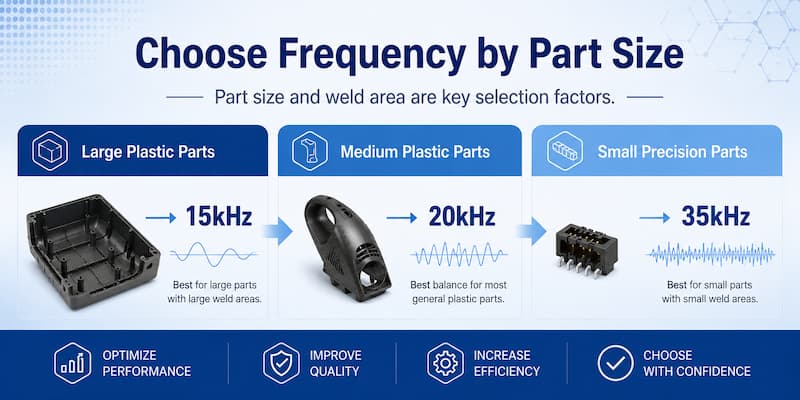
Part size is usually the first factor.
Large parts: choose 15kHz
Medium parts: choose 20kHz
Small parts: choose 35kHz
Large parts need stronger vibration energy. Small parts need better control and lower vibration impact.
A wide weld area needs more energy and a properly designed horn. A small weld area needs precision and
stable pressure control.
Wide weld area: 15kHz or 20kHz
Medium weld area: 20kHz
Small local weld area: 35kHz
The welding horn must also match the selected frequency. A horn designed for one frequency cannot be used
freely on another frequency.
Different plastics respond differently to ultrasonic energy. Harder or thicker materials may need stronger energy,
while thin or delicate materials may require lower amplitude.
Common factors include:
Plastic type
Wall thickness
Glass fiber content
Filler content
Moisture condition
Surface texture
Joint design
For example, ABS, PC and some rigid materials may weld well at 20kHz, while thin PP or small precision parts
may need more careful testing before final machine selection.
If the part has strict cosmetic requirements, frequency selection becomes more important.
For visible surfaces, small parts or precision assemblies, 35kHz may help reduce marks and flash. For hidden
structural welds, 15kHz or 20kHz may be more suitable because strength is usually more important than appearance.
If the final product must withstand pulling, pressure, impact or vibration, the frequency should be selected together
with the horn, fixture and welding parameters.
Strong welding does not only depend on frequency. It also depends on:
Joint design
Energy director design
Horn contact surface
Fixture support
Welding pressure
Amplitude
Welding time or energy
Hold time
For manual or semi-automatic production, a standard pneumatic ultrasonic welder may be enough.
For high-volume production, strict consistency or automatic loading and unloading, a custom ultrasonic welding
automation line may be more suitable. Automation can integrate feeding, welding, inspection, sorting and data
control into one stable process.
Choosing the wrong frequency may cause many welding problems, including:
Weak weld strength
Excessive flash
Cracks around the weld area
Burn marks
Visible surface damage
Unstable welding results
Inconsistent collapse distance
Horn overheating
Poor repeatability in mass production
If these problems appear during testing or production, the solution is not always to increase power. Sometimes
the real issue is wrong frequency, poor horn design, weak fixture support or unsuitable joint design.
For example:
If a large part cannot weld strongly at 35kHz, the frequency may be too high.
If a small precision part is damaged at 15kHz, the amplitude may be too aggressive.
If welding results vary from part to part, fixture alignment and part tolerance should also be checked.
Frequency Selection Is Not Only About the Machine
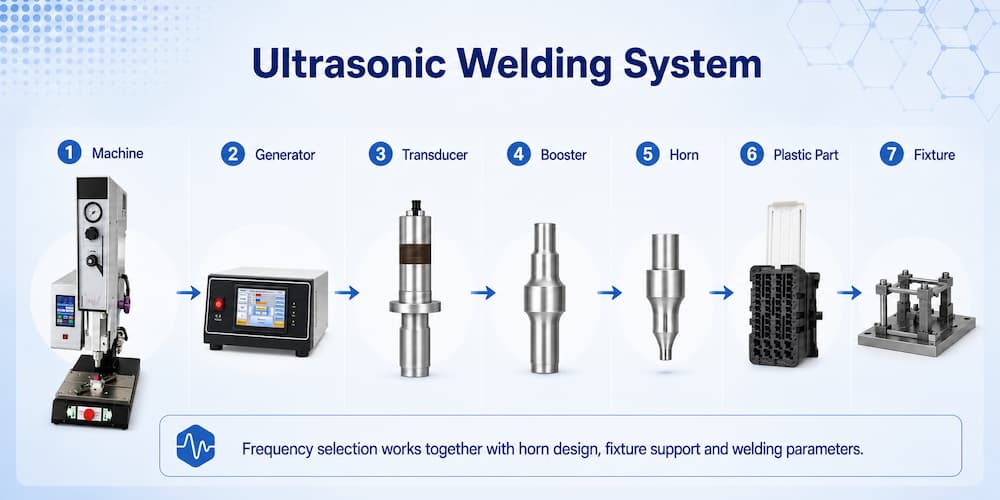
Many buyers only compare machine frequency and power, but ultrasonic welding quality depends on the complete system.
A stable ultrasonic welding process should include:
Correct frequency
Suitable machine power
Matched ultrasonic generator
Proper transducer and booster
Precisely tuned welding horn
Stable fixture and part support
Correct welding parameters
Reliable sample testing before mass production
Even if the frequency is correct, poor horn or fixture design can still cause weak welds, part deformation or
unstable results.
Sample testing is strongly recommended when:
The material is new or unfamiliar
The weld strength requirement is strict
The part has a thin wall or complex shape
The surface cannot have visible marks
The weld area is very large or very small
The product will be used in automotive, medical, electronics or safety-related applications
The project may require custom tooling or automation
A proper welding test can confirm the right frequency, horn design, fixture support and welding parameters
before investing in equipment.
Simple Frequency Selection Guide
Choose 15kHz if:
The part is large or thick
The weld area is wide
High strength is required
Cosmetic appearance is not the main concern
The product is used in heavy-duty industrial or automotive applications
Choose 20kHz if:
The part is medium-sized
You need a balance between strength and precision
The product is a common plastic assembly
You want a flexible machine for different applications
You are not sure whether 15kHz or 35kHz is necessary
Choose 35kHz if:
The part is small or delicate
The weld area is localized
Appearance is important
Flash and vibration marks must be minimized
The product is used in electronics, medical devices or precision plastic assemblies
Q1. Which ultrasonic welding frequency is best?
There is no universal best frequency. 15kHz, 20kHz and 35kHz are used for different product sizes, materials
and welding requirements. The best frequency is the one that provides stable weld strength, good appearance
and repeatable production results for your specific part.
Q2. Can 20kHz replace 15kHz?
Not always. 20kHz can handle many general plastic welding applications, but large or thick parts may require
the stronger amplitude and higher power of a 15kHz system.
Q3. Can 20kHz replace 35kHz?
Not always. If the part is small, thin or delicate, 35kHz may provide better precision and lower risk of part damage.
Q4. Is higher frequency always better?
No. Higher frequency usually provides better precision, but it also means lower amplitude and lower power.
For large parts, a higher frequency may not provide enough welding energy.
Q5. Why does the wrong frequency cause flash or weak welds?
Wrong frequency can create poor energy transfer. If the amplitude is too high, it may cause flash, cracks or
surface damage. If the amplitude is too low, the joint may not receive enough energy, resulting in weak welding.
Q6. Do I need a different horn for each frequency?
Yes. The horn must be designed and tuned for the specific ultrasonic frequency. A horn for 20kHz cannot
simply be used on a 35kHz system.
Q7. How can I confirm the right frequency before buying?
The safest method is to send product samples, material information and welding requirements for testing.
A welding test can help confirm the right frequency, machine power, horn design, fixture support and welding parameters.
Q8. Need Help Choosing the Right Ultrasonic Welding Frequency?
TIMEAST provides ultrasonic welding machine selection, sample testing, custom horn design, fixture design and
automation solutions for plastic assembly projects.
If you are not sure whether your product needs 15kHz, 20kHz or 35kHz ultrasonic welding, send us your product photos,
material information, drawings or samples. Our engineering team can help evaluate the right welding solution before
production investment.
Phone: +86-15989541416
E-mail: sales@sztimeast.com
Whatsapp:+86-15989541416
Add: Building 5, Huixin Intelligent Industrial Park,Guangming, Shenzhen,China 518107
We chat