
sales@sztimeast.com
+86-15989541416

Weak ultrasonic welds are not just a production defect—they are a system-level failure involving part design,
material behavior, and energy transmission.
In many cases, understanding ultrasonic welding principles helps clarify why weld strength becomes unstable
in mass production conditions.
This is closely related to how ultrasonic welding systems transfer energy into thermoplastic materials under
A weak ultrasonic weld means the plastic joint does not achieve enough mechanical strength, sealing strength,
or long-term reliability for the application. The part may fail during tensile testing, peel testing, torque testing,
burst testing, drop testing, vibration testing, or actual product use.
Common signs of weak ultrasonic welds include:
The welded parts separate easily by hand.
The joint breaks under low pulling force.
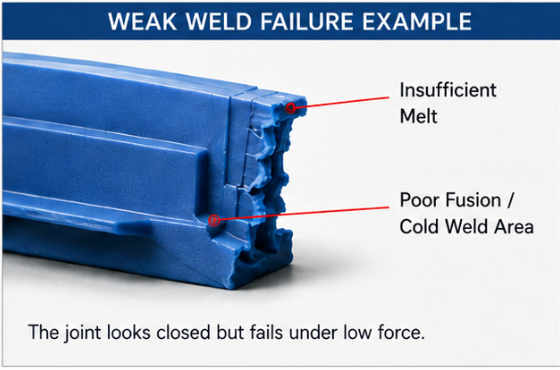
The weld looks closed but fails during leak testing.
Weld strength varies from part to part.
Some areas of the joint are welded while other areas remain cold.
The weld line cracks after aging, vibration, or temperature cycling.
The product passes visual inspection but fails functional testing.
A strong ultrasonic weld is not only about appearance. In many industrial applications, the most important question
is not “Does it look welded?” but “Can it consistently survive the required force, pressure, vibration, temperature,
and service life?”
Joint design is one of the biggest reasons for weak ultrasonic welds. Ultrasonic welding works best when
vibration energy is concentrated at the intended weld area. If the joint design does not direct energy properly,
the plastic may not melt efficiently.
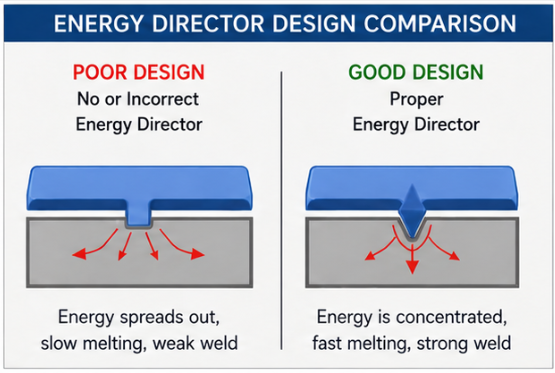
A common example is a flat-to-flat joint without an energy director. In this case, the ultrasonic energy spreads
across a wider surface instead of focusing at the weld line. The result is slow melting, inconsistent bonding,
excessive flash, or weak fusion.
Common joint design problems include:
No energy director
Energy director too small or too large
Uneven joint contact
Inconsistent wall thickness
Large welding area without enough energy concentration
Sharp corners that create stress concentration
Gaps between mating parts
Insufficient collapse distance
Fix:
Review the part design and make sure the weld joint supports ultrasonic energy concentration. For many
thermoplastic parts, a triangular energy director can help start melting quickly and improve weld consistency.
For sealing applications, tongue-and-groove, step joints, or shear joints may provide better strength and leak
resistance.
Not all plastics weld well together. Ultrasonic welding depends on the ability of the materials to melt and fuse
at the joint. If two materials have very different melting temperatures, chemical structures, or stiffness, the weld
may be weak even when the machine settings look correct.
For example, welding the same material to itself usually gives better results than welding two different materials.
ABS to ABS, PC to PC, PP to PP, and POM to POM are generally more predictable than mixed-material combinations.
Some plastics also absorb ultrasonic vibration better than others.
Material-related causes include:
Different melting points
Different molecular structures
High filler content
Glass fiber reinforcement
Flame retardant additives
Moisture in the plastic
Recycled material variation
Contaminated surfaces
Material batch differences
Fix:
Confirm the material type, grade, filler percentage, and melting temperature. If the material is hygroscopic, drying
may be required before welding. Avoid contamination such as oil, mold release agent, dust, or moisture on
the welding surface. For critical products, conduct material verification before mass production.
Weak welds often come from poor parameter balance. Ultrasonic welding parameters usually include amplitude,
pressure, weld time, energy, trigger force, hold time, and collapse distance. These parameters must work together.
Increasing only one parameter does not always improve strength. For example, too much pressure can squeeze
molten plastic out of the joint before proper bonding occurs. Too much time can cause over-melting, flash,
internal stress, or part deformation. Too little amplitude may not create enough heat at the weld area.
Typical parameter problems include:
Welding time too short
Amplitude too low
Pressure too high or too low
Hold time too short
Trigger force unstable
Collapse distance not controlled
Energy setting not matched to the part
No proper parameter window established
Fix:
Do not adjust settings randomly. Build a welding parameter window through testing. Start with a reasonable baseline,
then adjust one factor at a time. For production parts, record the relationship between weld strength, weld time, energy,
collapse distance, and appearance. The best setting is not always the one that produces the most melt; it is the one that
produces stable strength with acceptable appearance and dimension.
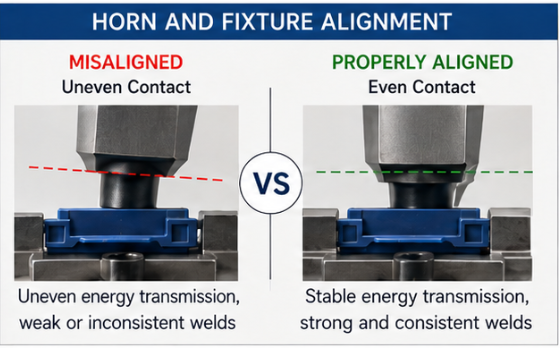
The ultrasonic horn transfers vibration energy from the transducer and booster to the plastic part. If the horn does not
contact the part correctly, energy transmission becomes unstable. Even a well-designed product can have weak welds
if the horn surface, shape, or alignment is wrong.
Common horn-related problems include:
Uneven horn contact
Wrong horn material
Poor horn frequency matching
Horn surface not parallel to the part
Horn touching only one side of the part
Horn causing part slipping
Excessive horn wear
Incorrect horn amplitude distribution
Horn design not matched to product geometry
A horn that looks simple may still require professional acoustic design. Large or irregular parts often need modal
analysis to ensure vibration is distributed correctly. For precision parts, small contact errors can cause big differences
in weld strength.
Fix:
Check horn contact with pressure paper, carbon paper, or visual marking. Confirm that the horn is properly tuned
and matched to the ultrasonic system frequency. For complex parts, use a custom horn designed according to
the product shape. If the part requires consistent cosmetic quality, horn texture and contact surface should also
be considered.
The fixture is just as important as the horn. During ultrasonic welding, the lower fixture must support the part firmly
and prevent movement, vibration loss, deformation, or misalignment. If the fixture does not match the part shape,
the ultrasonic energy may be absorbed or lost before reaching the weld area.
Fixture-related causes of weak welds include:
Loose part positioning
Poor nest support
Part movement during welding
Fixture material too soft
Insufficient support under the weld line
Uneven clamping
Poor repeatability between cavities
Fixture wear after long-term production
A weak fixture may create unstable weld strength even when the ultrasonic machine settings remain unchanged.
Fix:
Ensure the fixture supports the part as close as possible to the weld area. The part should sit consistently in the
same position every cycle. For thin, flexible, or irregular plastic parts, the fixture should prevent bending and
energy loss. In automated ultrasonic welding lines, fixture repeatability is especially important because manual
correction is not available.
Ultrasonic welding is sensitive to part dimensions. If molded parts vary from batch to batch, the weld result
may also vary. A small difference in wall thickness, joint gap, energy director height, flatness, or shrinkage can
change the welding behavior.
Common part variation issues include:
Warped parts
Uneven joint gap
Energy director height variation
Flash or burrs from molding
Sink marks near the weld area
Different shrinkage between cavities
Inconsistent part thickness
Poor dimensional control after cooling
Even if the ultrasonic welding process is stable, poor molded part consistency can still lead to weak welds.
Fix:
Measure the critical welding dimensions of both good and bad parts. Compare cavity numbers, material batches,
molding conditions, and cooling time. If weak welds happen only on certain cavities or batches, the root cause
may be molding variation instead of welding parameters.
Ultrasonic welding requires clean contact between plastic surfaces. Contamination can block molecular bonding
and reduce weld strength. Even a very thin layer of oil, dust, release agent, moisture, or fingerprints can cause
inconsistent welding.
Common contaminants include:
Mold release agent
Oil or grease
Dust
Moisture
Printing ink
Coating
Silicone
Handling contamination
Residue from previous processes
Fix:
Keep welding surfaces clean. Reduce or eliminate mold release agents if possible. Use controlled handling,
clean storage, and pre-welding cleaning if needed. For medical, automotive, and high-reliability products,
contamination control should be part of the production process, not only a troubleshooting step.
Different ultrasonic frequencies are suitable for different applications. Common frequencies include 15 kHz,
20 kHz, 30 kHz, 35 kHz, and 40 kHz. Lower frequencies usually provide higher amplitude and are often used
for larger or tougher parts. Higher frequencies usually provide lower amplitude and are often used for smaller,
more delicate, or precision parts.
Weak welds may occur if the selected frequency does not match the part size, material, weld area, or precision
requirement.
For example:
Large parts may not receive enough energy from a high-frequency system.
Small delicate parts may be damaged by excessive amplitude from a low-frequency system.
Precision welding may require better control of amplitude and collapse distance.
Thin parts may need a more carefully controlled welding process.
Fix:
Choose the frequency according to the part size, material, welding area, cosmetic requirement, and strength
requirement. For uncertain applications, sample testing is the safest way to confirm the proper ultrasonic frequency.
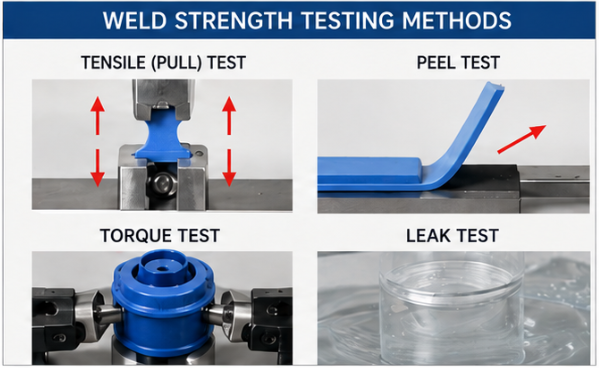
Visual inspection is not enough. A weld can look good but still be weak. Reliable testing should include both
appearance checks and functional strength verification.
A tensile pull test measures how much force is required to separate the welded parts. This is one of the most
direct methods for evaluating weld strength.
It is useful for:
Plastic housings
Inserted components
Filters
Medical parts
Automotive plastic assemblies
Small welded parts that require pull resistance
The result should be compared with the product’s actual working requirement, not only with a general number.
A peel test is useful when the welded area has a flange, film, fabric, membrane, or flat joint. The test shows how
the weld separates and whether the failure occurs at the interface or through the material.
A strong weld often causes material tearing rather than clean separation at the joint.
For round parts, caps, threaded components, filter parts, or plastic assemblies exposed to twisting force, torque testing
is very important. A weld may pass pull testing but fail under rotation.
Torque testing helps evaluate whether the weld can resist real assembly or usage conditions.
For sealed parts, weld strength is not enough. The part must also be leak-tight. Leak testing is commonly used for
automotive components, medical devices, liquid containers, filter assemblies, and electronic housings.
Common leak testing methods include:
Air pressure decay test
Vacuum decay test
Bubble test
Water immersion test
Burst test
Leak testing should be matched to the product’s real working pressure and safety requirements.
Cutting and inspecting the weld cross-section can reveal what happened inside the joint. This method is especially
useful when visual appearance does not explain the failure.
Cross-section analysis can show:
Insufficient melt
Uneven melt distribution
Voids
Cold weld areas
Excessive flash
Part deformation
Poor energy director collapse
Internal cracks
For difficult ultrasonic welding problems, cross-section analysis is often more useful than simply adjusting
machine settings.
Destructive testing helps identify whether the failure mode is acceptable. A weak weld often separates cleanly
at the interface. A stronger weld may break through the base material, which usually indicates better molecular bonding.
Destructive testing is especially important during process development, before mass production begins.
Modern ultrasonic welding systems can monitor key data such as energy, power, time, distance, force, and final position.
These data are useful for detecting process drift.
For automated production, process monitoring helps identify abnormal parts before they reach the customer.
Important data points include:
Weld energy
Peak power
Weld time
Collapse distance
Final weld position
Trigger force
Hold time
Alarm history
Data monitoring cannot replace physical testing, but it can improve process control and reduce risk in mass production.
If the weld is weak because the joint does not melt properly, improving the energy director is often the most effective fix.
The energy director should be consistent in height, angle, and position. It should focus energy at the exact area where
bonding is required.
For many plastic parts, a small change in energy director design can greatly improve welding strength.
Avoid changing too many settings at the same time. Use a structured testing method:
Establish a baseline setting.
Test weld strength.
Change only one parameter.
Record the result.
Compare strength, appearance, dimension, and cycle time.
Define the acceptable process window.
The goal is not simply to get one good sample. The goal is to find a stable parameter window for repeatable
mass production.
Horn and fixture alignment should be checked before making major parameter changes. If the horn is not parallel to
the fixture or the part is not properly supported, parameter adjustment may only hide the real problem.
A well-aligned horn and stable fixture can reduce weld variation and improve repeatability.
Ultrasonic welding cannot fully compensate for poor molded parts. If part gaps, warpage, shrinkage, or wall thickness
vary too much, weld strength will also vary.
Before blaming the ultrasonic welder, check whether good and bad welded samples come from different molding cavities,
batches, or material lots.
Different applications may require different welding modes. Common modes include time mode, energy mode,
peak power mode, and distance/collapse mode.
For precision plastic welding, distance control can be very useful because it controls how much the part collapses
during welding. For applications where material variation exists, energy mode may help improve consistency.
For high-precision or high-reliability products, servo-controlled ultrasonic welding can provide more accurate
control than traditional pneumatic systems.
Clean parts weld better. If weak welds appear randomly, contamination should always be considered. Review storage,
handling, molding release agents, printing, coating, and pre-assembly steps.
For some materials, drying before welding may also improve consistency.
Before full production, the ultrasonic welding process should be validated with real production parts, real fixtures,
real cycle time, and real test standards.
Validation should include:
Weld strength testing
Leak testing if required
Visual inspection
Dimensional inspection
Aging or environmental testing if needed
Continuous cycle testing
Tooling wear observation
Process data monitoring
A stable welding process should not depend on constant manual adjustment.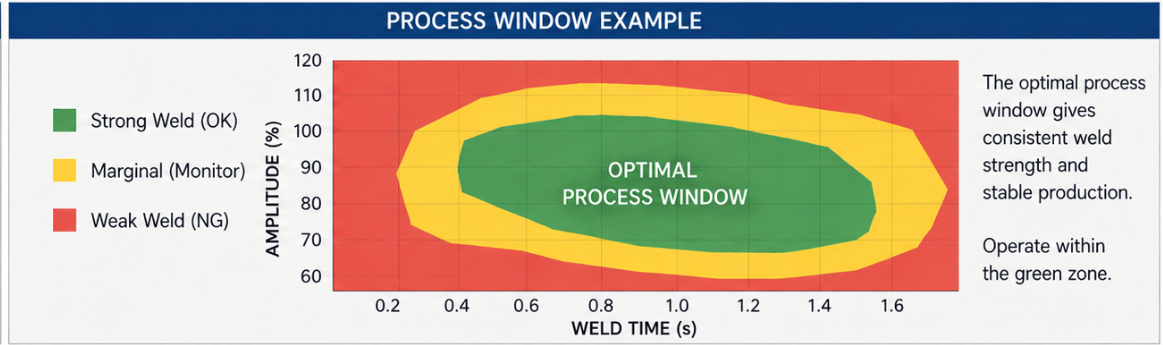
When weak welds occur, check the following points:
Part Design
Is there an energy director?
Is the joint gap too large?
Is the wall thickness consistent?
Is the weld area too large for the selected system?
Material
Are the materials compatible?
Is the material dry?
Is recycled material being used?
Are additives or fillers affecting welding?
Machine Parameters
Is the amplitude suitable?
Is the pressure too high or too low?
Is the weld time enough?
Is the hold time sufficient?
Is the collapse distance controlled?
Horn and Fixture
Is the horn properly tuned?
Is the horn surface contacting evenly?
Is the fixture supporting the weld area?
Is the part moving during welding?
Production Conditions
Are molded parts stable?
Are different cavities producing different results?
Is there contamination on the weld surface?
Has tooling wear changed the process?
This checklist can help separate machine problems from part design, material, tooling, or process control issues.
In small sample testing, weak welds may appear occasionally. In mass production, the same problem can become
expensive very quickly. A small variation in welding strength may cause high scrap rates, unstable quality,
customer returns, or production stoppages.
For high-volume production, especially in automotive, medical, filtration, and electronics industries, ultrasonic welding
should be developed as a complete process, not only as a machine setting. The best result comes from matching
the part design, ultrasonic system, horn, fixture, automation, inspection, and process control.
A reliable ultrasonic welding solution should answer four important questions:
Can the weld meet the required strength?
Can the weld remain stable during continuous production?
Can the process detect abnormal parts?
Can the tooling maintain performance over long-term use?
If the answer to any of these questions is unclear, further testing and optimization are needed before mass production.
Weak ultrasonic welds can be caused by many factors, including poor joint design, material mismatch, wrong parameters,
poor horn contact, weak fixture support, part tolerance variation, contamination, and incorrect frequency selection.
Solving the problem requires more than simply increasing weld time or pressure.
The most effective approach is to analyze the complete welding system: product design, plastic material, ultrasonic frequency,
horn design, fixture support, welding mode, process data, and final testing standard. With the right method, ultrasonic welding
can produce strong, clean, and repeatable plastic joints for demanding industrial applications.
For manufacturers developing plastic assembly products, early welding evaluation and sample testing can prevent costly
problems later. A professional ultrasonic welding solution should not only make the part stick together, but also ensure
stable strength, consistent appearance, and reliable performance in real production.
1. Why does my ultrasonic weld look good but fail easily?
This usually means the surface has closed, but the plastic has not fused strongly inside the joint. Possible causes include
low energy, poor joint design, insufficient collapse, contamination, poor horn contact, or unstable fixture support.
Sometimes, but not always. Increasing weld time may improve melting, but it can also cause flash, deformation,
internal stress, or material degradation. The correct solution depends on the root cause.
There is no single best test for all products. Tensile testing, peel testing, torque testing, leak testing, burst testing, and
cross-section analysis may all be useful depending on the application.
Inconsistent strength may come from part tolerance variation, material batch differences, unstable positioning,
fixture wear, horn misalignment, contamination, or a welding parameter window that is too narrow.
No. Higher power only helps if the part, horn, fixture, and parameters are properly matched. Weld quality depends on
controlled energy delivery, not only maximum machine power.
Servo ultrasonic welding is useful when the application requires precise control of force, speed, position, collapse distance,
and repeatability. It is especially suitable for high-precision, high-reliability, or difficult plastic welding applications.
Phone: +86-15989541416
E-mail: sales@sztimeast.com
Whatsapp:+86-15989541416
Add: Building 5, Huixin Intelligent Industrial Park,Guangming, Shenzhen,China 518107
We chat