
sales@sztimeast.com
+86-15989541416
Ultrasonic plastic welding is a fast and reliable joining process that uses high-frequency
mechanical vibration to create frictional heat between thermoplastic parts. The heat melts
the contact surface and forms a strong bond within seconds.
This technology is widely used in automotive, medical devices, electronics, packaging
and consumer products because it provides clean, precise and repeatable welding without
adhesives, screws or solvents.
If you are looking for production equipment, explore our ultrasonic welding machines or
contact us for custom solutions.
The welding process typically includes these steps:
Two plastic parts are positioned in a fixture
A horn applies pressure to the joint area
Ultrasonic vibration generates frictional heat
The plastic surface melts and bonds
The joint cools under pressure
Finished welded part is removed
Typical cycle time is only a few seconds, making ultrasonic welding ideal for mass production.
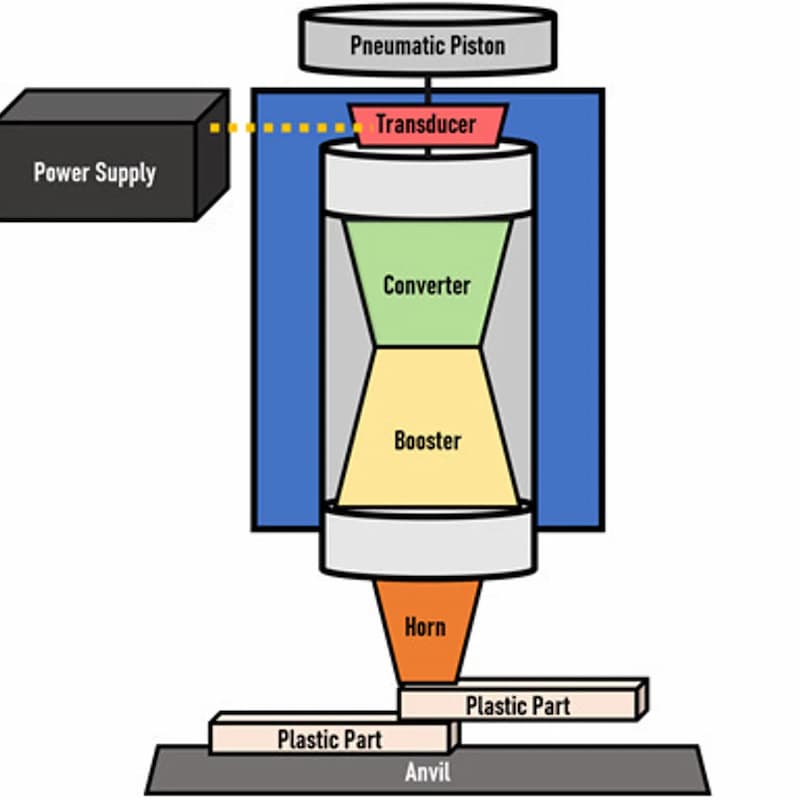
A complete ultrasonic plastic welding system usually includes:
Ultrasonic generator
Converter / transducer
Booster
Welding horn (sonotrode)
Pneumatic or servo press system
Fixture / tooling
PLC + HMI control system
Each component affects weld quality, speed and consistency.
Compared with traditional joining methods, ultrasonic welding offers:
Fast production cycles
Strong and clean weld seams
No glue or fasteners required
Low operating cost
High repeatability
Suitable for automation lines
Clean process for medical and electronics parts
Ultrasonic welding is suitable for many thermoplastics, including:
ABS
PP
PC
PS
PVC
Nylon (PA)
PET
Acrylic
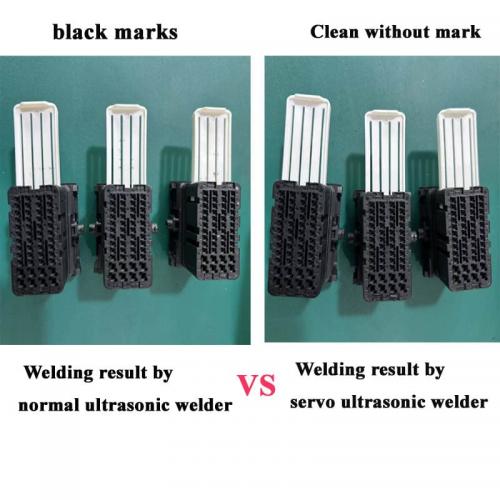
Sensors, dashboards, filters, battery housings, lamp parts
Filters, tubing connectors, housings, disposable components
Sensors, connectors, battery packs, plastic covers
Blister packs, caps, containers, sealed plastic packaging
Consumer Products
Toys, appliances, daily-use plastic parts
| Method | Speed | Cleanliness | Strength | Automation |
| Ultrasonic Welding | High | Excellent | High | Excellent |
| Adhesive Bonding | Low | Medium | Medium | Low |
| Screw Fastening | Medium | Good | Medium | Medium |
| Heat Staking | Medium | Good | Medium | Good |
For high-volume precision production, ultrasonic welding is often the best choice.
When selecting a machine, consider:
Plastic material type
Product size
Required strength
Output capacity
Precision requirement
Manual or automatic production
Frequency needed (15kHz / 20kHz / 30kHz / 35kHz)
Our engineers can recommend the right solution based on your samples or drawings.
Q1. Is ultrasonic plastic welding strong?
A1: Yes. Properly designed weld joints can achieve high mechanical strength.
Q2. Can different plastics be welded together?
A2: Some compatible materials can, but testing is recommended.
Q3. What frequency should I choose?
A3: 15kHz is suitable for larger parts, while 20kHz and above are common for medium or small precision parts.
Q4. Is sample testing available?
A4: Yes. We provide welding sample testing and solution evaluation.
Need Help With Your Plastic Welding Project?
TIMEAST provides:
Phone: +86-15989541416
E-mail: sales@sztimeast.com
Whatsapp:+86-15989541416
Add: Building 5, Huixin Intelligent Industrial Park,Guangming, Shenzhen,China 518107
We chat