
sales@sztimeast.com
+86-15989541416
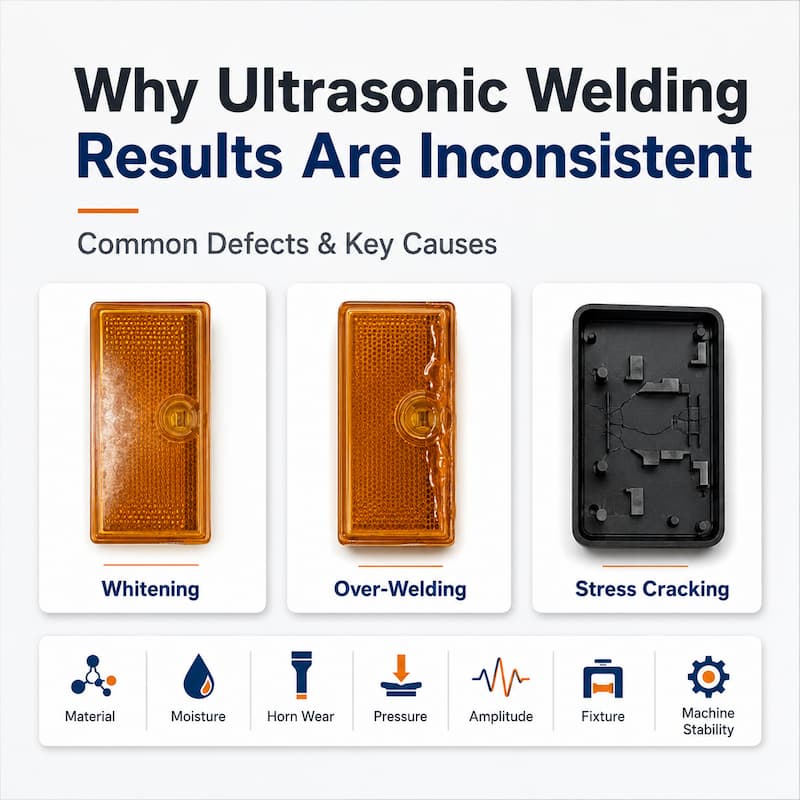
Ultrasonic welding is widely used in plastic assembly because of its speed, clean welding process,
and suitability for automated production. However, many manufacturers eventually face the same
challenge: welding quality becomes unstable even when the machine settings appear unchanged.
One batch may produce strong and clean welds, while the next batch shows weak bonding, excessive
flash, cracks, deformation, or inconsistent appearance. These problems not only increase scrap rates,
but also reduce production efficiency and affect customer confidence.
In reality, inconsistent ultrasonic welding results are rarely caused by a single factor. Welding quality
is influenced by material properties, tooling condition, machine parameters, fixture stability, and even
environmental conditions. Small variations in any of these areas can create significant differences in
weld strength and appearance.
This article explains the most common causes of unstable ultrasonic welding results and provides practical
solutions to improve process consistency in real production environments.
Consistency is one of the most important indicators of a reliable ultrasonic welding process.
A stable welding process helps manufacturers achieve:
Higher production efficiency
Lower reject rates
Better product appearance
Stronger weld strength
Reduced maintenance cost
Easier automation integration
When welding quality fluctuates, operators often compensate by continuously adjusting parameters.
While this may temporarily solve the issue, it usually creates further instability and makes troubleshooting
more difficult.
The key to stable ultrasonic welding is understanding how multiple variables interact during the welding cycle.
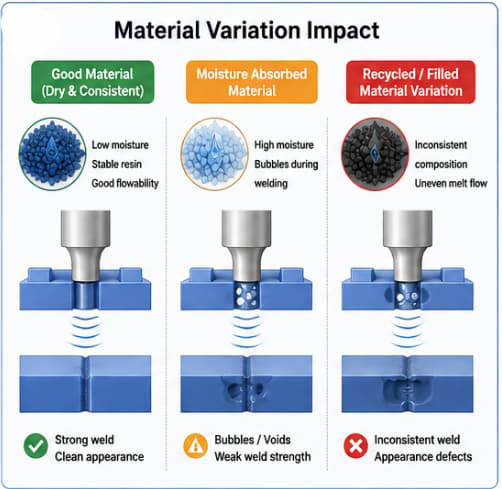
Plastic material variation is one of the most common reasons for inconsistent welding performance.
Even when parts look identical, differences in resin composition can significantly affect ultrasonic
energy transmission and melting behavior.
Several material-related factors may influence welding consistency:
Different resin suppliers
Recycled material ratio
Fillers or additives
Color masterbatch changes
Mold release agents
Flame retardants
Glass fiber content
For example, a material with higher glass fiber content may absorb ultrasonic energy differently,
leading to weaker or uneven welds. Similarly, excessive recycled material can reduce melt consistency.
Amorphous plastics such as ABS and PC generally weld more easily than semi-crystalline materials like
PP or PE. Semi-crystalline plastics require tighter parameter control because they have a narrower melting
range.
Use stable material suppliers
Maintain consistent resin batches
Reduce unnecessary material changes
Verify material compatibility before production
Conduct sample testing when changing resin specifications
If possible, material verification should become part of the quality control process before mass production begins.
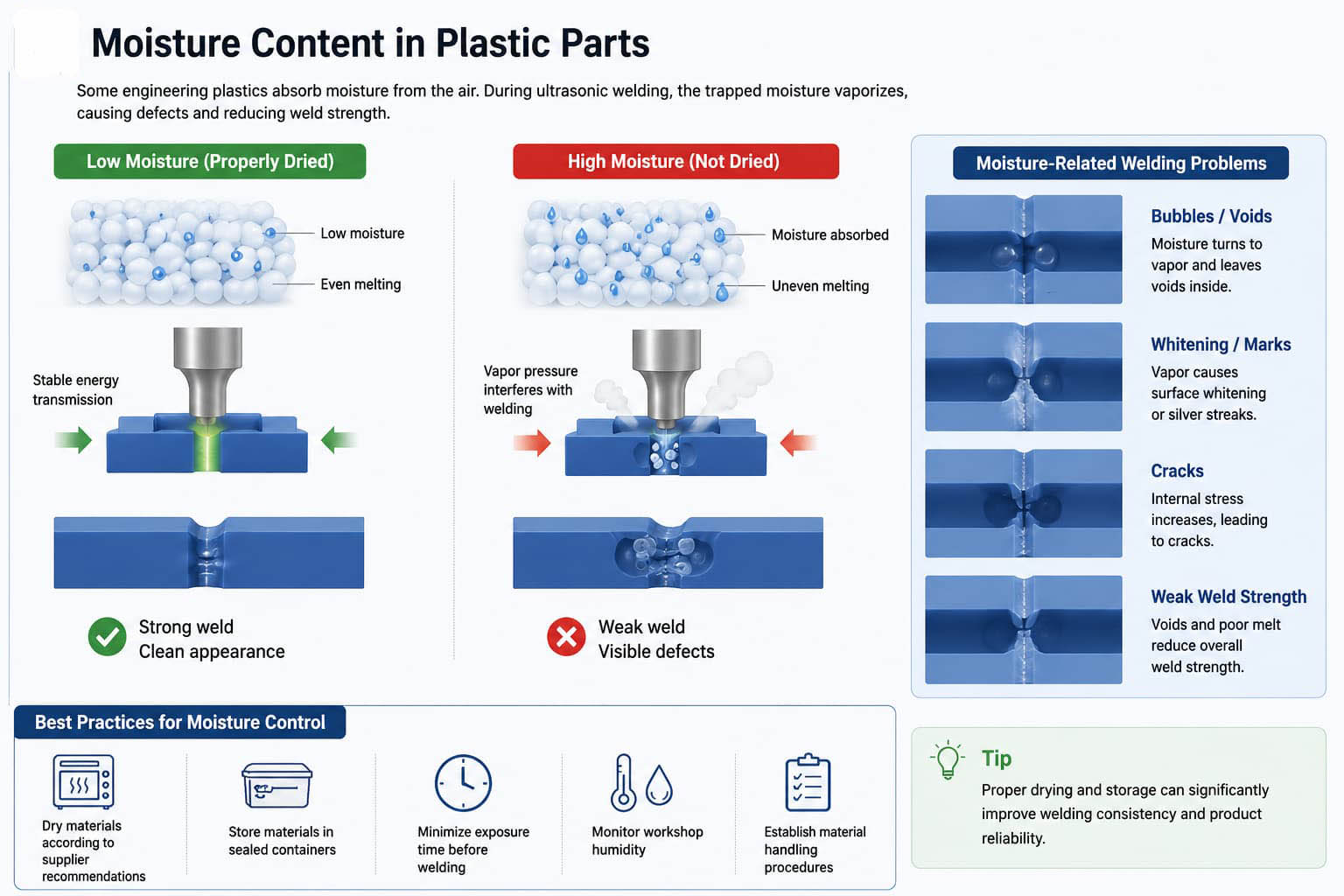
Moisture absorption is another frequently overlooked problem.
Some engineering plastics naturally absorb moisture from the air. When these materials are welded without
proper drying, the trapped moisture may vaporize during welding, causing:
Bubbles
Surface marks
Weak weld strength
Internal voids
Whitening
Cracks
Materials such as nylon (PA), polycarbonate (PC), PET, and ABS are especially sensitive to moisture.
In humid production environments, parts may absorb moisture after molding if they are stored improperly.
Dry materials according to supplier recommendations
Use sealed storage containers
Minimize exposure time before welding
Monitor workshop humidity
Establish material handling procedures
Stable moisture control often improves welding consistency more than repeated parameter adjustments.
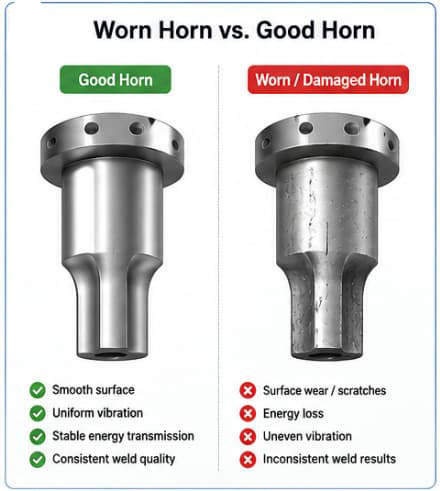
The ultrasonic horn is responsible for transferring vibration energy to the plastic part. If the horn becomes
worn, damaged, or contaminated, energy transmission becomes unstable.
Common horn problems include:
Surface wear
Cracks
Frequency mismatch
Uneven contact surface
Aluminum fatigue
Improper horn coating wear
Even minor horn damage may create uneven energy distribution, resulting in inconsistent weld appearance
and strength.
In automated production lines, horn wear may develop gradually, making the issue difficult to identify until
reject rates increase significantly.
Inspect horns regularly
Check resonance frequency periodically
Replace damaged horns immediately
Clean horn surfaces routinely
Avoid excessive welding pressure
Use proper horn materials for high-cycle production
Preventive maintenance is essential for stable long-term welding performance.
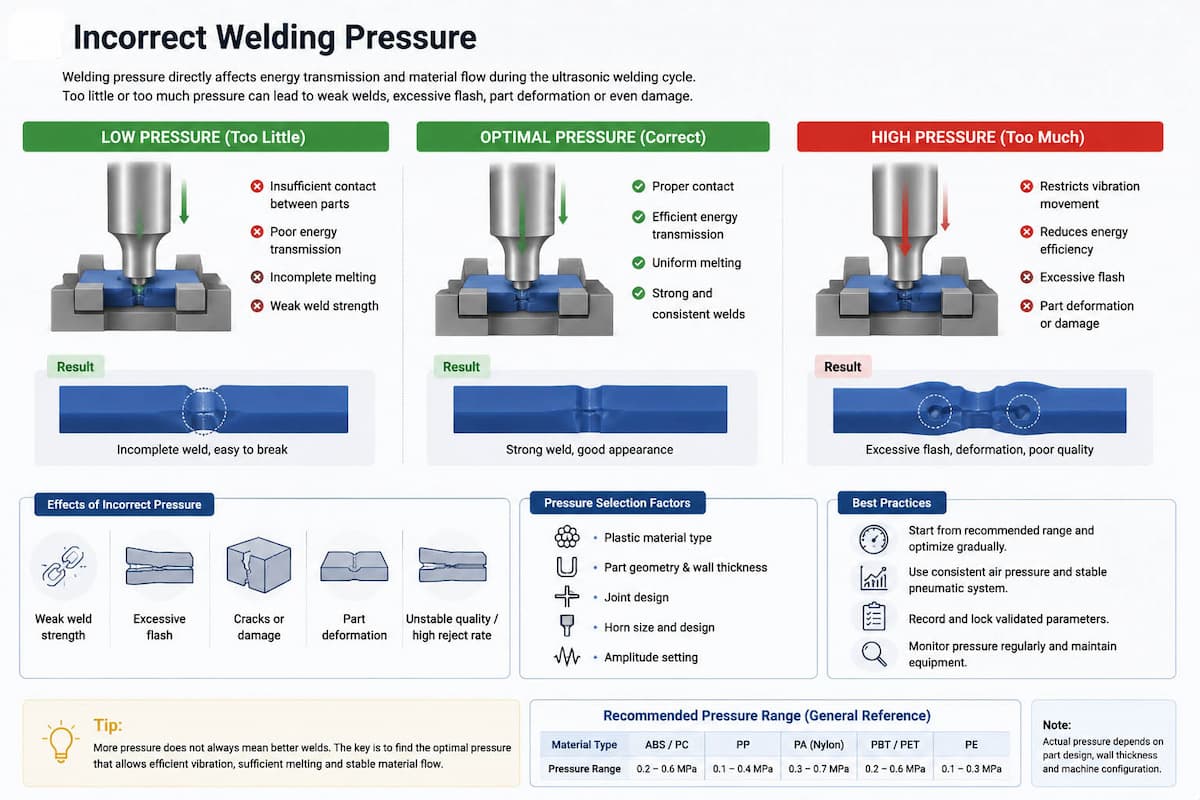
Welding pressure directly affects energy transfer and material flow during the welding cycle.
Too little pressure may cause poor contact between parts, while excessive pressure can suppress
vibration movement and reduce effective melting.
Incorrect pressure often leads to:
Weak welds
Excessive flash
Surface damage
Cracking
Part deformation
Unstable collapse distance
Pressure requirements vary depending on:
Plastic material
Part geometry
Joint design
Horn size
Amplitude setting
Many factories attempt to solve every welding issue by increasing pressure, but excessive pressure
frequently creates additional instability.
Optimize pressure gradually during testing
Record validated parameter ranges
Use stable pneumatic systems
Ensure consistent air supply pressure
Monitor regulator performance
Stable pressure control is especially important in high-speed automated production lines.
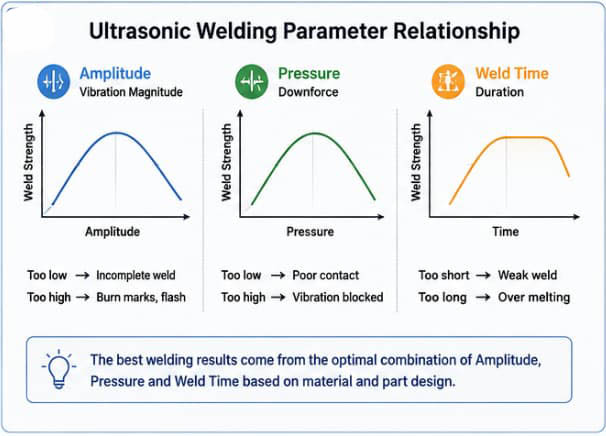
Amplitude determines how much ultrasonic vibration reaches the welding area. It is one of the most
critical welding parameters.
Low amplitude may result in insufficient melting, while excessive amplitude can damage parts or create
excessive flash.
Different plastics require different amplitude ranges. Harder materials often need higher amplitude,
while softer plastics may weld better with lower vibration levels.
Improper amplitude settings can cause:
Incomplete welds
Burn marks
Surface whitening
Excessive melting
Internal stress cracks
Match amplitude to material characteristics
Validate amplitude through sample testing
Avoid unnecessary parameter fluctuations
Use digital ultrasonic generators for better control
Maintain consistent booster configurations
Modern servo ultrasonic welding systems can provide more precise amplitude control compared to
conventional pneumatic systems.
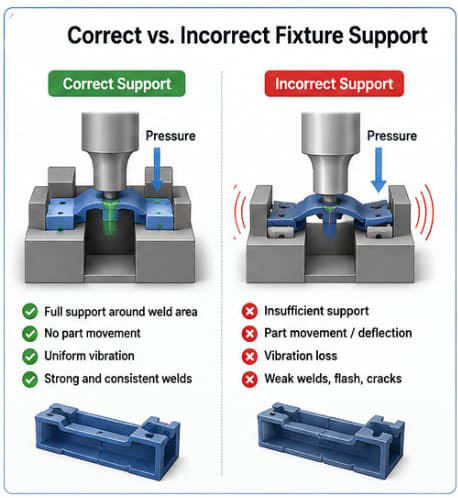
Fixture stability is often underestimated in ultrasonic welding.
If the fixture cannot properly support the plastic part during vibration, welding energy may disperse
unpredictably.
Poor fixture design may lead to:
Part movement
Uneven welding
Cosmetic defects
Cracks
Dimensional variation
Reduced weld strength
Thin-wall plastic parts are especially sensitive to support quality.
A properly designed fixture should:
Support critical welding areas
Prevent part deformation
Maintain repeatable positioning
Absorb unnecessary vibration
Allow fast loading and unloading
Improve fixture rigidity
Add support ribs where necessary
Use precision machining for nests
Verify alignment between horn and fixture
Inspect fixture wear regularly
In automated production systems, fixture repeatability becomes even more important because minor
positioning variation may accumulate over thousands of cycles.
Sometimes the welding process itself is stable, but external machine conditions create inconsistency.
Common equipment-related issues include:
Unstable air pressure
Generator overheating
Frequency drift
Loose electrical connections
Cylinder wear
Poor grounding
Cooling problems
Air supply instability is particularly common in factories operating multiple pneumatic machines simultaneously.
Voltage fluctuations may also affect ultrasonic generator output, especially in older equipment.
Practical Solutions
Maintain stable compressed air supply
Perform regular machine maintenance
Inspect electrical connections
Monitor generator temperature
Replace worn pneumatic components
Calibrate equipment periodically
Preventive maintenance is much more effective than emergency troubleshooting after production problems occur.
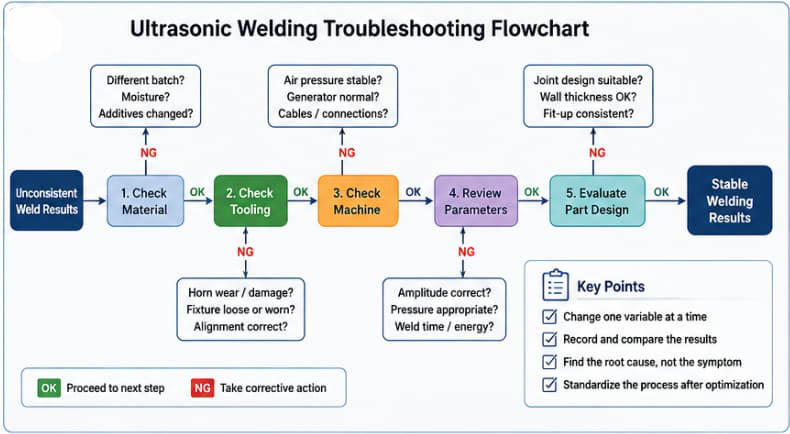
When instability occurs, many operators immediately adjust welding parameters. However, changing multiple
parameters at once often makes the problem harder to identify.
A more effective troubleshooting approach is to isolate variables systematically.
Recommended Troubleshooting Process
Check whether material batches, moisture levels, or additives have changed.
Examine the horn, booster, fixture, and nesting condition.
Confirm air pressure, generator stability, and actuator movement.
Analyze amplitude, pressure, weld time, energy, and collapse distance.
Inspect joint design, wall thickness, and part fitment.
By following a structured process, manufacturers can identify root causes more efficiently instead of
relying on repeated trial-and-error adjustments.
The following practices can significantly improve long-term welding consistency:
Standardize welding parameters
Lock validated machine settings
Train operators consistently
Schedule preventive maintenance
Store materials properly
Inspect tooling regularly
Monitor reject trends
Use sample testing before mass production
Maintain stable environmental conditions
Factories that implement process standardization usually experience lower reject rates and more
predictable production performance.
Some ultrasonic welding applications are straightforward, while others require extensive process validation.
Sample testing is strongly recommended when:
Using new plastic materials
Developing complex part geometry
Requiring airtight or watertight sealing
Integrating automation systems
Welding thin-wall components
Working with high cosmetic requirements
Transitioning to mass production
Professional testing can identify potential welding risks before tooling investment and large-scale production begin.
Q1: Why do ultrasonic welds become weak suddenly?
A1: Weak welds may result from material variation, horn wear, unstable pressure, moisture absorption, or machine
instability. The root cause is often a combination of several factors rather than a single parameter issue.
Q2: Can ultrasonic horn wear affect weld quality?
A2: Yes. Worn or damaged horns reduce energy transfer efficiency and may create uneven vibration distribution,
leading to inconsistent weld strength and appearance.
Q3: Why does the same parameter work differently on another batch?
A3: Material composition, moisture content, molding conditions, and environmental factors may vary between
batches, affecting welding behavior even when parameters remain unchanged.
Q4: Is higher pressure always better?
A4: No. Excessive pressure may suppress vibration movement and reduce effective energy transfer, sometimes
causing weaker welds or cosmetic damage.
Q5: How can I improve welding consistency in automated production?
A5: Stable material control, precise fixtures, preventive maintenance, and consistent machine calibration are
critical for reliable automated ultrasonic welding production.
Inconsistent ultrasonic welding results are usually caused by a combination of material variation,
tooling condition, parameter mismatch, fixture instability, and machine performance issues.
Rather than repeatedly adjusting machine settings, manufacturers should focus on identifying root causes
systematically and establishing a stable process foundation.
A well-optimized ultrasonic welding process not only improves weld quality, but also reduces downtime,
lowers reject rates, and increases long-term production efficiency.
If your production line is experiencing unstable ultrasonic welding performance, professional sample testing
and process evaluation can help identify the most effective solution before problems become costly.
TIMEAST provides ultrasonic welding machines, tooling design, fixture development, and sample welding evaluation
for various plastic assembly applications.
You can send your plastic parts, material information, and production requirements for technical evaluation and
Phone: +86-15989541416
E-mail: sales@sztimeast.com
Whatsapp:+86-15989541416
Add: Building 5, Huixin Intelligent Industrial Park,Guangming, Shenzhen,China 518107
We chat