
sales@sztimeast.com
+86-15989541416
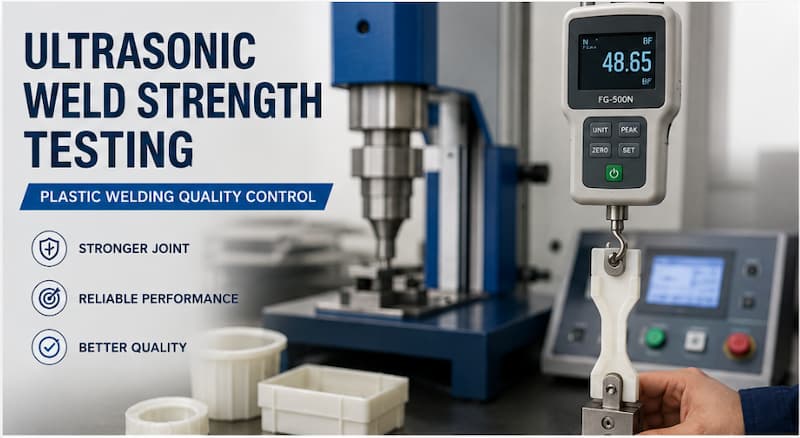
Ultrasonic welding is widely used to join plastic parts in automotive components, medical devices, electronics,
filters, packaging, consumer products and many other industries. A good ultrasonic weld should not only look
clean on the surface, but also provide enough mechanical strength, sealing performance and long-term stability
for the final product.However, weld strength is not something that should be judged only by appearance.
A plastic part may look well welded, but still fail during pulling, bending, peeling, leakage, vibration or long-term use.
That is why weld strength testing is an important step in ultrasonic plastic welding process validation and production
quality control.
This article explains the common methods used to test ultrasonic weld strength for plastic parts, how to choose
the right test method, and what problems the test results can reveal.
Ultrasonic weld strength refers to the ability of a welded plastic joint to resist separation, cracking, leakage or
functional failure under external force or working conditions.
For different products, weld strength may mean different things.
For a plastic housing, it may mean the joint can resist pulling or twisting.
For a filter component, it may mean the end capstays firmly attached during use.
For a medical plastic part, it may mean the weld has no sharp flash, no leakage and no weak bonding area.
For a sealed container, it may mean the weld can pass air pressure, water pressure or vacuum testing.
In simple terms, a strong ultrasonic weld should meet three requirements:
The joint does not separate under the required load.
The weld area has stable and repeatable quality.
The part can pass its real application requirement, not only a laboratory test.
Ultrasonic welding is affected by many factors, including plastic material, part design, energy director design,
welding horn, fixture support, amplitude, pressure, welding time, trigger force, holding time and machine stability.
If any of these factors are not controlled well, the weld may become weak or inconsistent.
Weld strength testing helps manufacturers:
Confirm whether the welding process meets product requirements
Compare different welding parameters
Identify weak weld areas before mass production
Reduce field failure risk
Improve fixture, horn and part design
Set quality standards for production inspection
Verify whether a welding machine is suitable for the product
For mass production, testing is not only used during sample validation. It can also be used during incoming
material changes, mold changes, horn replacement, fixture adjustment and regular process audits.
There is no single test method that fits all plastic parts. The correct method depends on the product design,
joint type and final application.The most common ultrasonic weld strength testing methods include:
| Test Method | Best For | What It Checks |
|---|---|---|
| Visual inspection | All welded plastic parts | Surface defects, flash, cracks, gaps |
| Tensile pull test | Parts pulled apart in use | Pulling force and joint separation strength |
| Lap shear test | Overlapped plastic joints | Shear strength of the welded area |
| Peel test | Thin plastic parts, films, covers, membranes | Peel resistance and weld consistency |
| Burst test | Sealed plastic parts | Maximum pressure before failure |
| Leak test | Sealed housings, reservoirs, filters, medical parts | Air, water or vacuum leakage |
| Cross-section inspection | Process validation and failure analysis | Weld depth, bonding area and internal defects |
| Functional test | Finished product validation | Real working performance |
Visual inspection is the first and simplest method for checking ultrasonic welded plastic parts. It does not measure
strength directly, but it can quickly show whether the welding process is stable.
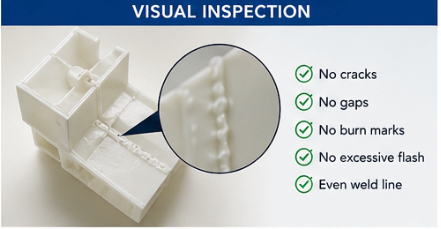
During visual inspection, check the weld area for:
Cracks
Gaps
Excessive flash
Burn marks
Whitening or stress marks
Misalignment
Uneven weld line
Incomplete contact
Deformation around the joint
A good ultrasonic weld usually has a clean and consistent appearance. However, visual inspection alone
is not enough. Some weak welds may look acceptable from the outside, especially when the defect is
inside the joint.Visual inspection should be combined with mechanical or functional testing when weld
strength is important.
The tensile pull test is one of the most common methods for testing ultrasonic weld strength. In this test,
the welded plastic part is pulled apart using a tensile testing machine or a force gauge until the joint fails.
The test result is usually recorded as maximum force, such as Newtons or kilograms-force.
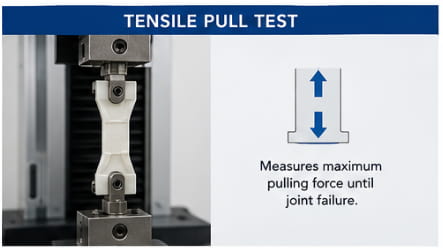
A tensile pull test is useful when the product may experience pulling force during assembly, transportation
or final use.Examples include:
Plastic clips
Medical plastic parts
Filter components
Plastic connectors
Plastic caps and housings
When doing a tensile pull test, it is important to hold the part in a repeatable position. If the fixture is not stable,
the test result may change because of part movement, bending or uneven force direction.
A good test should record:
Maximum breaking force
Failure location
Failure mode
Sample quantity
Welding parameters
Material batch
Test speed
Test fixture design
The failure mode is very important. If the plastic material breaks outside the weld area, it usually means
the weld is stronger than the base material. If the joint separates exactly at the weld interface, the weld
may be weak or incomplete.
A lap shear test is used when two plastic parts overlap and the weld area is loaded in shear. Instead of pulling
the two parts directly apart, the force tries to slide one part against the other.
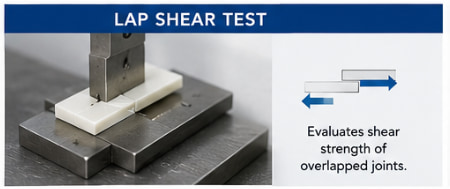
This method is useful for flat plastic coupons, overlapped plastic joints and comparative testing during
process development.Lap shear testing can help compare:
Different welding amplitudes
Different welding times
Different energy director designs
Different plastic materials
Different surface textures
Different horn and fixture designs
For production parts, the shape may not always be suitable for a standard lap shear test. In that case,
a custom fixture may be needed to simulate the real force direction of the product.
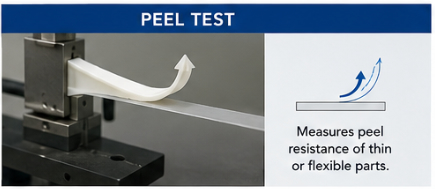
A peel test is often used for thin plastic parts, flexible materials, membranes, covers, films or plastic parts
with a narrow weld seam.In this test, one side of the welded area is peeled away from the other side.
The test measures the force needed to separate the weld.Peel testing is helpful when the product may fail
by edge lifting or progressive separation. It can also show whether the weld is consistent along the full
welding path.
Typical applications include:
Plastic packaging
Medical covers
Thin plastic assemblies
Membrane welding
Flexible plastic parts
Small sealed components
For ultrasonic welding, a peel test can reveal weak spots that may not appear in a simple pull test.
If the peel force changes greatlyalong the weld line, it may indicate uneven energy transfer, poor
fixture support or inconsistent part contact.
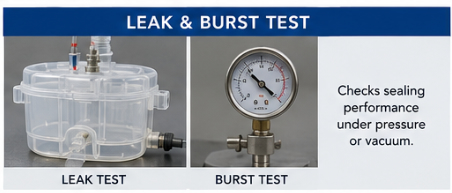
A burst test is used for sealed plastic parts. The welded part is pressurized with air or water until
it leaks, deforms or breaks.This test is useful when the product must resist internal pressure.
Examples include:
Plastic tanks
Fluid reservoirs
Filter housings
Medical fluid components
Automotive fluid parts
Sealed plastic containers
The result is usually recorded as burst pressure. For example, the part may be required to withstand
a certain pressure for a specific time, or it may be tested until failure to understand the safety margin.
A burst test is more application-oriented than a simple mechanical test. It tells whether the welded
part can survive pressure in real use.
A leak test checks whether the ultrasonic weld can seal properly. It does not always measure mechanical
strength directly, but it is one of the most important quality tests for sealed plastic products.
Common leak test methods include:
Air pressure decay test
Vacuum decay test
Water immersion bubble test
Flow test
Helium leak test for high-precision applications
Leak testing is often used for:
Medical plastic parts
Automotive filters
Battery components
Fluid containers
Electronic housings
Sensor housings
Waterproof plastic products
A part may pass a pull test but fail a leak test if the weld has small internal channels, incomplete fusion
or local gaps.Therefore, for sealed products, leak testing should be part of the validation process.
Cross-section inspection is a destructive testing method. The welded part is cut through the weld area so
the internal joint can be examined.This method helps engineers understand what actually happened inside
the weld.
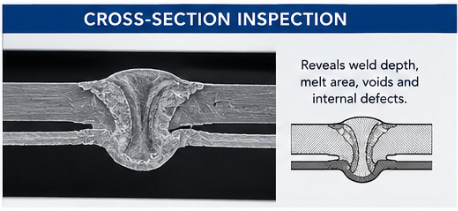
Cross-section inspection can show:
Weld depth
Melt area
Remaining energy director
Internal voids
Incomplete fusion
Excessive collapse
Material flow
Part deformation
Gap between parts
Cross-section analysis is especially useful during new project development, tooling validation and
failure analysis.For example, if the weld strength is low, a cross-section may show that the energy director
did not melt fully, the fixture did not support the part properly, or the welding horn pressure was not evenly
distributed.
Functional testing checks whether the welded product works correctly in its final application. It is often
the most meaningful test for customers.Depending on the product, functional testing may include:
Assembly force testing
Drop testing
Vibration testing
Torque testing
Pressure holding test
Waterproof test
Thermal cycling
Aging test
Real product operation test
For example, an automotive plastic part may need vibration and temperature cycling tests. A medical
plastic component may need leak testing and sharp edge inspection. A filter component may need
pressure resistance and flow performance testing.Functional testing is important because a strong
laboratory result does not always guarantee real application performance.
The sample quantity depends on the product risk level, customer standard and production volume.
For early welding trials, manufacturers may test a small number of samples to compare parameter windows.
For process validation, more samples should be tested across different conditions.
A practical validation plan may include:
Samples welded at low, middle and high parameter settings
Samples from different cavities if the part is injection molded
Samples from different material batches
Samples before and after horn or fixture adjustment
Samples after continuous production running
Samples from normal production for routine quality checks
The goal is not only to find the highest strength value. The more important goal is to find a stable
welding window thatcan produce repeatable results.
When reviewing test results, do not look only at the maximum strength number. A good ultrasonic weld
should have stable test results and an acceptable failure mode.
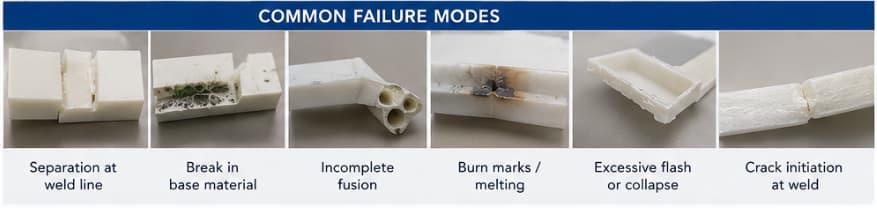
A weld is usually considered better when:
The strength meets the product requirement
The variation between samples is small
The failure happens in the base material instead of the weld interface
There is no leakage
The appearance is acceptable
There is no excessive flash or sharp edge
The part dimension remains within tolerance
The process can be repeated in production
A high test value from one sample is not enough. If other samples fail at much lower force, the welding process
may still be unstable.
If the weld strength is not enough, the cause may come from the part, material, tooling or welding parameters.
Common causes include:
The energy director may be too small, too large, uneven or missing. The joint may not guide the ultrasonic energy
into the correct area.
Low amplitude, short welding time, insufficient pressure or poor trigger settings can cause incomplete melting.
Excessive energy may cause flash, cracks, burning or material degradation.
If the lower fixture does not support the part correctly, ultrasonic energy may be lost. The part may move, bend
or absorb vibration instead of welding properly.
The welding horn must contact the plastic part evenly. Poor horn contact can cause uneven welding, local damage or
unstable strength.
Some plastics weld better than others. Material grade, filler content, moisture, additives, color masterbatch and
recycled material can all affect weld quality.
Injection molding variation can create gaps, uneven contact or inconsistent collapse distance, leading to unstable
weld strength.
Oil, dust, release agent or moisture on the joint surface can reduce weld strength.
Ultrasonic weld testing can be divided into destructive and non-destructive testing.Destructive tests include
tensile pull test, peel test, burst test and cross-section inspection. These tests destroy the sample but provide
direct information about weld strength and failure mode.
Non-destructive tests include visual inspection, leak testing, dimensional inspection and some functional checks.
These tests can often be used in production without damaging every part.For most plastic welding projects,
both types are needed.During project development, destructive testing helps define the welding window.
During mass production, non-destructive testing helps monitor quality without wasting too many parts.
A practical testing process can follow these steps:
Understand the product function and failure risk.
Select the right test method according to the application.
Prepare samples using controlled welding parameters.
Test multiple samples, not only one part.
Record force, pressure, leakage, failure mode and appearance.
Compare test results with customer requirements.
Adjust welding parameters, horn or fixture if needed.
Confirm the stable welding window.
Set production quality inspection standards.
Review test data regularly during mass production.
This process helps avoid the common problem of making a sample that passes once but cannot be repeated
in real production.
The best test method depends on the product.
If the part is mainly loaded by pulling force, use a tensile pull test.
If the joint is overlapped and loaded sideways, use a lap shear test.
If the part is thin or may peel from the edge, use a peel test.
If the product must hold pressure, use a burst test.
If the product must be sealed, use a leak test.
If the cause of failure is unclear, use cross-section inspection.
If the product has strict application requirements, use functional testing.
In many real projects, more than one method is required.
For example, a welded automotive filter component may need visual inspection, pull testing and leak testing.
A medical plastic component may need visual inspection, tensile testing, leak testing and sharp edge inspection.
A waterproof electronic housing may need appearance inspection, leak testing and functional testing.
Testing weld strength is only one part of the process. If the result is unstable, the real challenge is to
find the cause and improve the welding solution.TIMEAST provides ultrasonic plastic welding machines, custom welding horns, fixtures and automated
welding systems for different plastic parts. For projects with strict strength, sealing or appearance requirements,
we help customers evaluate the welding process from several aspects:
Plastic material and joint design
Lower fixture support
Welding parameter setting
Servo or pneumatic welding machine selection
Weld strength testing method
Vision inspection and OK/NG sorting
Production repeatability
For high-volume production, TIMEAST can also integrate ultrasonic welding with automatic feeding, rotary indexing,
robotic handling, visual inspection, leak testing, marking and sorting systems.
A good ultrasonic welding solution should not only pass sample testing. It should be stable, repeatable and suitable for
long-term production.
Q1. What is the best way to test ultrasonic weld strength?
The best method depends on the product application. Tensile pull testing is common for mechanical
strength, peel testin is useful for thin or flexible parts, lap shear testing is used for overlapped joints,
and leak or burst testing is used for sealed plastic parts.
Q2. Can visual inspection prove that an ultrasonic weld is strong?
No. Visual inspection can find surface defects such as cracks, gaps, burn marks or excessive flash,
but it cannot fullyprove internal weld strength. Mechanical or functional testing is needed when
weld strength is important.
Q3.Why does an ultrasonic welded part break at the weld line?
If the part separates at the weld interface, possible causes include insufficient energy, poor joint design,
weak fixture support,poor horn contact, material problems or contamination on the welding surface.
Q4.Is destructive testing necessary for ultrasonic welding validation?
Yes, destructive testing is often necessary during process development and validation. It helps confirm
the real weld strength and failure mode. In mass production, destructive testing can be combined with
non-destructive inspection methods.
Q5.How can ultrasonic weld strength be improved?
Weld strength can be improved by optimizing part design, energy director geometry, welding amplitude,
pressure, time, collapse distance, horn design, fixture support and material consistency. For precision
applications, servo ultrasonic welding can provide better control of welding depth and repeatability.
Q6.What data should be recorded during weld strength testing?
Useful data includes welding parameters, sample number, material grade, test method, maximum force,
pressure value,leak result, failure mode, appearance and production conditions. Good records help
identify trends and improve process stability.
Ultrasonic weld strength testing is essential for plastic parts that require reliable assembly, sealing or
long-term performance. A clean-looking weld is not always strong enough, so manufacturers should
choose the correct test method based on the product’s real application.
Tensile, shear, peel, burst, leak, cross-section and functional testing all provide different information.
The best quality control strategy is to combine proper testing with good part design, accurate toolingstabl welding parameters and repeatable production equipment.
For plastic parts with demanding strength, sealing or automation requirements, TIMEAST can help
evaluate the welding process and provide customized ultrasonic welding solutions for stable mass
production.
Phone: +86-15989541416
E-mail: sales@sztimeast.com
Whatsapp:+86-15989541416
Add: Building 5, Huixin Intelligent Industrial Park,Guangming, Shenzhen,China 518107
We chat