
sales@sztimeast.com
+86-15989541416
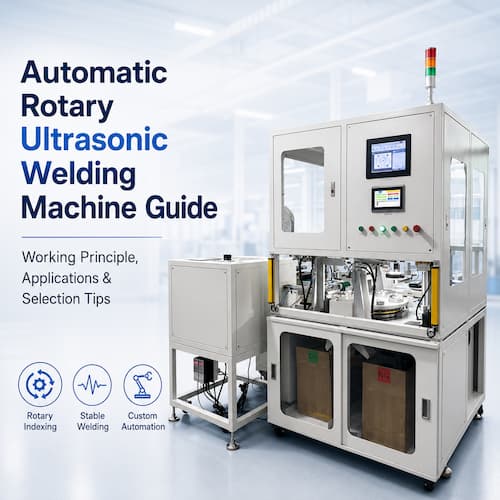
For manufacturers that need stable welding quality and higher production efficiency,
a standard ultrasonic plastic welding machine may not always be enough. When production volume
increases, operators need faster loading, more consistent positioning, safer operation, and better integration
with other automation systems.
An automatic rotary ultrasonic welding machine, also called an ultrasonic turntable welding machine,
is designed for this type of production requirement. It combines an ultrasonic welding system with
a rotary indexing table, fixtures, PLC control, safety protection, and optional automatic loading and
unloading devices. This allows plastic parts to be welded in a continuous and repeatable process.
An automatic rotary ultrasonic welding machine is a customized ultrasonic welding system built
around a rotating turntable. The turntable is divided into different workstations. Each station can
perform one step of the production process, such as manual loading, part detection, ultrasonic welding,
cooling, unloading, or product inspection.
Compared with a single-station ultrasonic welding machine, a rotary welding system can reduce
waiting time between operations. While one set of parts is being welded, another set can be loaded
or unloaded at the same time. This makes the machine especially suitable for high-volume plastic
welding applications.
Depending on the product and production requirements, the machine can be designed with manual
loading and unloading, semi-automatic operation, or fully automatic feeding and removal by a robotic arm.
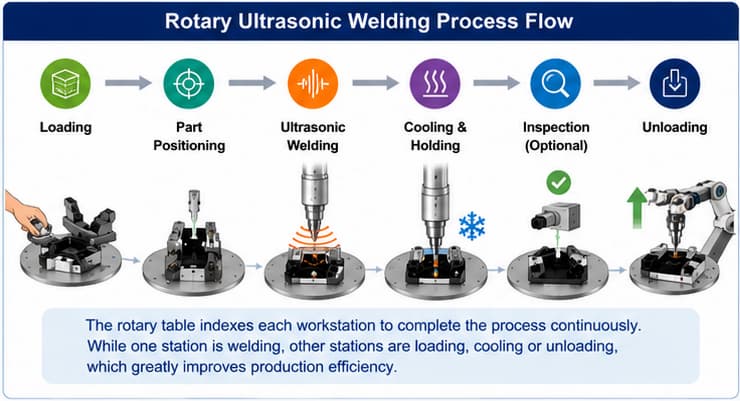
The working process usually includes the following steps:
The operator or automatic feeder places plastic parts into the fixture.
The rotary table indexes the fixture to the welding position.
The ultrasonic welding head moves down and applies pressure.
Ultrasonic vibration generates heat at the joint surface and melts the plastic locally.
The machine holds pressure for cooling and solidification.
The turntable moves to the next station for unloading or inspection.
Because the parts are located by dedicated fixtures, the welding position remains consistent. This helps
improve welding strength, appearance, and production stability.
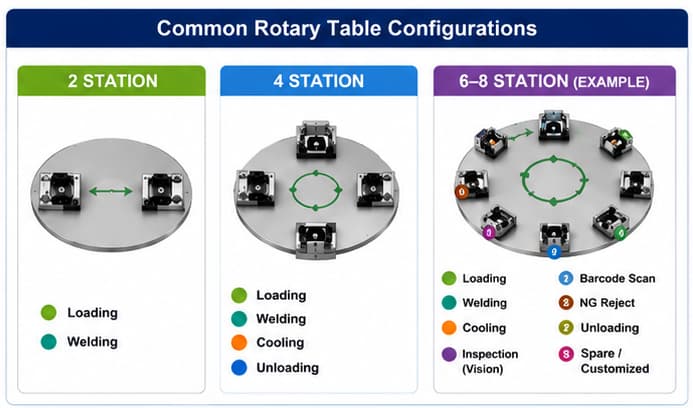
An automatic turntable ultrasonic welding machine can be customized with different numbers of
workstations according to the production process.
Common options include:
2-station rotary ultrasonic welding machine
4-station rotary ultrasonic welding machine
6-station rotary ultrasonic welding machine
8-station rotary ultrasonic welding machine
10-station or 12-station customized rotary welding system
A simple 2-station machine is suitable for basic loading and welding. A 4-station or 6-station machine
can include loading, welding, cooling, unloading, and inspection. For complex automated production,
more stations can be added for feeding, orientation, barcode scanning, leak testing, vision inspection,
or automatic rejection of defective products.
The biggest advantage of a rotary ultrasonic welding machine is continuous production. Multiple operations
can be performed at the same time on different stations. This reduces idle time and improves output compared
with single-station welding.
The machine uses customized fixtures to position the parts accurately. PLC control helps keep welding parameters
consistent, including welding time, pressure, trigger position, holding time, and output energy. This improves
repeatability and reduces quality variation caused by manual operation.
The system can be designed as a semi-automatic machine or a fully automatic production unit. For lower budgets
or smaller batches, operators can manually load and unload parts. For higher production requirements, the machine
can be equipped with automatic feeding, robotic arm unloading, conveyor connection, and product counting.
Rotary ultrasonic welding machines are not standard machines for every product. The fixture, horn, turntable layout,
and welding process must be designed according to the actual plastic part. A good fixture ensures accurate positioning,
stable support, and proper welding pressure distribution.
The machine can be equipped with PLC and touchscreen control for easier operation. Operators can adjust welding
parameters, monitor production status, switch programs, count finished parts, and check alarms through the control panel.
Safety covers, light curtains, emergency stop buttons, and noise reduction enclosures can be added according to
the application. This is especially useful for factories that want to improve working conditions and reduce operator
exposure to ultrasonic welding noise.
Automatic rotary ultrasonic welding machines are widely used in industries that require stable plastic joining
and mass production.
Typical applications include:
Automotive interior plastic parts
Electronic housings and connectors
Sensor housings
Medical plastic components
Filter assemblies
Cosmetic packaging parts
Household appliance plastic parts
Battery-related plastic components
Plastic caps, covers, and containers
For products with repeated welding points, high daily output, or strict quality requirements, a rotary ultrasonic
welding system can be more efficient than using several separate manual welding machines.
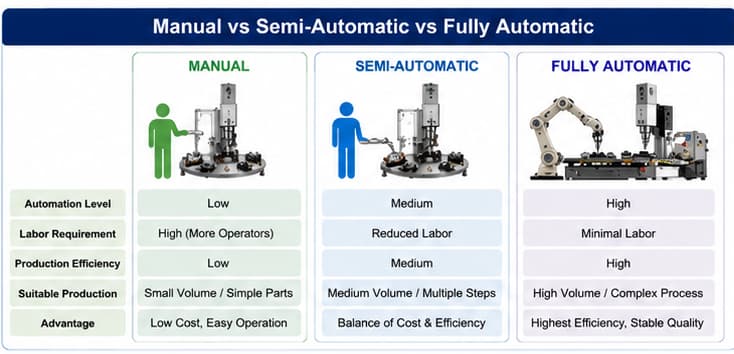
A standard ultrasonic welding machine is suitable for simple production, small batches, or products that do not
require complex automation. It has lower initial cost and is easier to operate.
A rotary ultrasonic welding machine is more suitable when the customer needs:
Higher production capacity
More consistent welding quality
Reduced labor cost
Multiple production steps in one machine
Integration with conveyors or robotic arms
Better safety and process control
Although the initial investment is higher, the rotary system can reduce labor dependence and improve long-term
production efficiency.
Before designing a rotary ultrasonic welding system, the following information should be confirmed:
Plastic material and product size
Required welding strength
Production capacity target
Manual, semi-automatic, or fully automatic operation
Number of welding points
Loading and unloading method
Available factory space
Inspection requirements
Budget and automation level
The best solution is usually confirmed after sample testing. By testing the actual plastic parts, the correct ultrasonic
frequency, power, horn design, welding parameters, and fixture structure can be selected.
Ultrasonic welding results depend on material, part design, joint structure, fixture support, and welding parameters.
Even if two products look similar, the required horn and fixture may be different.
Sample testing helps confirm:
Whether the material is suitable for ultrasonic welding
Whether the joint design can achieve stable welding
Welding strength and appearance
Cycle time
Fixture design direction
Automation feasibility
For customized automation projects, sample testing reduces risk before machine production.
An automatic rotary ultrasonic welding machine is an efficient solution for manufacturers that need
high-volume plastic welding, stable quality, and better automation. By combining ultrasonic welding
technology with a rotary indexing table, PLC control, customized fixtures, and optional robotic loading
or unloading, the system can greatly improve production efficiency.
For automotive, electronics, medical, packaging, and other plastic product manufacturers, a customized
rotary ultrasonic welding machine can be a practical way to reduce labor cost, improve consistency, and
build a more automated production process.
Q1. What is a rotary ultrasonic welding machine?
A rotary ultrasonic welding machine uses an indexing turntable to perform loading, welding,
cooling, inspection, and unloading operations in a continuous production process.
Q2. How many stations can a rotary ultrasonic welding machine have?
Common configurations include 2, 4, 6, 8, and 12 stations, depending on production requirements.
Q3. What industries use rotary ultrasonic welding machines?
Automotive, electronics, medical devices, household appliances, packaging, and industrial plastic products.
Q4. Can rotary ultrasonic welding machines be fully automated?
Yes. They can integrate robotic loading, conveyor systems, vision inspection, barcode scanning, and automatic unloading.
Phone: +86-15989541416
E-mail: sales@sztimeast.com
Whatsapp:+86-15989541416
Add: Building 5, Huixin Intelligent Industrial Park,Guangming, Shenzhen,China 518107
We chat