
sales@sztimeast.com
+86-15989541416
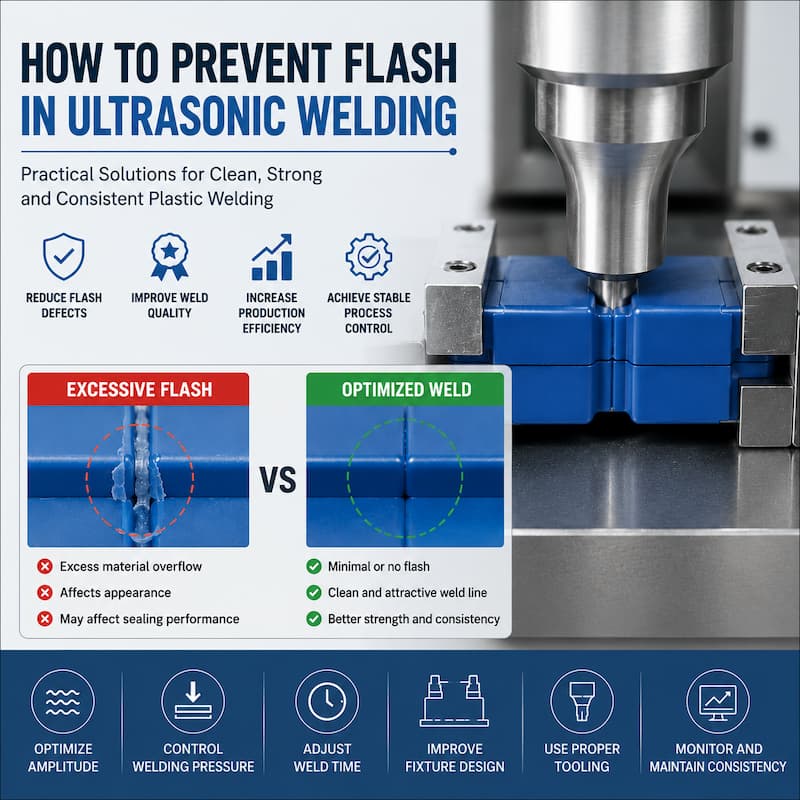
Flash is one of the most common quality problems in ultrasonic plastic welding. It occurs when
excessive melted plastic escapes from the joint area during the welding process, creating unwanted
overflow around the weld line. While a small amount of flash may sometimes be acceptable,
excessive flash can affect product appearance, dimensional accuracy, sealing performance, and
overall product quality.
For manufacturers producing consumer electronics, automotive components, medical devices,
or precision plastic assemblies, flash defects can lead to higher reject rates and costly rework.
In severe cases, excessive flash may even interfere with assembly functions or reduce the lifespan
of the final product.
The good news is that flash problems are usually preventable. By understanding the root causes of
flash and optimizing welding conditions, manufacturers can significantly improve weld appearance
and process stability.
This article explains why flash occurs in ultrasonic welding and provides practical methods to prevent
it in real production environments.
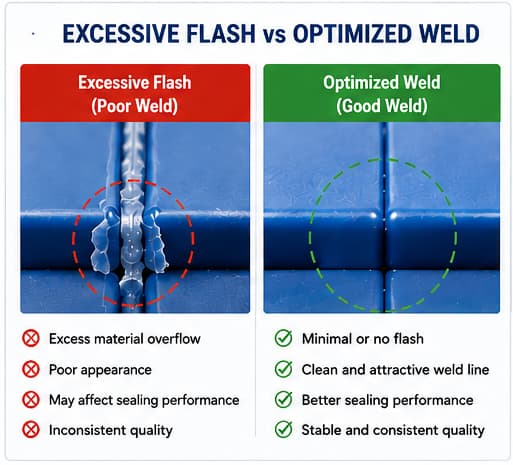
Flash refers to excess plastic material that is squeezed out of the joint area during ultrasonic welding.
It usually appears as thin plastic overflow around the weld seam.
Flash is created when the plastic melts too aggressively or flows uncontrollably under vibration and
pressure.
Typical flash defects include:
Thin plastic overflow around the weld edge
Irregular melted material
Excessive resin squeeze-out
Sharp plastic edges
Cosmetic surface defects
Burn marks near the weld area
In some applications, minor flash may be hidden inside the assembly and may not affect functionality.
However, for visible consumer products or airtight components, flash control becomes extremely important.
Flash is usually caused by excessive energy concentration or poor joint control during welding.
Several factors may contribute to flash formation:
Excessive amplitude
High welding pressure
Long weld time
Weak fixture support
Improper horn contact
Material sensitivity
Excessive collapse distance
In many factories, operators attempt to increase welding strength by increasing pressure or weld time.
While this may temporarily improve bonding, it often creates excessive melting and leads to flash.
The key is balancing energy input and material flow.
Amplitude controls the vibration movement transmitted to the plastic part. It is one of the most
important parameters affecting flash formation.
High amplitude generates more frictional heat and faster melting. If the amplitude is too high for
the material or part geometry, excessive molten plastic may escape from the joint.
Different plastics require different amplitude ranges.
For example:
ABS usually tolerates moderate-to-high amplitude
PC may require more controlled settings
PP and PE are more sensitive to overheating
Thin-wall parts often require lower amplitude
How to Reduce Flash Through Amplitude Control
Lower amplitude gradually during testing
Use only the minimum energy required for proper bonding
Avoid unnecessary booster amplification
Use servo-controlled systems for better amplitude management
Modern Servo Ultrasonic Welding Machines can provide more stable amplitude control
compared to conventional pneumatic systems.
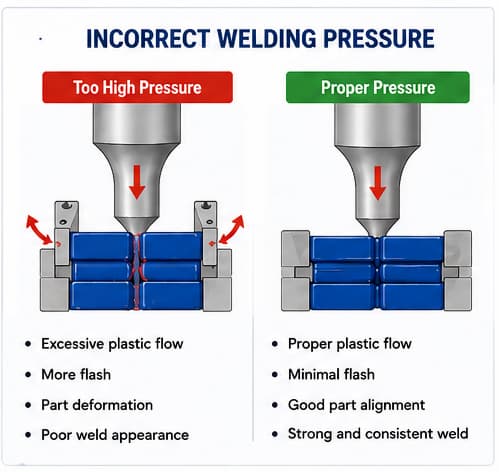
Pressure directly affects how molten plastic flows during welding.
Too much pressure may force softened plastic out of the joint area, especially when welding
thin-wall parts or cosmetic products.
Excessive pressure can also suppress ultrasonic vibration, creating unstable melting behavior.
Common signs of excessive pressure include:
Heavy flash around the weld line
Part deformation
Surface whitening
Cracking
Uneven weld appearance
Best Practices
Use the lowest effective pressure
Optimize pressure together with amplitude
Maintain stable air supply
Avoid sudden pressure increases during troubleshooting
Pressure optimization should always be performed gradually rather than through large adjustments.
Longer weld times generate more heat accumulation.
Even when amplitude and pressure are reasonable, excessive weld time may overheat the plastic
and produce flash.
Many flash problems occur because operators compensate for weak welds by extending welding time
instead of identifying the actual root cause.
How to Improve Weld Time Control
Reduce unnecessary weld duration
Use energy mode or collapse mode when possible
Monitor cycle consistency
Validate settings through sample testing
Precise time control becomes especially important in automated high-volume production.
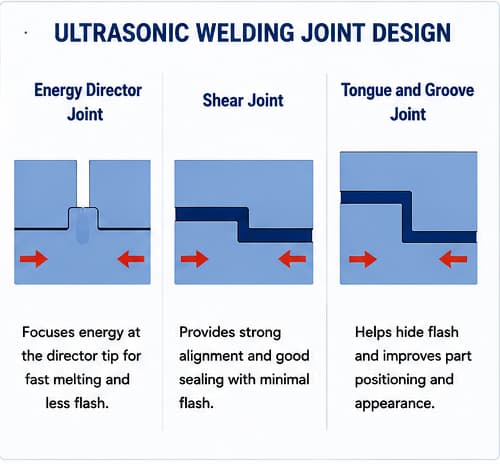
Joint design has a major influence on flash control.
Poorly designed joints allow molten plastic to escape easily during welding.
Well-designed joints help concentrate energy while controlling material flow.
Common Joint Designs for Flash Reduction
Energy Director Joints
Used mainly for amorphous plastics such as ABS and PC.
Advantages:
Fast energy concentration
Lower overall heat generation
Reduced uncontrolled melting
Shear Joints
Commonly used for airtight or watertight assemblies.
Advantages:
Better alignment
Improved flash containment
Stronger sealing performance
Tongue and Groove Structures
Useful for cosmetic parts.
Advantages:
Helps hide small flash
Improves part positioning
Enhances assembly appearance
Proper Ultrasonic Welding Horns and Tooling also help maintain stable energy distribution during welding.
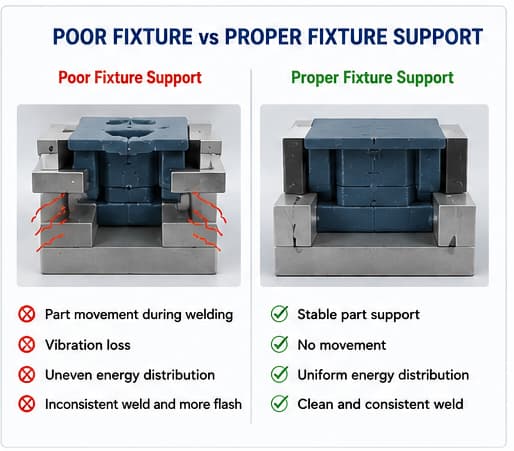
Poor fixture support often causes uneven vibration and uncontrolled material flow.
If the part moves during welding, the energy distribution becomes unstable, increasing the risk of flash.
Thin plastic parts are especially sensitive to fixture quality.
Good Fixture Design Should:
Support the entire welding area
Prevent part movement
Reduce vibration loss
Maintain repeatable positioning
Minimize part deformation
A rigid fixture helps ensure that ultrasonic energy is concentrated at the intended joint location instead of
dispersing unpredictably.
Horn condition and design also affect flash generation.
A damaged or poorly designed horn may create uneven energy transfer, causing localized overheating.
Common horn-related problems include:
Uneven horn contact
Worn horn surfaces
Frequency mismatch
Cracks in the horn
Poor horn alignment
Regular inspection of Ultrasonic Welding Horns is essential for stable long-term production.
Some materials are naturally more sensitive to flash formation.
Soft plastics or low-viscosity materials may flow excessively when exposed to ultrasonic energy.
Material additives may also affect melting behavior.
Factors influencing flash risk include:
Melt flow rate
Moisture content
Filler percentage
Recycled material ratio
Material stiffness
Moisture absorption can worsen flash problems because trapped moisture may rapidly expand during welding.
Proper material drying is especially important for:
Nylon (PA)
PC
PET
ABS
Traditional pneumatic ultrasonic welders rely heavily on air pressure consistency, which may fluctuate
during production.
Servo ultrasonic welding systems provide better control over:
Pressure
Weld depth
Speed
Position
Collapse distance
This allows more precise energy management and significantly reduces flash risk in precision applications.
Industries producing medical devices, automotive components, and consumer electronics increasingly prefer
servo-controlled welding systems for improved consistency.
Collapse distance refers to how much the plastic compresses during welding.
Excessive collapse distance usually indicates excessive melting, which often leads to flash.
Monitoring collapse distance helps maintain process consistency.
Benefits of Collapse Monitoring
Prevents over-welding
Improves repeatability
Reduces material overflow
Detects process drift early
Servo systems provide more accurate collapse monitoring compared to conventional systems.
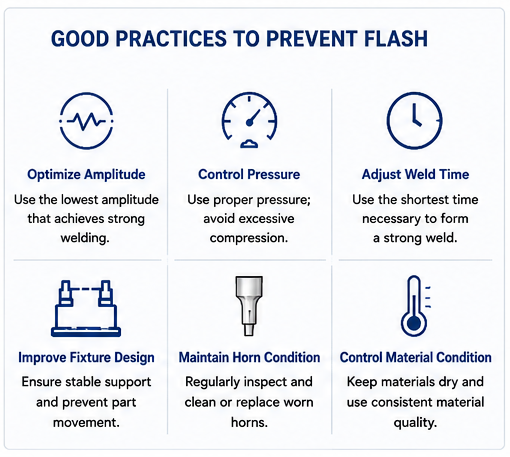
In high-volume production environments, heat accumulation may gradually increase flash defects over time.
Common causes include:
Continuous high-speed operation
Poor cooling
Horn overheating
Generator instability
Excessive cycle rates
Flash may appear only after several hours of production, making the issue difficult to diagnose.
Practical Solutions
Schedule cooling intervals if necessary
Improve workshop ventilation
Monitor horn temperature
Maintain stable generator performance
Use proper duty cycle settings
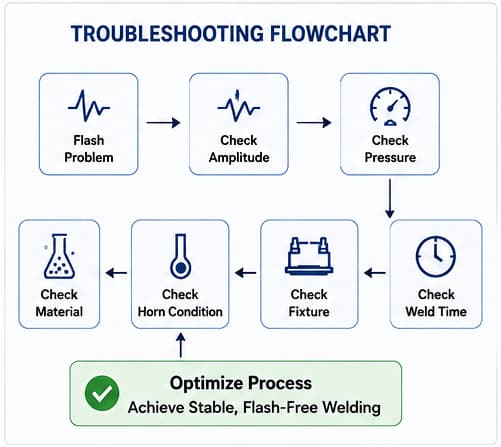
Instead of adjusting multiple parameters randomly, manufacturers should follow a structured
troubleshooting process.
Recommended Process
Check whether the joint properly controls material flow.
Ensure the part is fully supported during welding.
Inspect for wear, cracks, or uneven contact.
Avoid sudden parameter changes.
Adjust parameters together rather than independently.
Check moisture content and resin consistency.
This systematic approach usually identifies the root cause faster and improves long-term process stability.
| Problem | Possible Cause | Recommended Solution |
| Heavy flash around weld seam | Excessive amplitude | Reduce amplitude |
| Thin plastic overflow | High welding pressure | Lower pressure |
| Burn marks near weld | Excessive weld time | Shorten weld cycle |
| Uneven flash | Poor fixture support | Improve fixture rigidity |
| Flash after long production runs | Heat accumulation | Improve cooling |
| Flash only on one side | Horn alignment issue | Re-align horn |
| Flash with brittle cracks | Material overheating | Reduce energy input |
FAQ
Is some flash normal in ultrasonic welding?
Yes. Small amounts of flash may occur naturally depending on joint design and material type.
However, excessive flash usually indicates poor process optimization.
Can flash affect airtight sealing?
Yes. Excessive flash may interfere with sealing surfaces or indicate unstable melting, which can
reduce airtight performance.
Manufacturers often use Air Leak Testing Machines to verify sealing quality after welding.
Does higher welding pressure create stronger welds?
Not always. Excessive pressure may suppress vibration and create unstable material flow, leading to
flash or weak bonding.
Which joint design helps reduce flash?
Shear joints and properly designed energy directors are commonly used to improve energy concentration
and reduce uncontrolled plastic overflow.
Can automation improve flash consistency?
Yes. An Automatic Ultrasonic Welding Line can improve repeatability and reduce operator-related
process variation.
Flash in ultrasonic welding is usually caused by excessive energy input, poor material flow control,
or unstable process conditions.
Rather than simply reducing parameters blindly, manufacturers should optimize the entire welding system,
including amplitude, pressure, fixture support, horn condition, and joint design.
Stable process control not only reduces flash defects, but also improves product appearance, weld strength,
production efficiency, and long-term manufacturing consistency.
For precision plastic welding applications, proper tooling design and process validation are essential before
mass production begins.
TIMEAST provides Ultrasonic Welding Machines, custom tooling design, automation systems, and
sample welding evaluation for various plastic assembly applications.
You can send your plastic parts, material information, and production requirements for technical evaluation
Phone: +86-15989541416
E-mail: sales@sztimeast.com
Whatsapp:+86-15989541416
Add: Building 5, Huixin Intelligent Industrial Park,Guangming, Shenzhen,China 518107
We chat