
sales@sztimeast.com
+86-15989541416
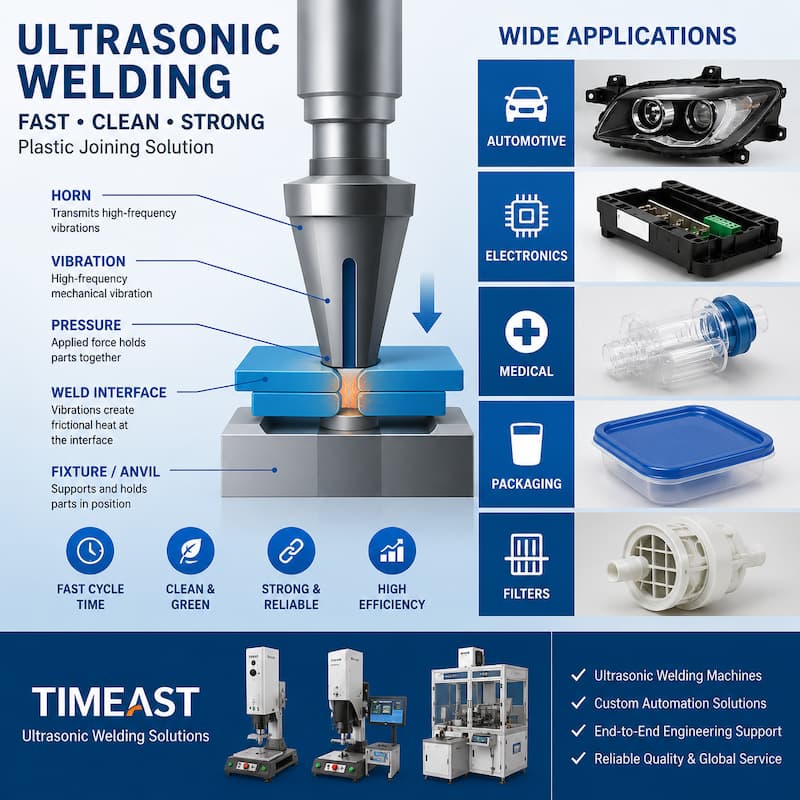
Ultrasonic welding is one of the most widely used plastic joining technologies in modern manufacturing.
By combining high-frequency mechanical vibration with controlled pressure, it creates strong and
repeatable bonds between thermoplastic components without adhesives, screws, or external heat sources.
Compared with conventional joining methods, ultrasonic welding offers faster cycle times, cleaner welds,
lower operating costs, and excellent suitability for automated production environments.
Today, ultrasonic welding is widely applied in automotive components, consumer electronics,
medical devices,filtration products, packaging containers, battery assemblies, and numerous
custom-engineered plastic products.
For manufacturers, successful ultrasonic welding depends not only on the machine itself but also on
material selection,joint design, tooling quality, process control, and production consistency.
This guide explains the complete ultrasonic welding process and provides practical engineering insights
for achieving reliable welding results.
Ultrasonic welding is a process that uses high-frequency mechanical vibration to generate frictional heat
at the interface of two plastic components.
The vibration is produced by an ultrasonic generator and converted into mechanical movement through
a transducer and booster. The horn then transfers this vibration into the plastic parts while a controlled
force is applied. The performance of the horn depends heavily on material selection and geometry.
Learn more in Ultrasonic Welding Horn Design, Material, Shape and Failures.
As the temperature rises at the joint interface, the thermoplastic material softens and melts locally.
After the vibration stops, the material cools under pressure and forms a permanent bond.
Unlike thermal welding methods, ultrasonic welding concentrates energy directly at the weld area,
minimizing heat exposure to surrounding components.
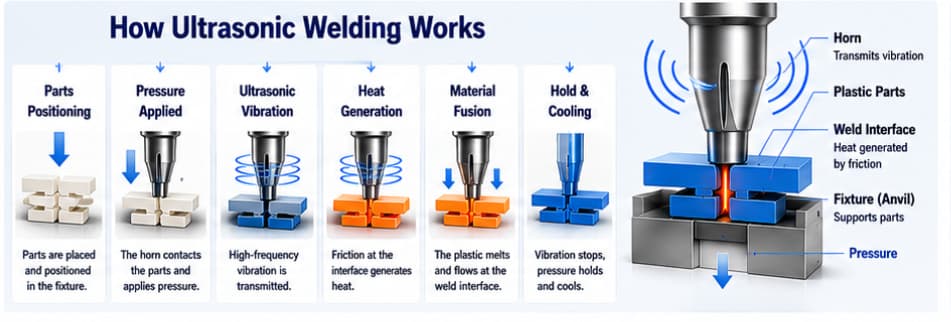
The plastic components are placed into a fixture designed to ensure repeatable alignment.
The welding horn contacts the upper part and applies a predetermined force.
High-frequency vibration, typically between 20 kHz and 40 kHz, is transmitted into the plastic.
Mechanical vibration creates friction and molecular movement at the interface.
The plastic melts locally and flows into the designed weld joint.
After vibration stops, pressure remains for a short holding period to allow solidification.
The result is a strong and consistent welded assembly.
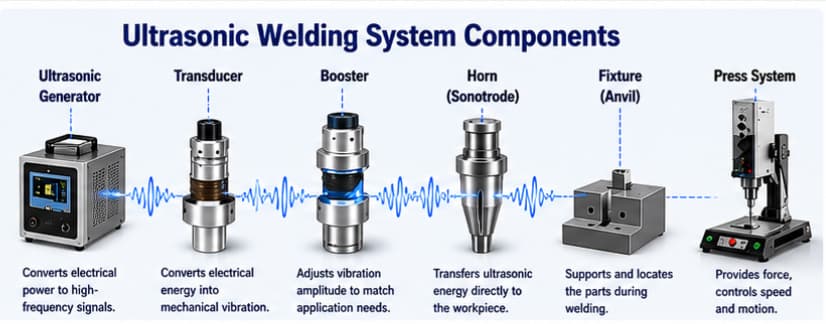
Converts electrical power into high-frequency electrical signals.
Transforms electrical energy into mechanical vibration.
Adjusts vibration amplitude to match application requirements.
Transfers ultrasonic energy directly to the workpiece.
Supports and positions the plastic components during welding.
Controls welding force, speed, and motion.
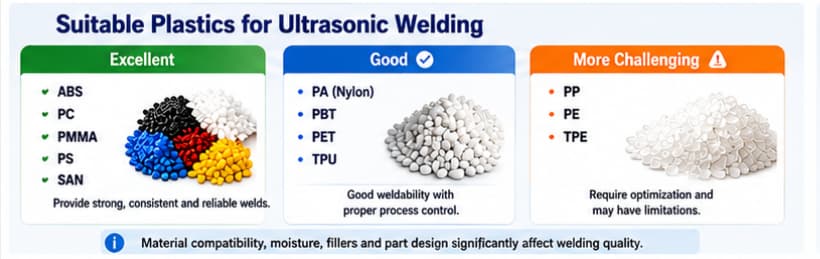
Not all plastics weld equally well.
ABS
PC
PMMA
SAN
PS
These materials typically provide strong and consistent welds.
PA
PBT
PET
TPU
Process optimization may be required.
PP
PE
Because of their lower stiffness and energy transmission characteristics.
Material compatibility should always be evaluated through sample testing before production.
For a more detailed comparison of material compatibility, see What Plastics Are Best for Ultrasonic Welding.
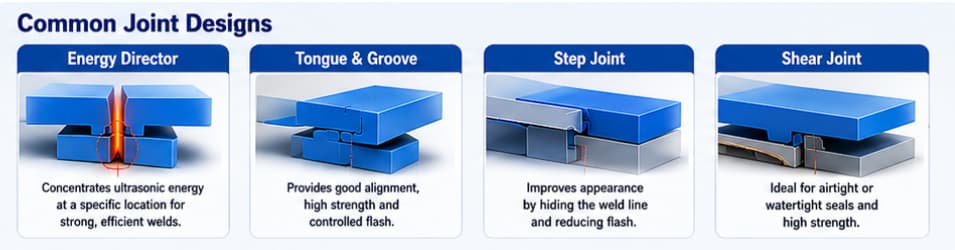
Joint design is one of the most critical factors affecting welding performance.
A properly designed joint concentrates ultrasonic energy at a specific location, reducing
cycle time and improving weld strength.Common joint designs include:
Energy Director
Most commonly used for amorphous plastics.
Tongue and Groove
Provides excellent alignment and flash control.
Step Joint
Improves cosmetic appearance.
Shear Joint
Often used for applications requiring airtight or watertight sealing.
Poor joint design is a major cause of inconsistent welding results.
For detailed energy director, shear joint, and tongue-and-groove examples, refer to
Ultrasonic Welding Joint Design for Plastic Parts.
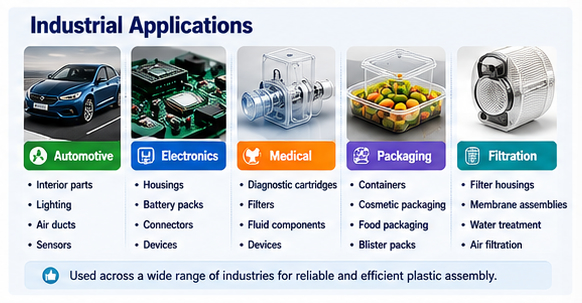
Interior trim components
Air duct assemblies
Lighting housings
Sensors
Battery packs
Control housings
Connectors
Smart device enclosures
Diagnostic cartridges
Filters
Fluid management components
Food containers
Cosmetic packaging
Blister packaging
Filter housings
Membrane assemblies
Water treatment components
Fast Production Speed
Typical weld cycles range from 0.2 to 2 seconds.
No Consumables
No adhesives, screws, or solvents are required.
High Repeatability
Suitable for automated manufacturing environments.
Clean Process
No smoke, open flame, or chemical emissions.
Low Operating Cost
Energy consumption is relatively low compared with thermal welding methods.
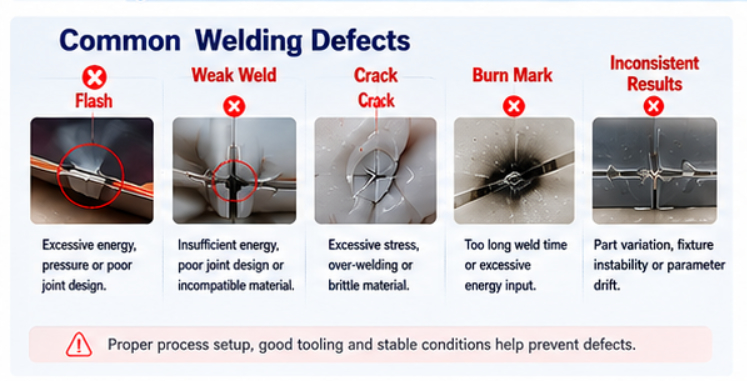
Possible causes:
Excessive amplitude
Excessive pressure
Poor joint design
See How to Prevent Flash in Ultrasonic Welding for practical troubleshooting methods.
Possible causes:
Insufficient energy
Incorrect horn design
Material incompatibility
Possible causes:
Excessive stress concentration
Over-welding
Material brittleness
Possible causes:
Excessive welding time
Excessive energy input
Possible causes:
Part dimensional variation
Fixture instability
Horn wear
Process parameter drift
Consistent process validation is essential for long-term production stability.
For a complete analysis, read Why Ultrasonic Welding Results Are Inconsistent.
Machine selection should consider:
Part size
Material type
Weld area
Production volume
Automation requirements
Quality traceability requirements
For standard applications, pneumatic ultrasonic welding machines are often sufficient.
For precision products requiring tighter process control, servo ultrasonic welding systems
provide improved repeatability and process monitoring capabilities.
High-volume manufacturing environments may benefit from fully automated ultrasonic welding lines
integrated with:
Automatic loading
Conveyor systems
Vision inspection
NG sorting
Robot handling
PLC and HMI control
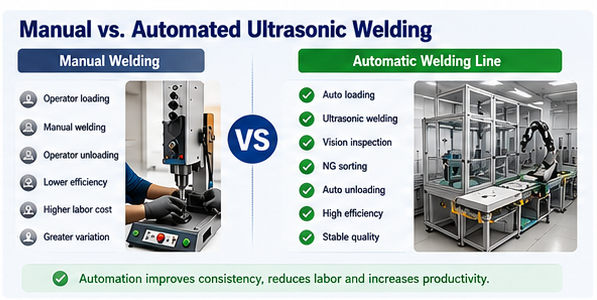
As labor costs increase and quality requirements become more demanding, many manufacturers
are integrating ultrasonic welding into automated production systems.
A typical automated welding line may include:
Automatic part feeding
Vision positioning
Ultrasonic welding
Leak testing
Functional inspection
Automatic unloading
Such systems improve consistency while significantly increasing throughput.
Q1. What plastics can be ultrasonically welded?
A1: Most thermoplastics can be welded ultrasonically, although material compatibility and
joint design significantly influence results.
Q2. Is ultrasonic welding stronger than adhesive bonding?
A2: For many plastic assemblies, ultrasonic welding provides stronger and more repeatable joints
while eliminating curing time.
Q3. Can ultrasonic welding create airtight seals?
A3: Yes. Properly designed shear joints can achieve airtight and watertight sealing.
Q4. What frequency is commonly used?
A4: 20 kHz, 30 kHz, and 40 kHz are the most common industrial frequencies.
Q5. Can ultrasonic welding be automated?
A5: Yes. Ultrasonic welding is highly compatible with automated production systems and is widely
integrated into Industry 4.0 manufacturing environments.
Ultrasonic welding has become one of the most efficient and reliable methods for joining thermoplastic components.
However, successful implementation requires careful consideration of material properties, joint design, tooling,
process parameters, and automation requirements.
By combining proper engineering design with suitable welding equipment and process validation,manufacturers
can achieve high-strength welds, improved productivity, and consistent product quality across a wide range of
industrial applications.Manufacturers seeking automated production can also explore custom ultrasonic welding
Phone: +86-15989541416
E-mail: sales@sztimeast.com
Whatsapp:+86-15989541416
Add: Building 5, Huixin Intelligent Industrial Park,Guangming, Shenzhen,China 518107
We chat