
sales@sztimeast.com
+86-15989541416
When it comes to plastic assembly, choosing the right joining method directly impacts product quality,
strength, and production efficiency. Among the most widely used technologies, ultrasonic welding,
heat staking, and vibration welding each offer unique advantages depending on your application.
However, many engineers and buyers struggle with questions like:
Which method provides the strongest bond?
Is ultrasonic welding better than heat staking?
When should vibration welding be used?
In this guide, we provide a clear comparison of ultrasonic welding vs heat staking vs vibration welding,
covering their working principles, advantages, limitations, and real-world applications. By the end,
you’ll know exactly which solution is best for your plastic parts and production goals, and if
ultrasonic assembly is the right choice, you can explore our ultrasonic welding systems for
different production needs.
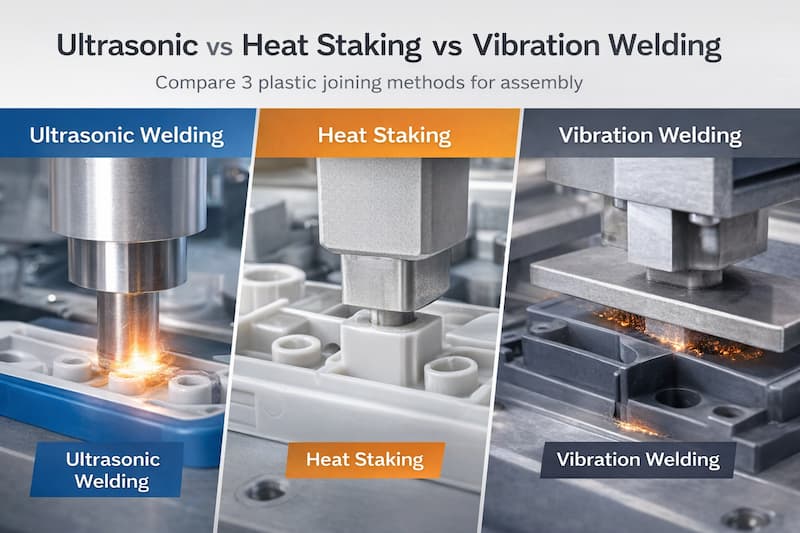
1) What Are the Key Differences Between Plastic Welding Methods?The main difference between ultrasonic welding, heat staking, and vibration welding lies in
how heat is generated and applied to join plastic parts.
Ultrasonic welding uses high-frequency vibrations to create frictional heat at the joint interface.
Heat staking uses direct thermal energy to deform plastic and lock components together.
Vibration welding generates heat through mechanical friction between large plastic parts.
Quick Summary:
Ultrasonic welding = fast, precise, ideal for small parts
Heat staking = simple, cost-effective, ideal for inserts
Vibration welding = strong, suitable for large components
Ultrasonic welding is a high-speed plastic joining process that uses high-frequency
mechanical vibrations (typically 20–40 kHz) to generate heat and fuse materials.
✅ Advantages of Ultrasonic Welding
Extremely fast cycle time (usually < 3 seconds)
Clean process (no adhesives or consumables)
High precision and repeatability
Suitable for automation and mass production
❌ Limitations
Not ideal for very large parts
Requires compatible thermoplastics
Initial equipment cost can be higher
✅ Typical Applications
Electronics (connectors, housings)
Medical devices
Automotive interior components
Heat staking is a process where heated tools soften plastic studs, which are then
deformed to mechanically lock components such as metal inserts or other plastic parts.
✅ Advantages of Heat Staking
Simple and reliable process
Lower equipment cost
Ideal for plastic-to-metal assembly
Good for embedded components
❌ Limitations
Slower cycle time than ultrasonic welding
Less aesthetically clean
Lower joint strength compared to welding
✅ Typical Applications
PCB mounting
Automotive dashboards
Consumer electronics assembly
Vibration welding joins plastic parts by applying linear or orbital motion under
pressure, generating frictional heat to melt and fuse materials.
✅ Advantages of Vibration Welding
Very strong welds
Suitable for large or complex parts
Works with a wide range of thermoplastics
Good for irregular geometries
❌ Limitations
Larger equipment footprint
Higher cost
More flash (material overflow)
✅ Typical Applications
Automotive components (air intake manifolds)
Large plastic housings
Industrial containers
| Feature | Ultrasonic Welding | Heat Staking | Vibration Welding |
| Process Type | High-frequency Vibration | Thermal forming | Friction Wedling |
| Suitable Materials | Thermoplastics | Plastic+metal | Large thermoplastics |
| Cycle Time | 0.2-2 seconds | 2-10 seconds | 5-20 seconds |
| Weld Strength | High | Medium | Very High |
| Airtight Seal | Excellent | Limited | Excellent |
| Precison Parts | Excellent | Good | Limited |
| Automation Compatibility | Excellent | Good | Good |
| Equipment Cost | Medium | Low | Higher |
| Typical Applications | Electronics,Medical,Filters | Inerts,Fasterners | Automative Tanks,Air Ducts |
Choosing the right method depends on your product design, materials, and production volume.
Choose Ultrasonic Welding if:
You need high-speed production
Parts are small or precision-based
Clean appearance is important
If your project is still in the evaluation stage, our ultrasonic welding sample testing service
can help verify weld feasibility and optimize parameters before equipment investment.
Choose Heat Staking if:
You are joining plastic with metal inserts
Cost control is a priority
Structural strength requirements are moderate
Choose Vibration Welding if:
You are working with large plastic parts
Maximum strength is required
Your product has complex geometry
Applications by Industry
Automotive Industry
Vibration welding for large components
Heat staking for interior assembly
Ultrasonic welding for small connectors
In automotive manufacturing, ultrasonic welding is commonly used for
small connectors and precision plastic assemblies. See our
automotive ultrasonic welding applications for typical component examples.
Electronics Industry
Ultrasonic welding dominates due to precision
Heat staking used for PCB mounting
In electronics manufacturing, ultrasonic welding is widely used because of its
speed, precision, and clean joint quality. Learn more about our electronics
ultrasonic welding solutions for connectors, housings, and other plastic components.
Medical Industry
Ultrasonic welding preferred for clean and sterile bonding
High repeatability is critical
For medical manufacturing, ultrasonic welding is often preferred for clean and
repeatable assembly. You can review our medical device ultrasonic welding solutions
for typical device applications.
Q1. Which is stronger, ultrasonic or vibration welding?
A: Vibration welding generally produces stronger joints due to deeper melt layers, especially for large parts.
Q2. Is ultrasonic welding better than heat staking?
A: Ultrasonic welding is faster and cleaner, while heat staking is better for joining plastic with metal inserts.
Q3. Can ultrasonic welding replace heat staking?
A: In some cases, yes — but not when metal inserts or mechanical locking are required.
Before replacing heat staking with ultrasonic welding, it is recommended to review a practical
ultrasonic welding validation guide to confirm joint feasibility, strength, and cosmetic results.
Q4. What plastics are suitable for ultrasonic welding?
A: Common materials include ABS, PP, PE, and PC, especially thermoplastics with good vibration transmission.
Q6. When should vibration welding be used?
A: Vibration welding is ideal for large, irregular parts that require strong structural bonds.
Conclusion
Each plastic joining method has its strengths:
Ultrasonic welding offers speed and precision
Heat staking provides cost-effective assembly
Vibration welding delivers maximum strength for large parts
The best choice ultimately depends on your application, materials, and production requirements.
Looking for the right plastic welding solution?
Explore our full range of ultrasonic welding machines and plastic joining systems,
or contact our engineers for a customized recommendation tailored to your application.
Phone: +86-15989541416
E-mail: sales@sztimeast.com
Whatsapp:+86-15989541416
Add: Building 5, Huixin Intelligent Industrial Park,Guangming, Shenzhen,China 518107
We chat