
sales@sztimeast.com
+86-15989541416
Handheld ultrasonic welders are widely used in manual assembly operations where flexibility,
precision, and efficiency are required.Compared with traditional bonding or heat welding methods,
handheld ultrasonic welding machinesprovide faster cycle times, cleaner joints, and greater
control for operators.
In this article, we explain how to choose the right handheld ultrasonic welder for plastic welding
applications and what factors you should consider before purchasing.
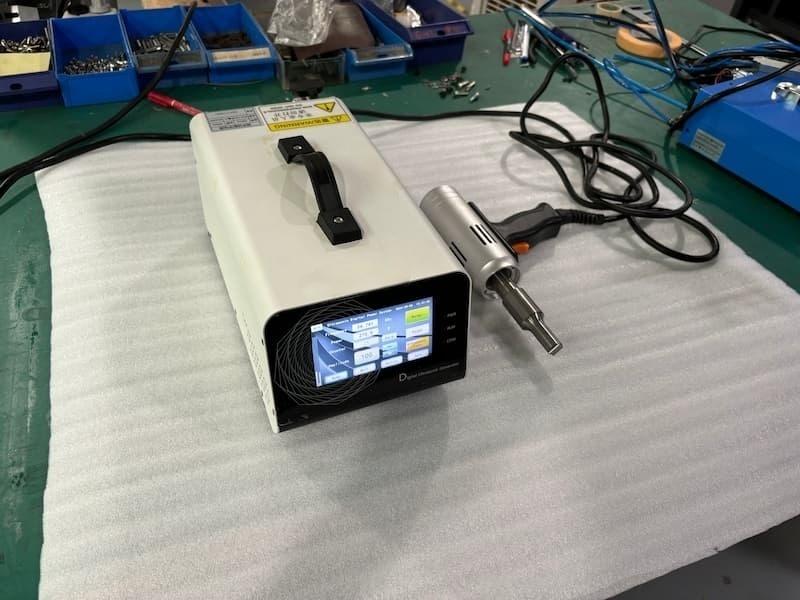
A handheld ultrasonic welder is a portable ultrasonic welding tool that uses high-frequency
vibration to join thermoplastic materials without adhesives or fasteners.
It is especially suitable for:
Manual assembly stations
Small batch production
Repair and rework operations
Welding in hard-to-reach areas
a) Frequency Selection
High-frequency options such as 35kHz are ideal for precision welding of small
plastic parts with minimal deformation.
b) Power Output
Typical handheld ultrasonic welders range from 800W to 1200W, providing sufficient
energy for spot welding, riveting, and staking.
c) Ergonomic Design
Lightweight and well-balanced handheld tools reduce operator fatigue during long working hours.
d) Intelligent Control
An intelligent control system allows precise adjustment of welding time and power,
ensuring consistent results.
Handheld ultrasonic welders are commonly used for:
Plastic housings and enclosures
Electronic components and connectors
Automotive interior parts
Packaging and textile welding
Choosing the right handheld ultrasonic welder can significantly improve welding
quality and productionefficiency for manual operations.By focusing on frequency,
power, and ergonomic design, manufacturers can achieve reliable and repeatable
welding results.
Phone: +86-15989541416
E-mail: sales@sztimeast.com
Whatsapp:+86-15989541416
Add: Building 5, Huixin Intelligent Industrial Park,Guangming, Shenzhen,China 518107
We chat