
sales@sztimeast.com
+86-15989541416
Ultrasonic welding is widely used in automotive, electronics, medical, and precision plastic
manufacturing due to its speed, cleanliness, and reliability.
However, one challenge frequently raised by end-use factories in Europe and North America
is noise generated during ultrasonic welding operations.
As factories move toward higher safety standards, better working conditions, and stricter
compliance requirements, reducing ultrasonic welding noise has become an important
consideration—not only for operator comfort, but also for long-term production sustainability.
This article explores why noise occurs in ultrasonic welding and outlines practical, factory-proven
solutions to reduce it.
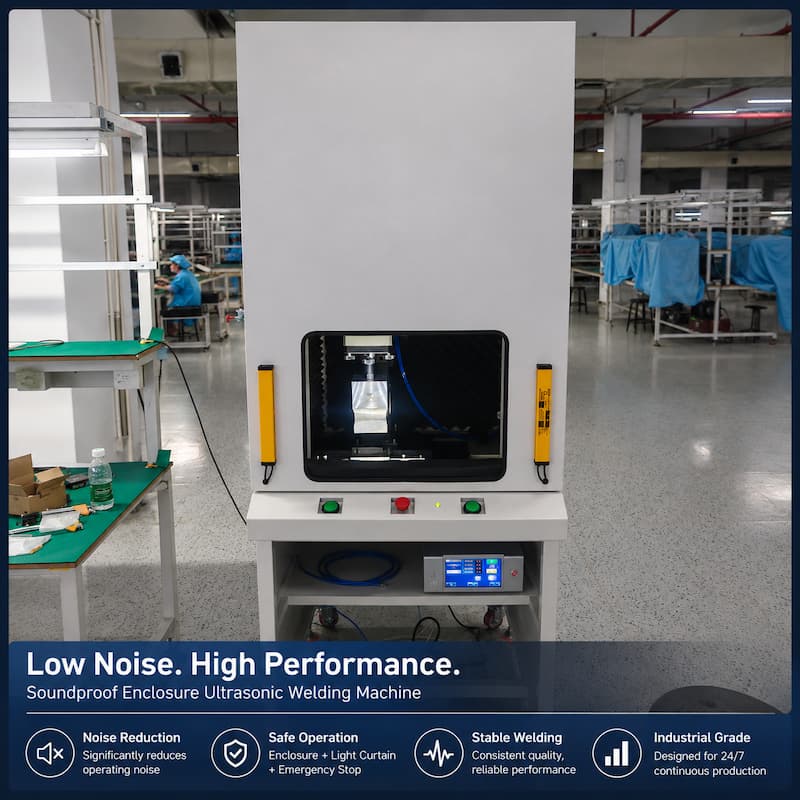
Ultrasonic welding operates by generating high-frequency mechanical vibrations
(typically 15–40 kHz) that are transmitted through the horn into the workpiece.
While much of this energy is focused on the weld interface, part of it propagates
as airborne noise and structural vibration.
Common noise sources include:
Vibration of the horn, fixture, and workpiece
Resonance changes caused by different materials or part geometries
Inconsistent frequency control under varying loads
Open machine structures that allow sound to spread freely
In open-frame welding machines, these factors can result in high noise exposure,
especially during continuous or multi-shift operation.
In many European and North American factories, noise is not just a comfort issue—
it is a workplace safety and compliance concern.
Excessive noise can lead to:
Operator fatigue and reduced concentration
Long-term hearing risks
Increased use of personal protective equipment
Difficulty meeting internal safety or environmental standards
For factories running high-volume, long-duration production, addressing noise
early in equipment selection can significantly improve overall operational efficiency.
Noise in ultrasonic welding does not come from the generator only. In most real production environments,
noise is caused by a combination of high-frequency vibration, horn resonance, fixture vibration, part geometry,
machine rigidity and open-frame machine design.
Common noise sources include:
Horn and booster vibration
Fixture resonance
Thin or hollow plastic parts acting as sound amplifiers
Unstable frequency tracking under load
Loose mechanical parts or weak support structure
Open machine frames without acoustic isolation
Incorrect welding pressure, amplitude or trigger settings
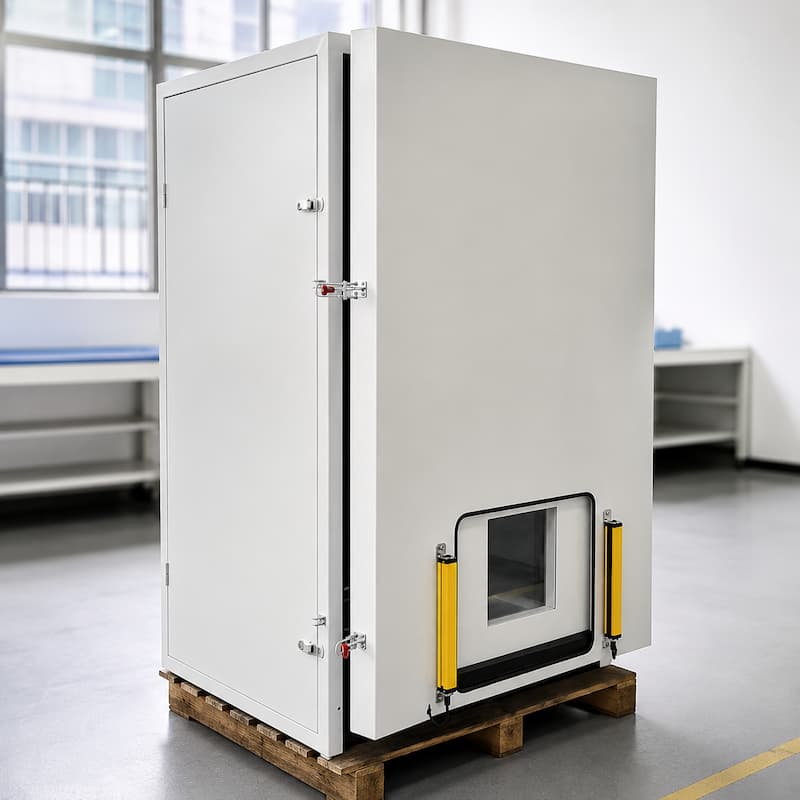
One of the most effective solutions is the use of a fully enclosed soundproof cabinet.
A properly designed enclosure can:
Significantly reduce airborne noise exposure
Isolate high-frequency sound from the surrounding workspace
Improve operator comfort without affecting welding performance
Create a more controlled and stable welding environment
For end-use factories, this solution is often preferred over relying solely on personal
protective equipment.
Noise levels can increase when an ultrasonic welding system operates away from its
optimal resonance frequency.Machines equipped with automatic frequency tracking help to:
Maintain resonance under different material loads
Reduce unnecessary vibration
Improve both welding consistency and noise stability
Stable ultrasonic output benefits not only noise reduction, but also weld quality and
process repeatability.
Mechanical structure plays a critical role in both noise and welding consistency.
Key design considerations include:
Rigid frames to minimize vibration transfer
Precision linear guide rails for controlled motion
Proper horn and fixture alignment
A stable mechanical system reduces unwanted vibration, which directly contributes
to lower noise levels.
Modern industrial ultrasonic welding systems often integrate:
Safety light curtains
Controlled welding parameters (time, energy, amplitude)
Digital monitoring interfaces
These features help ensure that the welding process remains controlled, repeatable,
and predictable, reducing the likelihood of abnormal noise spikes during operation.
| Item | Open-Frame Ultrasonic Welder | Soundproof Enclosed Ultrasonic Welder |
|---|---|---|
| Noise Control | Limited | Much better noise isolation |
| Operator Comfort | Depends on working environment | Better for long-term operation |
| Safety Protection | Basic machine protection | Can integrate enclosure, light curtain and E-stop |
| Application | General plastic welding | Medical, electronics, precision parts and clean workshops |
| Cost | Lower initial cost | Higher initial cost but better workplace control |
| Best For | Short-cycle or low-noise applications | High-volume, multi-shift or noise-sensitive factories |
For factories exporting to EU and US markets, selecting an ultrasonic welding
machine should go beyond power and speed.
Key questions to consider:
Is the machine suitable for long-term, multi-shift operation?
How is noise managed in real factory conditions?
Does the system maintain stable output under varying loads?
Is the design aligned with modern safety expectations?
Machines designed with soundproof enclosures, stable frequency control, and
industrial-grade structures are generally better suited for these environments.
What to Check Before Buying
Before choosing a low-noise ultrasonic welding system, factories should check:
Required welding frequency and power
Real noise condition during sample testing
Whether the enclosure affects loading and unloading
Whether the machine supports automatic frequency tracking
Whether the horn and fixture are designed to reduce resonance
Whether the system includes safety light curtains and emergency stop
Whether the machine can support future automation
Whether the supplier can test real samples before purchase
Noise reduction in ultrasonic welding is not achieved through a single feature,but through a combination of enclosure design, frequency stability, mechanical precision, and process control.For end-use factories aiming to improve working conditions while
maintaining high production quality, investing in a low-noise,industrial-grade ultrasonic welding solution can deliver
long-term benefits in safety, consistency, and operational efficiency.
Phone: +86-15989541416
E-mail: sales@sztimeast.com
Whatsapp:+86-15989541416
Add: Building 5, Huixin Intelligent Industrial Park,Guangming, Shenzhen,China 518107
We chat