
sales@sztimeast.com
+86-15989541416
Choosing the right ultrasonic welding system is critical for achieving consistent quality,
especially when welding high-precision or thin-wall plastic parts.
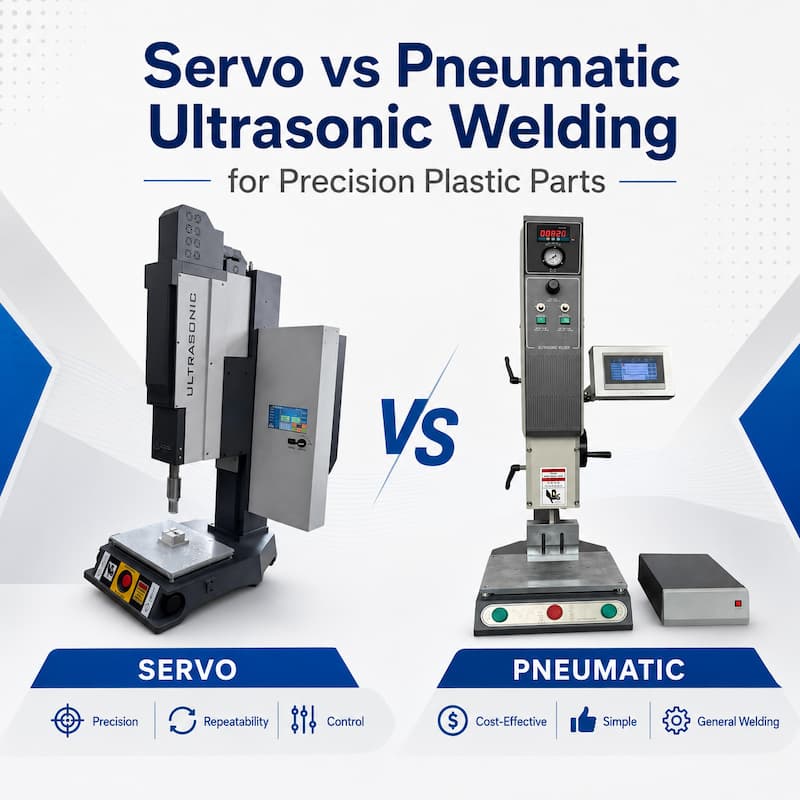
Many manufacturers struggle to decide between servo driven ultrasonic welding and
traditional pneumatic ultrasonic welding.For different applications, selecting the correct
ultrasonic welding machine depends on part design, material, tolerance and production
requirements.
In this article, we compare servo driven vs pneumatic ultrasonic welders, explain their
working principles, and help you determine which solution is best for your plastic
welding application.
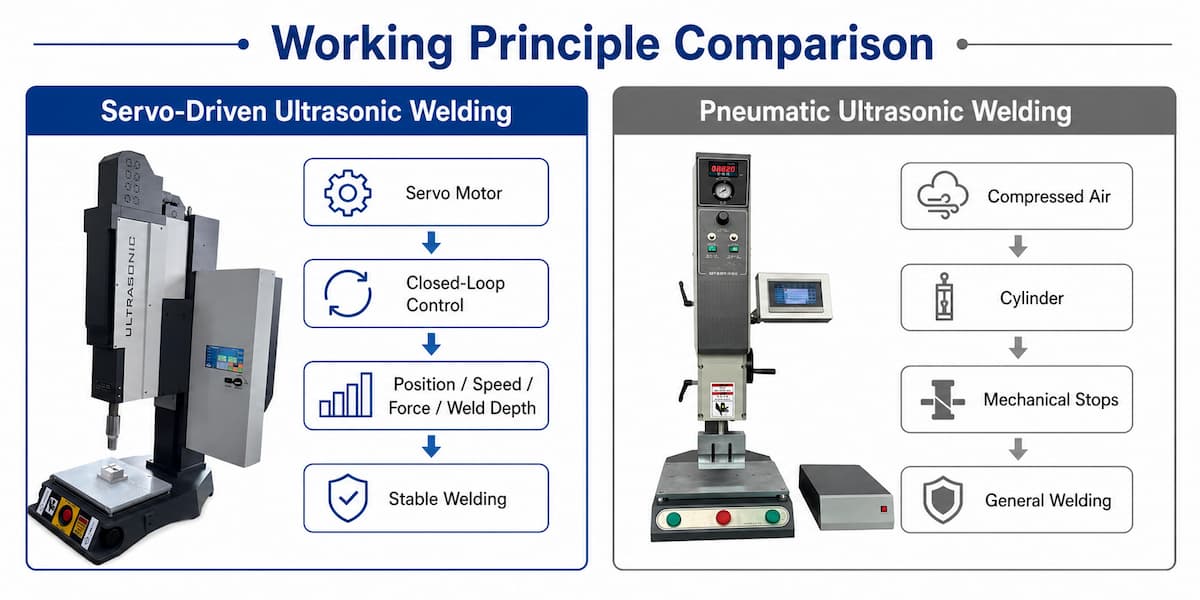
A pneumatic ultrasonic welder uses compressed air to drive the welding head downward.
The welding force and movement are controlled by air pressure and mechanical stops.
Key Characteristics of Pneumatic Ultrasonic Welding
Cost-effective solution
Simple structure and easy maintenance
Suitable for thick or structural plastic parts
Limited control over exact welding depth and force
Sensitive to air pressure fluctuations
Pneumatic ultrasonic welding is commonly used for general-purpose plastic welding,
where cosmetic appearance and micron-level accuracy are not critical.For standard plastic
assembly applications, a pneumatic ultrasonic welding machine provides a reliable and
cost-effective solution for manufacturers requiring stable welding performance without
advanced process control.
What Is Servo Driven Ultrasonic Welding?
A servo driven ultrasonic welder uses an electrical servo motor instead of compressed
air to control the welding movement.This allows closed-loop control of: Position,Speed,
Force,Welding depth.
As a result, servo ultrasonic welding delivers higher repeatability and precision, even when
part tolerances vary.For applications requiring precise force control, weld depth control and
production traceability, a servo ultrasonic welding machine is usually the preferred solution.
Although both servo-driven and pneumatic ultrasonic welding systems use ultrasonic vibration to
join plastic parts, the way they control welding movement is completely different.
A pneumatic ultrasonic welder uses compressed air to move the welding horn, while a servo-driven
ultrasonic welder uses an electric servo motor with closed-loop control. This difference directly
affects welding depth, force stability, repeatability and production consistency.
The welding result also depends on proper ultrasonic welding horn design and fixture support,
because tooling directly affects energy transfer and welding stability.
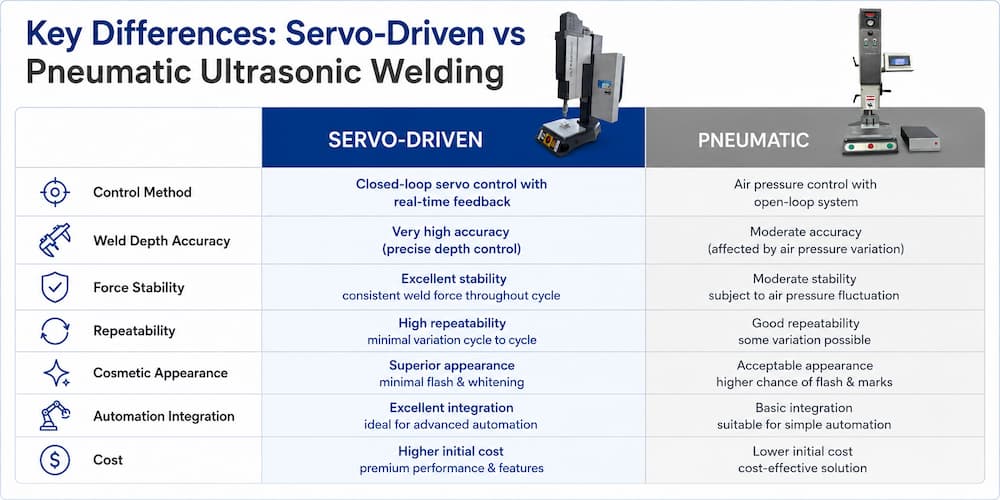
For precision plastic parts, the challenge is not only whether the part can be welded. The real challenge is
whether every part can be welded with the same depth, same pressure, same collapse distance and same
appearance during continuous production.
A servo driven ultrasonic welder controls the welding movement by servo motor instead of compressed air.
This allows more stable control of weld depth, force, speed and position.
For thin-wall parts, electronic components, medical plastic parts and cosmetic assemblies, this control helps reduce:
Part deformation
Whitening
Flash
Over-welding
Inconsistent collapse distance
Surface marks
Scrap caused by air pressure variation
This is why servo ultrasonic welding is often selected for products where repeatability is more important than
the lowest machine cost.
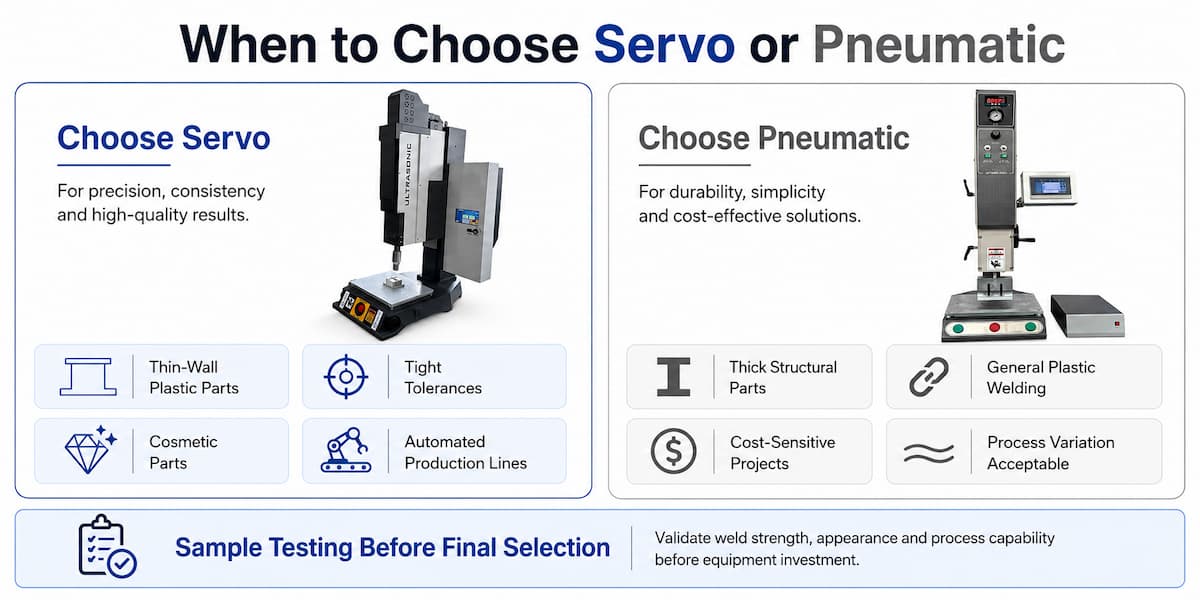
Pneumatic ultrasonic welding may still be suitable if:
Parts are thick and structural
Cosmetic appearance is not critical
Budget is the main concern
Process variation is acceptable
In these cases, pneumatic systems provide a cost-effective and reliable solution.
How Servo-Driven Ultrasonic Welding Improves Production Consistency
A successful sample test does not always mean stable mass production. In real production, welding results
can be affected by material variation, part tolerance changes, fixture positioning, air pressure fluctuation
and operator adjustment.
Servo-driven ultrasonic welding improves production consistency because each welding cycle can follow
a more controlled movement profile. The machine can control weld depth, speed and position more accurately,
reducing variation from part to part.
For high-volume production, this can help reduce over-welding, insufficient welding, part deformation, flash
and inconsistent collapse distance.
Although servo ultrasonic welding usually has a higher initial cost than pneumatic welding, it can provide
better long-term value when the product requires stable quality, lower scrap rate and repeatable production results.
A pneumatic ultrasonic welding machine usually has a lower initial cost. For general plastic welding,
thick parts or products with wide tolerance, pneumatic welding is still a practical and reliable choice.
However, when parts are expensive, tolerances are tight, or the production volume is high, the lowest
equipment price is not always the lowest total cost. Servo ultrasonic welding may reduce long-term
production cost by improving:
Weld repeatability
First-pass yield
Cosmetic consistency
Parameter control
Process traceability
Automation compatibility
Scrap and rework reduction
For manufacturers producing medical parts, automotive connectors, electronic housings or precision
plastic assemblies, servo welding can often provide better long-term value than pneumatic welding.
Choosing between servo-driven and pneumatic ultrasonic welding should not depend only on machine specifications.
The final decision should be based on the actual plastic part, material, weld area, tolerance, appearance requirement
and production volume.
In some projects, both servo and pneumatic ultrasonic welding can weld the sample successfully. However, the real
difference appears during continuous production, especially when stable weld depth, consistent appearance and
repeatable quality are required.
Sample testing can help confirm whether the part is suitable for ultrasonic welding, whether pneumatic welding
is sufficient, or whether servo control is needed for better precision and production stability.
For precision plastic parts, ultrasonic welding sample testing is recommended before final machine selection.
It helps confirm the welding result, horn and fixture design, process parameters and the most suitable machine
type before production investment.
There is no single “best” ultrasonic welding technology — the right choice depends on
your product design,quality requirements, and production goals.
For general plastic welding → Pneumatic ultrasonic welding
For precision, thin-wall, cosmetic or automated applications → Servo driven ultrasonic welding
If you are working with high-precision plastic parts and are unsure whether servo
driven ultrasonic welding is suitable for your application.
Phone: +86-15989541416
E-mail: sales@sztimeast.com
Whatsapp:+86-15989541416
Add: Building 5, Huixin Intelligent Industrial Park,Guangming, Shenzhen,China 518107
We chat