
sales@sztimeast.com
+86-15989541416
Introduction
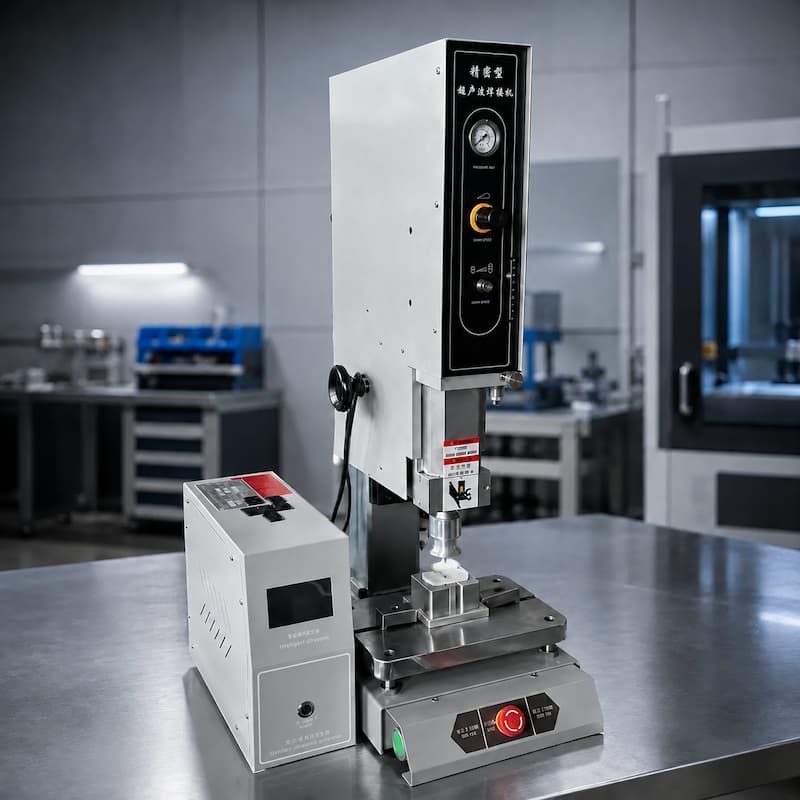
When selecting an ultrasonic welding machine for small plastic components, precision and process stability
are often more important than maximum welding power.A 35kHz ultrasonic welding machine is typically
designed for applications requiring:
Precise energy control
Small welding areas
Reduced risk of plastic deformation
Better control for delicate components
Consistent weld quality for high-value parts
Compared with lower-frequency ultrasonic welding systems, 35kHz machines operate with higher vibration
frequency and lower amplitude, making them suitable for precision plastic assemblies such as electronic
housings, medical components, sensors and small technical parts.
However, choosing the correct ultrasonic welding frequency is not only about the size of the part. Material type,
joint design, welding area, fixture support and production requirements all influence the final welding result.
This guide explains how to select a 35kHz ultrasonic welding machine based on real manufacturing requirements.
Ultrasonic welding works by converting electrical energy into mechanical vibration through the generator,
transducer and horn system.The horn transfers high-frequency vibration into the plastic parts, generating
frictional heat at the joint interface. The plastic melts locally and forms a molecular bond after cooling.
For 35kHz ultrasonic welding systems, the higher frequency provides:
Lower vibration amplitude
More precise energy concentration
Better control for small welding areas
Reduced stress on delicate components
This makes 35kHz systems suitable when part appearance, dimensional accuracy and repeatability are critical.
Frequency selection should match the application rather than simply choosing the highest power machine.
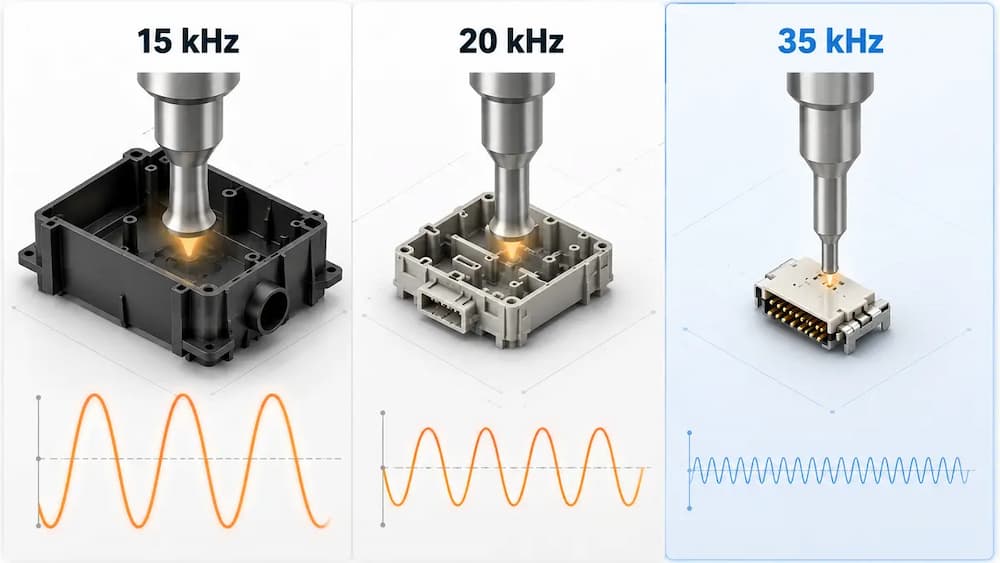
| Frequency | Typical Application |
| 15kHz | Large plastic parts, thick components, high-energy welding |
| 20kHz | General plastic welding applications, medium-size components |
| 35kHz | Precision plastic parts, small components, delicate assemblies |
A common mistake is selecting a higher-power machine for a small precision part. Excessive energy may cause:
Surface marks
Plastic deformation
Flashing
Damage to internal components
For small and sensitive parts, a properly configured 35kHz system often provides better process control.
35kHz ultrasonic welding machines are commonly used for precision plastic components where welding
accuracy and appearance are important.
Typical applications include:
Sensor housings
Connector assemblies
Small electrical enclosures
Plastic covers
These applications are especially common in electronics ultrasonic welding, where small weld areas,
limited deformation and consistent appearance are critical.
These parts usually require:
Accurate positioning
Minimal deformation
Stable weld strength
Many medical plastic parts require clean and repeatable assembly processes.
Typical applications include:
Disposable medical housings
Plastic filter components
Small fluid handling parts
Laboratory plastic assemblies
For medical applications, welding parameters must be carefully controlled because excessive vibration
or energy can damage thin-wall structures.
35kHz ultrasonic welding is also suitable for:
Small technical plastic parts
Clips and brackets
Micro assemblies
Thin-wall components
The final welding result depends heavily on joint design and fixture accuracy.
Power selection is one of the most misunderstood factors when purchasing an ultrasonic welder.
A higher power rating does not always mean better welding performance.
The required power depends on:
Plastic material
Weld area size
Part thickness
Joint design
Required weld strength
Production cycle requirements
Typical reference:
300W–600W
Suitable for:
Small plastic parts
Thin-wall components
Low welding area applications
600W–1200W
Suitable for:
Larger precision components
Stronger weld requirements
More demanding production conditions
The correct approach is to evaluate the actual parts rather than selecting equipment only by wattage.
A reliable precision ultrasonic welding system should include several important functions.
A modern digital generator provides:
Stable output frequency
Automatic frequency tracking
Better welding consistency
Easier parameter adjustment
Plastic materials and welding conditions can affect the resonant frequency.
Automatic frequency tracking helps maintain stable ultrasonic output during operation.
For precision components, the machine should support control methods such as:
Welding time
Energy control
Distance control
Trigger pressure control
These functions help maintain repeatability in mass production.
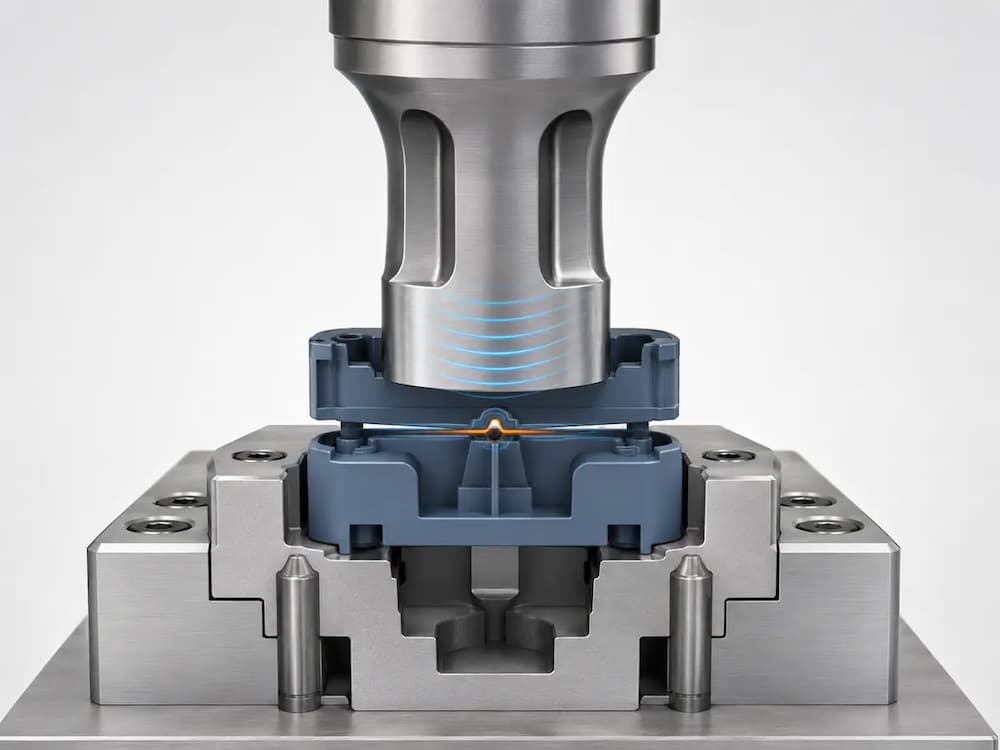
Even with the correct ultrasonic welding machine, poor tooling design can lead to unstable results.
The horn and fixture must be designed according to:
Part geometry
Contact surface
Weld joint location
Material characteristics
A good fixture should:
Hold the part securely
Prevent movement during vibration
Protect cosmetic surfaces
Provide consistent welding alignment
For precision plastic components, fixture design is often as important as machine power.
Even suitable equipment may produce poor results if the process is not correctly optimized.
Common issues include:
Possible causes:
Incorrect welding parameters
Poor joint design
Insufficient energy transfer
Improper horn contact
Possible causes:
Excessive pressure
Poor fixture support
Incorrect horn contact area
Possible causes:
Excessive amplitude
Too much welding energy
Incorrect joint structure
Before changing machine specifications, the welding process should be analyzed systematically.
The correct automation level depends on production volume and consistency requirements.
Suitable for:
Prototype development
Small production quantities
Product testing
Suitable for:
Stable production
Operator-assisted loading
Improved repeatability
Suitable for:
High-volume manufacturing
Multiple assembly steps
Continuous production lines
Automation should be considered after the welding process has been validated.
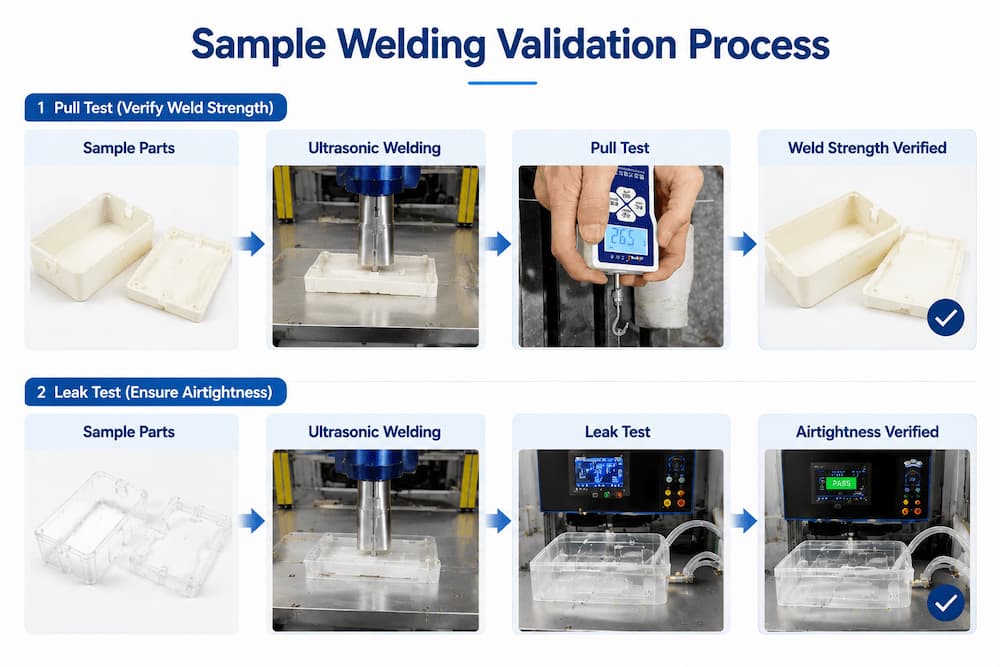
Because every plastic part has different geometry and material characteristics, theoretical calculations
cannot always guarantee welding success.
Before final equipment selection, sample testing is recommended.
During sample welding evaluation, engineers can verify:
Weld feasibility
Required welding parameters
Weld strength
Appearance quality
Suitable horn and fixture design
Typical validation methods include:
Pull test
Destructive strength test
Leak test
Dimensional inspection
Testing actual components helps reduce equipment selection risks before mass production.
Send Your Parts for Ultrasonic Welding Evaluation→
How to Choose the Right 35kHz Ultrasonic Welding Machine?
Before purchasing, consider the following questions:
Common ultrasonic welding plastics include:
ABS
PP
PC
PA
ABS+PC blends
Small welding areas usually require less energy and higher precision control.
For visible surfaces, fixture design and welding control are critical.
The required automation level depends on:
Daily output
Cycle time
Labor requirements
A 35kHz ultrasonic welding machine is an excellent choice for precision plastic welding applications
where accuracy, repeatability and appearance quality are important.
However, selecting the correct machine requires more than choosing frequency or power.
The final welding performance depends on the complete system:
Ultrasonic generator
Transducer
Fixture design
Plastic material
Joint structure
Welding parameters
For new applications, testing actual samples before equipment production is the most reliable way to
confirm the welding solution.
Need Help Selecting a 35kHz Ultrasonic Welding Machine?
Send us your plastic parts, drawings or welding requirements.
Our engineers can help evaluate:
Welding feasibility
Suitable frequency and power
Horn and fixture design
Production automation options
Phone: +86-15989541416
E-mail: sales@sztimeast.com
Whatsapp:+86-15989541416
Add: Building 5, Huixin Intelligent Industrial Park,Guangming, Shenzhen,China 518107
We chat