
sales@sztimeast.com
+86-15989541416
In the automotive filtration industry, product quality, durability, and production
stability are critical.Automotive filters must withstand high temperatures, vibration,
pressure changes, and long service cycles. As a result, manufacturers are increasingly
replacing traditional bonding methods with ultrasonic welding
in automated production lines.
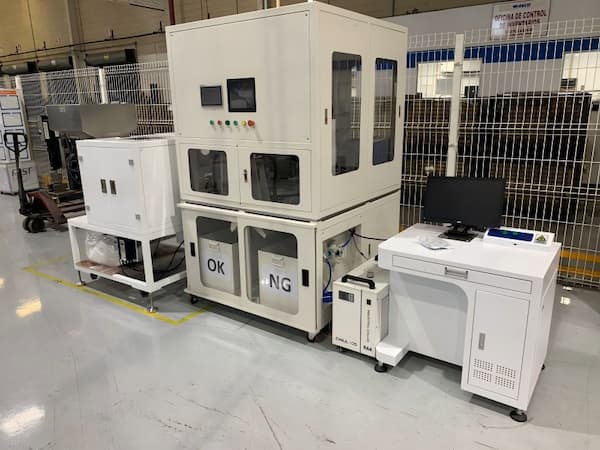
This article explains how ultrasonic welding is used in automotive filter manufacturing,
particularly forfilter end caps and nonwoven sealing materials, and why it has become
a preferred technology for high-volume automotive production.
Automotive filters play a key role in protecting engines and systems from contamination.
Poor sealing or weak bonding can lead to:
Air or fluid leakage
Reduced filtration efficiency
Premature filter failure
Warranty and recall risks
For this reason, automotive manufacturers require consistent, repeatable, and
contamination-free joining processes.
Ultrasonic welding is a solid-state joining process that uses high-frequency
mechanical vibration to generate localized heat at the joint interface.
Key characteristics:
No adhesives or solvents required
Minimal thermal impact on surrounding materials
Fast cycle times suitable for automation
Highly repeatable weld quality
These features make ultrasonic welding especially suitable for plastic components
and composite materials used in automotive filters.
Common Materials
Automotive filter end caps are typically made from thermoplastics such as:
PP (Polypropylene)
PA (Nylon)
ABS or modified plastic compounds
Nonwoven sealing cotton or fiber materials are often used to ensure airtight sealing.
Ultrasonic welding allows these materials to be bonded cleanly and securely, without
introducing foreign substances.
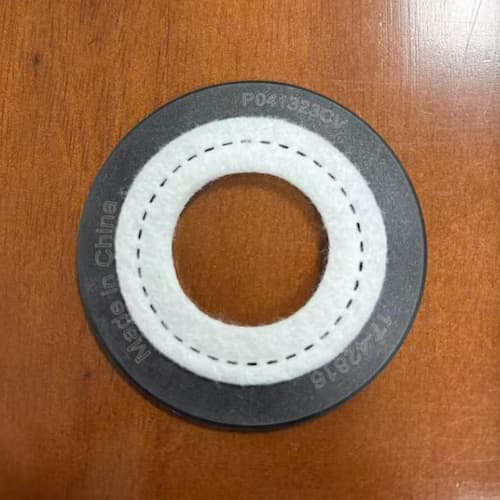
One of the challenges in filter manufacturing is joining plastic end caps with
nonwoven sealing materials.Ultrasonic welding offers several advantages:
Strong mechanical bonding without glue
Clean joints without curing time
Consistent sealing performance
Reduced material contamination risk
When welding parameters are properly optimized, the process delivers stable
results suitable for long-term automotive use.
Modern automotive filter production requires more than just a welding process.
Manufacturers increasingly demand fully automated production lines to ensure
consistency and efficiency.
A typical ultrasonic welding automation line for automotive filters includes:
Automatic loading of components
Precision ultrasonic welding
In-line inspection or quality monitoring
Automatic unloading of finished parts
Automation reduces labor dependency, minimizes human error, and ensures
stable cycle times for mass production.
Automotive brands and Tier suppliers prefer ultrasonic welding automation
because it provides:
High repeatability for large production volumes
Stable weld quality meeting automotive standards
Clean and environmentally friendly process
Easy integration with inspection and traceability systems
Long-term production reliability
For well-established automotive brands, these factors are essential when selecting
production equipment.
Unlike standard machines, ultrasonic welding systems used in automotive filter
production are usually custom-engineered.Key customization areas include:
Fixture and tooling design for specific filter geometry
Welding parameter optimization for material combinations
Automation sequence based on production workflow
Inspection methods aligned with quality requirements
This is why automotive manufacturers typically work with automation suppliers
who can deliver customer-specific solutions, rather than off-the-shelf equipment.
Ultrasonic welding has become a proven and widely adopted technology in
automotive filter manufacturing, especially for joining filter end caps and
nonwoven sealing materials.When combined with custom automation,
ultrasonic welding enables manufacturers to achieve:
Consistent product quality
High production efficiency
Reduced operational risk
Long-term process stability
As automotive standards continue to rise, ultrasonic welding automation
will remain a key technology in filtration production lines.
If you are developing or upgrading an automotive filter production line,
a customized ultrasonic weldingautomation system may be the right solution.
Phone: +86-15989541416
E-mail: sales@sztimeast.com
Whatsapp:+86-15989541416
Add: Building 5, Huixin Intelligent Industrial Park,Guangming, Shenzhen,China 518107
We chat