
sales@sztimeast.com
+86-15989541416
In ultrasonic plastic welding, a joint that looks good isn’t always a joint that seals well.
Many production teams experience the same frustrating scenario: the weld line appears
uniform, pull strength meets spec, and the cycle time is stable—but the part fails the
leak test(pressure decay,bubble test, or helium leak detection).Leak failures rarely
come from a single factor.
In most cases, they are the result of combined effects from part design, material
behavior, process settings, tooling/fixturing, and even the test method itself.
This article provides a practical, engineering-focused breakdown of thenmost
common causes and the most effective solutions—plus a step-by-step troubleshooting
roadmap you can use on the factory floor.
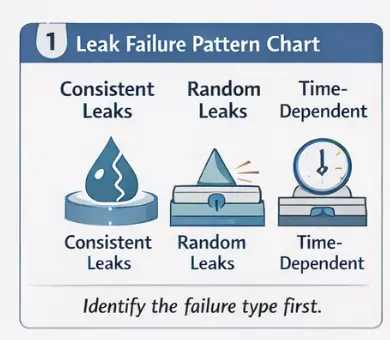
Before changing parameters, classify the failure. Different failure patterns usually point
to different root causes:
A. Consistent leak failure (almost every part fails)
Typical cause: insufficient melt or incomplete fusion, often driven by joint design,
horn contact, or low energy transfer.
B. Random leak failure (some pass, some fail)
Typical cause: variation—part fit-up, fixture repeatability, dimensional tolerance
stack-up, or inconsistent clamping.
C. Time-dependent leak failure (passes now, fails later)
Typical cause: residual stress, micro-cracks, creep relaxation, or seal deformation
after cooling/aging.
Why this matters:
If you don’t know which pattern you’re dealing with, you’ll chase symptoms with
parameter weaks and never stabilize the process.
If you are still not sure whether the issue comes from the weld, the test fixture, or the leak test settings,
this FAQ guide on common leak testing problems after ultrasonic welding can help you compare
typical symptoms before making process changes.
2) Root Cause Category #1 — Joint Design Issues (Most Common)
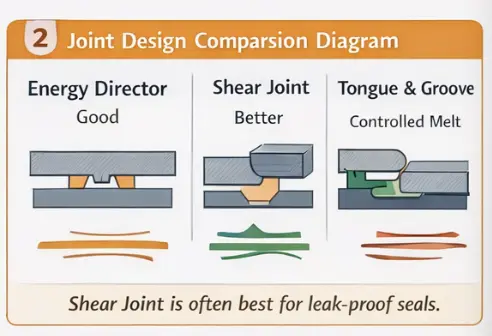
Even with a perfect machine, the joint must be designed to create controlled
melt flow and form a continuous sealing ring.
Common design-related leak causes include:
Cause 1: Energy director too small / discontinuous
If the energy director is undersized or interrupted, the joint may “stick” in spots
but never build a continuous hermetic seal.
✅ Solutions
Increase energy director height and angle (within material limits)
Ensure a continuous sealing path (avoid breaks in the perimeter)
Use a shear joint for demanding leak requirements (better melt containment)
Cause 2: No controlled melt containment (flash becomes a leak path)
If molten plastic is forced outward or inward unpredictably, it can form voids, channels,
or inconsistent collapse—leading to leaks.
✅ Solutions
Add a flash trap / overflow groove
Use tongue-and-groove features to control flow
Balance wall thickness to prevent differential melt
Cause 3: Weld line too close to ribs, bosses, or snap features
Nearby structures can pull heat away, deform during welding, or cause local stress
concentration.
✅ Solutions
Increase distance between seal line and structural features
Add local stiffening under the joint to reduce flex
Redesign ribs to avoid “hinge” movement
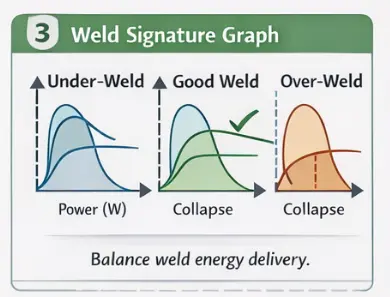
When leak failures occur, many teams raise weld time and pressure first. That often
makes things worse—by creating stress cracks, marking, or flash. Instead, focus on
how energy is delivered.
Cause 4: Under-weld (insufficient melt / incomplete fusion)
Parts may look fused, but micro gaps remain.
✅ Solutions
Increase amplitude (more effective than time alone)
Switch to energy mode or collapse distance mode for repeatability
Add hold time to stabilize the seal while cooling
Check stack tuning and horn-face contact
Cause 5: Over-weld (excessive melt → voids and seal collapse)
Too much energy can squeeze out molten material, trap bubbles, or create weld-line thinning.
✅ Solutions
Reduce amplitude, especially on thin walls
Use collapse distance limits to prevent over-collapse
Reduce pressure if it is forcing melt out too aggressively
Optimize trigger force to ensure consistent start
Cause 6: Inconsistent collapse (random leak failures)
If your collapse varies part-to-part, your seal continuity will vary too.
✅ Solutions
Use collapse distance control with strict limits
Improve fixture rigidity and part seating
Monitor peak power and collapse signatures for drift
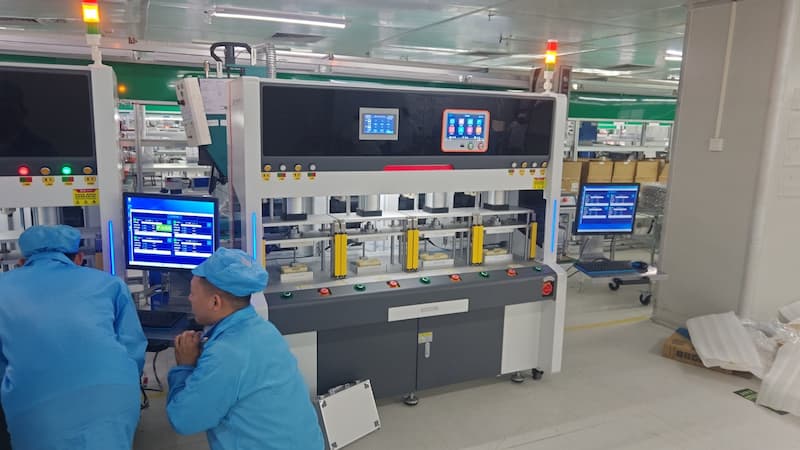
Fixturing issues cause more random leak failures than most teams realize.
Cause 7: Part rocking or incomplete seating
If the part tilts slightly, the horn may weld one side more than the other, leaving micro gaps.
✅ Solutions
Add locating features that constrain all axes
Increase fixture support directly under the seal line
Use vacuum or nest inserts to prevent tilt
Cause 8: Horn misalignment or uneven contact pressure
Even slight angular misalignment can create uneven energy distribution.
✅ Solutions
Verify horn parallelism and face flatness
Use carbon paper or pressure-sensitive film to check contact uniformity
Ensure horn/fixture rigidity; eliminate flex under load
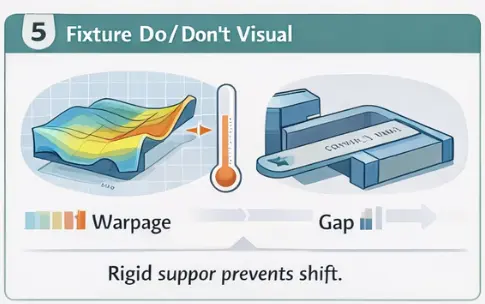
Sometimes the welding process is fine—the parts are not.
Cause 9: Moisture, contamination, mold release residue
Moisture can cause bubbling; mold release can prevent wetting and fusion.
✅ Solutions
Dry hygroscopic materials (PA, PC, PET, etc.) to spec
Ban mold release on sealing surfaces (or strictly control type and application)
Improve handling to avoid oil/dust contamination
Cause 10: Warpage / shrink variation → poor fit-up
Leak tests fail when the joint line has gaps before welding.
✅ Solutions
Improve molding process control (pack/hold, cooling balance)
Add design features for self-alignment
Tighten tolerances around seal line
Measure pre-weld gap using gauges or 3D scans

6) Root Cause Category #5 — Leak Test Method Errors (Yes, the Test Can Lie)
Leak test failures sometimes come from the test, not the weld.
Before adjusting the welding process, make sure the test pressure, stabilization time, sealing fixture, and PASS/FAIL criteria
are correctly defined. You can also review our guide on how to perform leak testing after ultrasonic welding to confirm
the basic test setup.
Cause 11: Wrong test pressure / stabilization time
Pressure decay tests can fail if the part expands, temperature changes, or the stabilization
time is too short.
✅ Solutions
Add stabilization time before measurement
Control test temperature (plastic expands with heat)
Set pressure based on part stiffness and design
Calibrate decay thresholds against known-good samples
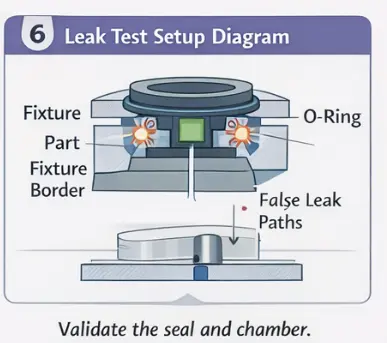
Cause 12: Fixture sealing leaks during test
If the test fixture O-ring leaks or seats inconsistently, good parts may fail.
✅ Solutions
Validate the fixture with a solid reference plug
Replace O-rings on schedule
Use consistent clamp force and alignment for testing
Here’s a fast, systematic approach that avoids guesswork:
Step 1: Confirm the failure pattern
Consistent / Random / Time-dependent?
Step 2: Locate the leak path
Bubble test to identify location
Helium sniffing for precision
Dye penetration (where applicable)
Step 3: Compare weld signatures
Look at:
peak power
energy
collapse distance
cycle time
hold phase stability
A good process leaves a consistent “fingerprint.”
Step 4: Validate fixture rigidity and alignment
If random failures exist, suspect the nest.
Step 5: Adjust the right knob
Under-weld → increase amplitude or energy
Over-weld → cap collapse distance, reduce amplitude
Random leaks → fix seating + alignment, then tune

Ultrasonic leak failures are almost never solved by “just increasing weld time.”
The most reliable approach is to treat the seal as a system:
Design for controlled melt flow
Deliver energy consistently
Clamp and locate parts rigidly
Control material and molding variation
Validate the leak test fixture and method
When these five pillars are aligned, leak performance becomes repeatable—
high yield, stable process, and fewer surprises.
Recommended Machine →
Phone: +86-15989541416
E-mail: sales@sztimeast.com
Whatsapp:+86-15989541416
Add: Building 5, Huixin Intelligent Industrial Park,Guangming, Shenzhen,China 518107
We chat