
sales@sztimeast.com
+86-15989541416
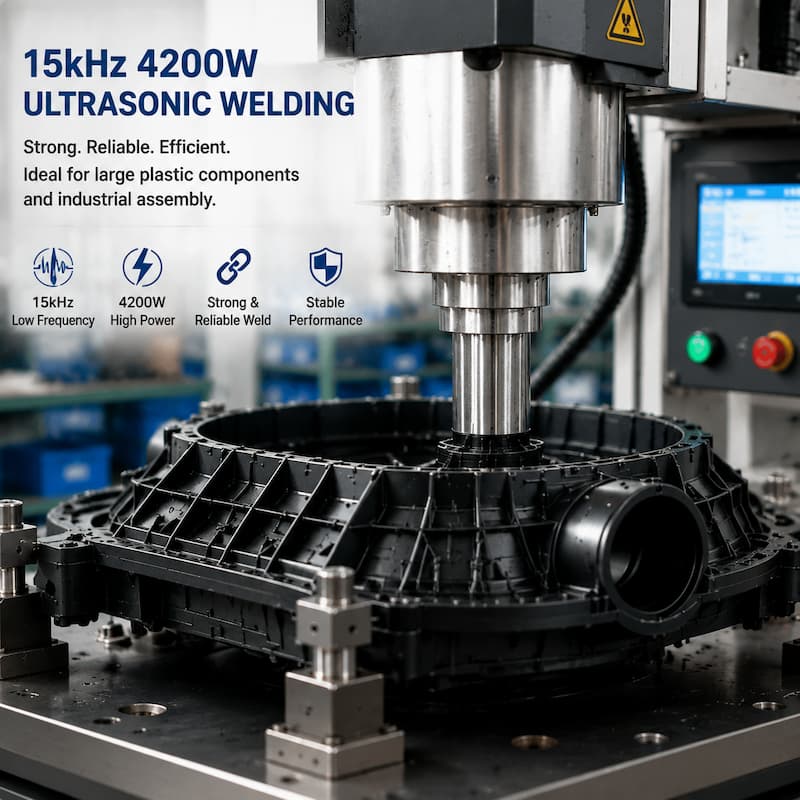
Ultrasonic welding is widely used for joining thermoplastic components in automotive, medical,
electronics and industrial applications. Among different ultrasonic welding frequencies, 15kHz
systems are commonly selected for large plastic parts and applications requiring higher welding
strength.
With higher amplitude and stronger energy transmission compared with higher-frequency ultrasonic
systems, 15kHz ultrasonic welding technology provides reliable bonding performance for thick-wall
components, structural parts and demanding industrial assemblies.
TIMEAST develops customized ultrasonic welding solutions based on product design, material
characteristics and production requirements, including welding parameter optimization, horn design
and fixture development.
Large plastic components usually require deeper energy penetration and stronger vibration amplitude
to achieve stable welding results.
15kHz ultrasonic welding systems provide higher mechanical amplitude, making them suitable for
applications where conventional higher-frequency equipment may not provide sufficient welding force.
Typical applications include:
Large plastic housings
Automotive plastic components
Filter assemblies
Industrial containers
Structural plastic parts
Material thickness and component structure directly affect ultrasonic welding results.
15kHz ultrasonic welding is often preferred for:
Thick thermoplastic components
Reinforced plastic parts
Large welding surfaces
High-strength assembly requirements
Proper horn design, fixture support and parameter adjustment are essential to achieve consistent welding quality.
Industrial manufacturers require more than welding power. Stable production also depends on:
Repeatable welding parameters
Accurate component positioning
Customized tooling
Process optimization
TIMEAST provides complete ultrasonic welding solutions from welding testing to customized machine development.
Different ultrasonic frequencies have different application advantages.
| Requirement | Recommended Frequency |
| Large plastic components | 15kHz |
Thick-wall plastic parts | 15kHz |
| High welding strength requirements | 15kHz |
| Small precision components | 20kHz |
| Compact electronic parts | 20kHz |
Generally, lower-frequency ultrasonic welding provides higher amplitude and stronger welding capability,
while higher-frequency systems are more suitable for smaller and more precise components.
The final selection depends on:
Product size
Plastic material
Welding area
Required strength
Production requirements
Key Factors Affecting Ultrasonic Welding Quality
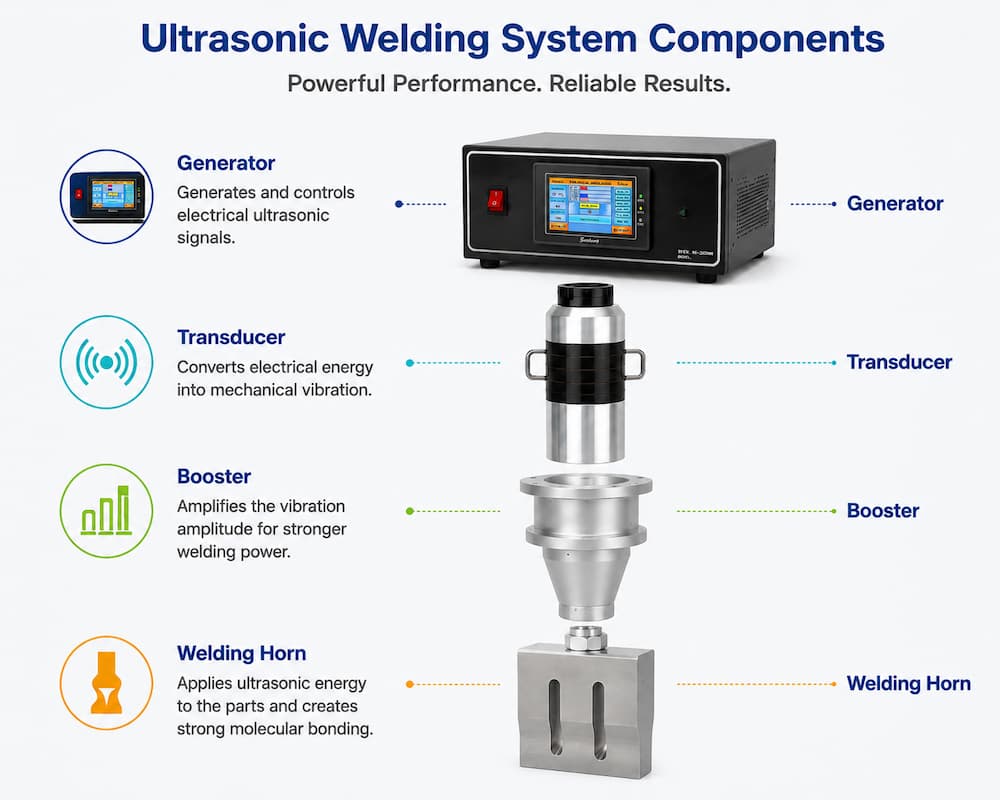
Even with high-power ultrasonic equipment, welding performance depends on several factors:
Different thermoplastics have different ultrasonic welding characteristics. Material type, additives
and component design influence weldability.
Customized ultrasonic horns and fixtures ensure proper energy transfer and accurate positioning during welding.
Parameters such as:
Welding time
Trigger pressure
Amplitude
Energy level
need to be optimized according to the specific product.
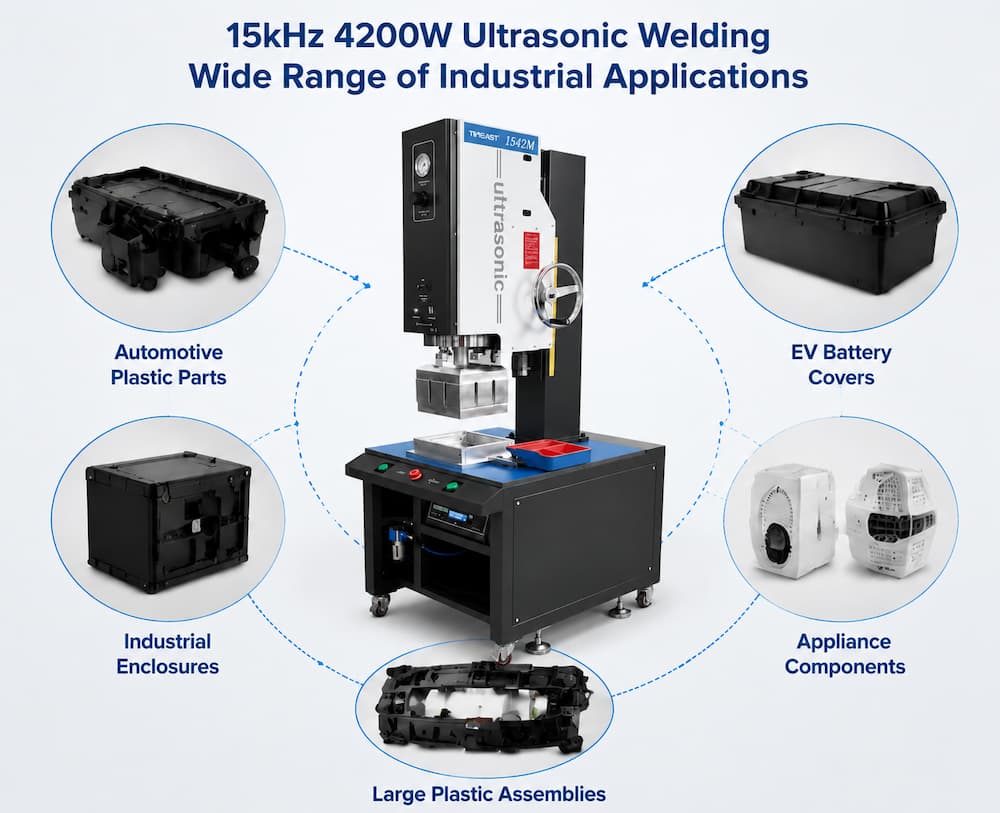
15kHz ultrasonic welding is widely used for applications requiring high welding strength
and stable production performance, including automotive components, filtration products
and customized industrial assemblies.
For example, ultrasonic welding is commonly applied in automotive plastic components
and filter assemblies, where consistent weld quality and precise positioning are required.
For higher-volume production, ultrasonic welding technology can also be integrated into
automated manufacturing systems, such as automatic loading and unloading ultrasonic
welding lines, to improve production efficiency and process stability.
A: 15kHz ultrasonic welding provides higher amplitude and stronger energy transmission,
making it suitable for large components requiring strong and stable weld joints.
A: Neither frequency is universally better. 15kHz is generally preferred for larger parts and
higher welding force requirements, while 20kHz is commonly used for smaller precision components.
A: Yes. Welding parameters, ultrasonic horn design and fixtures can be customized according to
product structure, material and production requirements.
Different plastic components require different ultrasonic frequencies, horn designs and welding parameters.
TIMEAST engineers evaluate each application based on:
Material characteristics
Component structure
Required welding strength
Production requirements
Our previous projects include automated ultrasonic welding lines, filter component assembly systems
and customized ultrasonic welding applications.
Phone: +86-15989541416
E-mail: sales@sztimeast.com
Whatsapp:+86-15989541416
Add: Building 5, Huixin Intelligent Industrial Park,Guangming, Shenzhen,China 518107
We chat