
sales@sztimeast.com
+86-15989541416
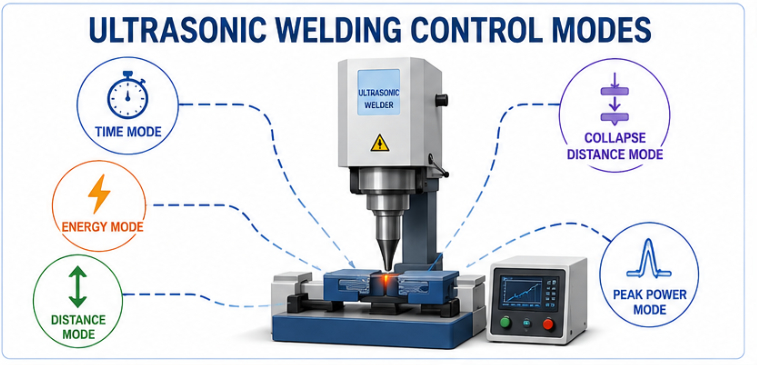
Ultrasonic welding is one of the most widely used plastic joining technologies in industries
such as automotive, medical devices, electronics, packaging, and household appliances.
While welding frequency, horn design, fixture quality, and material selection are important factors,
the welding control mode often plays an equally critical role in determining final weld quality.
Different plastic parts require different control strategies. A control mode that works perfectly
for a simple consumer product may not be suitable for a precision medical component or an
automotive safety part.
This article explains the most common ultrasonic welding control modes, their advantages and
limitations, and how to choose the right mode for your application.
During the ultrasonic welding process, high-frequency mechanical vibrations generate heat at the interface
between two plastic parts. The molten material then solidifies under pressure to form a permanent bond.
The question is:
How does the machine know when to stop welding?
The answer depends on the selected control mode.
Different control modes use different criteria to determine the end of the welding cycle, such as:
Welding time
Energy input
Material collapse distance
Peak power level
Absolute position
Choosing the correct control mode can significantly improve weld consistency, strength,
and appearance, especially when combined with proper ultrasonic welding joint design.
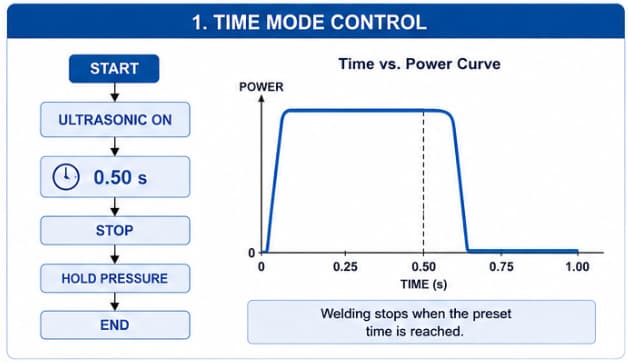
Time mode is the simplest and most commonly used ultrasonic welding control method.
In this mode, the machine welds for a predetermined amount of time and then automatically stops.
For example:
0.30 seconds
0.50 seconds
0.80 seconds
Once the preset welding time is reached, ultrasonic vibration stops regardless of the actual energy
consumed or material displacement.
Easy to set up
Low controller requirements
Fast production implementation
Suitable for many standard applications
Cost-effective solution
Time mode assumes that every cycle behaves exactly the same.
However, production environments often experience variations in:
Material batches
Molded part dimensions
Ambient temperature
Fixture wear
Machine conditions
These variations can influence weld quality even when welding time remains unchanged.
Time mode is commonly used for:
Consumer products
Packaging components
Household appliance parts
General-purpose plastic assemblies
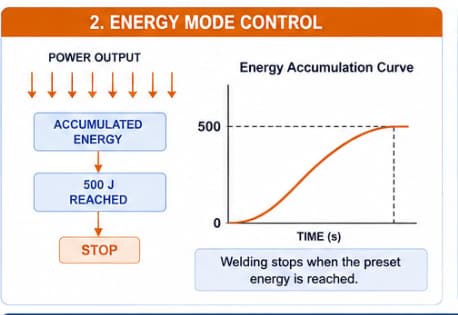
Energy mode controls the welding process based on the total amount of energy delivered to the part.
Instead of stopping after a fixed time, the machine continuously measures energy consumption.
For example:
500 Joules
800 Joules
1200 Joules
When the preset energy value is reached, welding automatically stops.
Because energy is directly related to heat generation, this mode can compensate for certain process variations.
Benefits include:
Better weld consistency
Improved process stability
Reduced sensitivity to material variation
More repeatable weld strength
Energy mode requires more advanced control systems and proper parameter optimization.
If the energy target is set incorrectly, excessive melting or insufficient bonding may occur.
Energy mode is widely used for:
Automotive components
Electronic housings
Sensor assemblies
Industrial plastic products
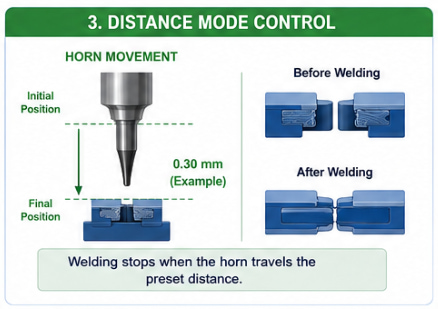
Distance mode controls the welding process according to the movement of the
The machine continuously measures vertical displacement during welding.
When the horn reaches a predefined distance, welding stops automatically.
Typical settings include:
0.10 mm
0.20 mm
0.35 mm
0.50 mm
Distance mode focuses on actual material collapse rather than welding time.
This control strategy provides excellent dimensional consistency.
Benefits include:
Highly repeatable results
Excellent weld appearance
Reduced flash formation
Better dimensional control
Superior process monitoring
Distance mode requires:
Precision sensors
Stable fixtures
Accurate machine calibration
Initial setup is typically more complex than time mode.
Distance mode is often used in:
Medical devices
Precision electronic components
Automotive safety parts
High-tolerance assemblies
Collapse distance mode is a specialized version of distance control.
Instead of measuring absolute horn position, it measures how much material collapses during welding.
For example:
0.15 mm collapse
0.25 mm collapse
0.40 mm collapse
The machine stops once the target collapse value is reached.
Collapse distance mode directly monitors the joining process.
Benefits include:
Excellent weld repeatability
Better compensation for molded-part variations
Improved strength consistency
Commonly used for:
Precision plastic assemblies
Medical products
Automotive connectors
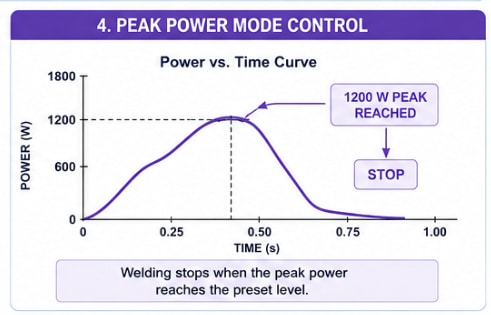
Peak power mode monitors the maximum power consumed during welding.
The machine stops when a predefined power level is reached.
Examples:
800 W
1200 W
1800 W
Peak power can indicate important process events such as:
Material softening
Joint collapse
Part engagement
Power consumption can fluctuate significantly.
As a result, peak power mode is usually used as a secondary monitoring parameter rather than
the primary welding control method.
Process development
Weld analysis
Special validation procedures
Absolute distance mode measures horn movement relative to a fixed reference position.
Unlike collapse distance mode, it does not focus on material deformation but on the final horn position.
Excellent dimensional accuracy
Tight assembly tolerances
Precise product height control
Used for:
Medical components
Battery-related plastic parts
Electronic connectors
Precision assemblies
| Control Mode | Process Stability | Dimensional Accuracy | Ease of Setup | Typical Cost |
| Time Mode | Medium | Low | Easy | Low |
| Energy Mode | High | Medium | Medium | Medium |
| Distance Mode | Very High | High | Medium | Medium-High |
| Collapse Distance | Very High | High | Medium | Medium-High |
| Peak Power Mode | Medium | Medium | Medium | Medium |
| Absolute Distance | Very High | Very High | Advanced | High |
How to Choose the Right Control Mode
Selecting the best control mode depends on several factors.
For products requiring precise dimensions:
Distance Mode
Absolute Distance Mode
are usually preferred.
For structural components requiring consistent weld strength:
Energy Mode
Collapse Distance Mode
often provide better results.
For high-volume manufacturing:
Energy Mode
Distance Mode
typically offer better long-term process stability.
For standard products with moderate quality requirements:
Time Mode
may provide the most economical solution.
Typical applications include:
Instrument panel components
Air duct assemblies
Battery housings
Sensor enclosures
Most manufacturers prefer:
Energy Mode
Distance Mode
for improved consistency.
Medical products often require strict process validation.
Common control modes include:
Distance Mode
Absolute Distance Mode
to ensure repeatable dimensions and weld integrity.
Electronic products frequently contain delicate internal components.
Preferred modes include:
Energy Mode
Distance Mode
to reduce overheating and improve weld quality.
Before selecting a welding control mode, sample testing should always be performed.
Testing helps determine:
Suitable welding parameters
Optimal control strategy
Weld strength performance
Cycle time
Production consistency
A control mode that works well for one plastic component may not be ideal for another, even when
the materials appear similar, particularly in near-field and far-field ultrasonic welding applications.
Professional sample testing minimizes production risks and helps achieve stable manufacturing results.
Modern ultrasonic welding systems increasingly combine multiple control methods.
For example:
Energy + Distance Control
Time + Energy Monitoring
Distance + Peak Power Verification
These hybrid strategies provide better process monitoring and support Industry 4.0 manufacturing requirements.
Advanced welding controllers can also collect production data for quality traceability and predictive maintenance.
Ultrasonic welding control modes have a direct impact on weld quality, dimensional consistency, and
production efficiency.
While time mode remains a practical choice for many applications, advanced modes such as energy control,
distance control, and collapse distance control offer significant advantages for demanding manufacturing
environments.
The best control mode depends on material properties, joint design, dimensional requirements, production
volume, and quality objectives. Through proper sample testing and process optimization, manufacturers can
achieve reliable weld quality and maximize the performance of their ultrasonic welding systems.
Phone: +86-15989541416
E-mail: sales@sztimeast.com
Whatsapp:+86-15989541416
Add: Building 5, Huixin Intelligent Industrial Park,Guangming, Shenzhen,China 518107
We chat