
sales@sztimeast.com
+86-15989541416
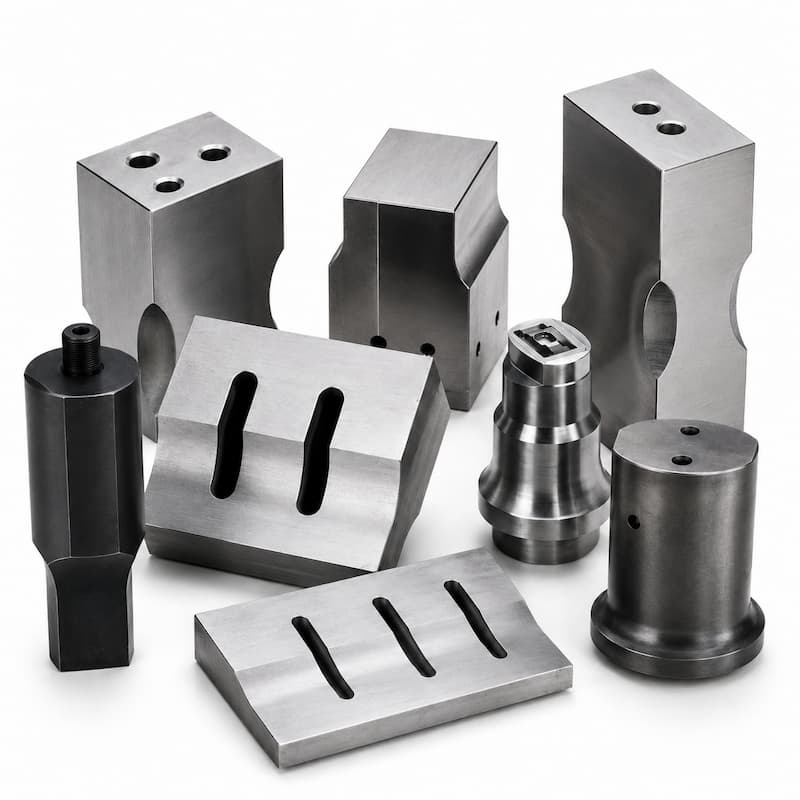
The material used to manufacture an ultrasonic horn affects vibration transfer, working amplitude,
fatigue life, surface wear, tooling weight, machining cost, and long-term welding stability.
Titanium, aluminum, and hardened steel are the most common ultrasonic horn materials for
plastic welding. However, no single material is suitable for every application.
Titanium is usually selected for high-amplitude and high-volume production. Aluminum is often
used for large horns, prototypes, and complex machining. Steel is preferred when surface hardness
and wear resistance are more important than horn weight or high-amplitude fatigue life.
The correct choice should be based on the horn size, ultrasonic frequency, required amplitude,
plastic material, production volume, contact pressure, and expected surface wear.
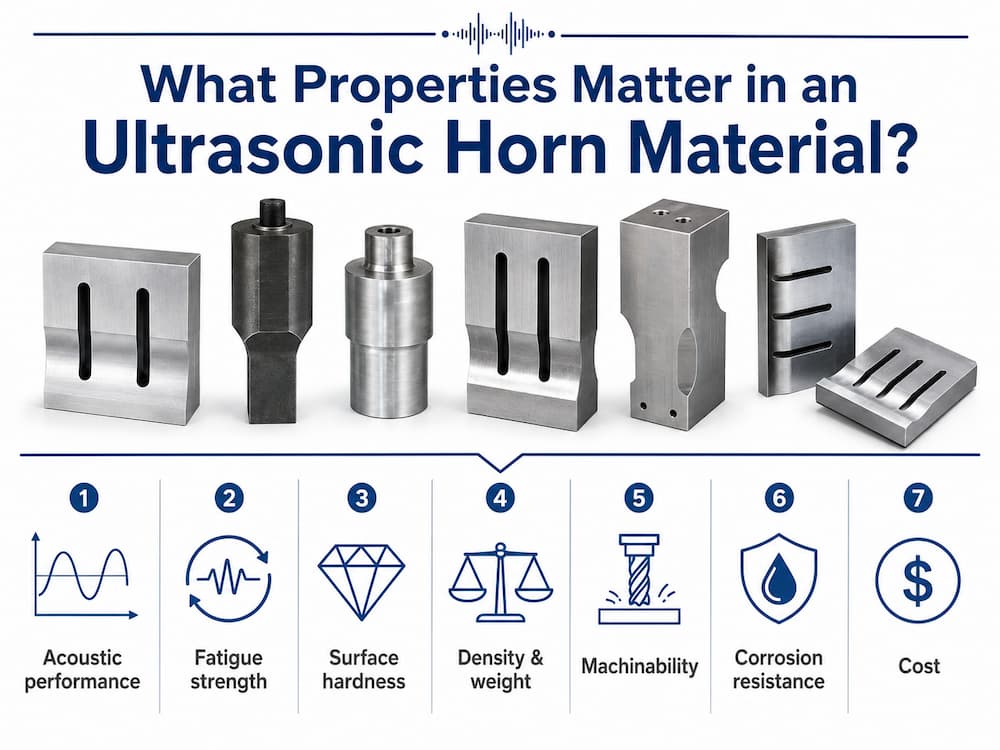
An ultrasonic horn is not only a metal tool that contacts the plastic part. It is a tuned acoustic
component that repeatedly expands and contracts at the operating frequency.
The horn material must therefore provide suitable acoustic and mechanical properties.
A horn must transfer ultrasonic vibration from the booster to the plastic part with minimum internal energy loss.
Materials with good acoustic performance transmit vibration efficiently and generate less unwanted internal heating.
Titanium and aluminum normally provide better acoustic transmission than steel, especially in applications
requiring higher amplitude.
However, material alone does not determine acoustic performance. Horn length, gain ratio, slot position,
contact area, and stress distribution are equally important parts of ultrasonic horn design and can directly
affect amplitude uniformity, operating temperature, and horn service life.
During production, the horn is exposed to thousands or millions of ultrasonic vibration cycles.
Each cycle creates alternating tensile and compressive stress inside the material. If the stress
exceeds the material’s fatigue capability, cracks may develop around threaded connections,
slots, corners, or other high-stress areas.
Fatigue resistance is particularly important for:
continuous production
high-amplitude welding
narrow or complex horn structures
high-gain horn designs
applications with short cycle times
Titanium normally provides the strongest fatigue performance among the three common materials.
The horn face repeatedly contacts the plastic component. Surface wear becomes more serious when
welding glass-fiber-reinforced plastics, mineral-filled plastics, rough molded surfaces, parts containing
metal inserts, or components requiring sharp contact features.
The resin type and filler content should therefore be confirmed before the horn material is selected.
Plastics such as ABS, PP, PC, PA, and glass-filled nylon behave differently during ultrasonic welding,
as explained in our overview of plastics suitable for ultrasonic welding.
Steel provides the highest natural wear resistance after suitable heat treatment. Titanium has moderate
wear resistance, while untreated aluminum can wear relatively quickly.
Horn weight affects the complete ultrasonic stack, including the converter, booster, mounting system,
and actuator.Aluminum is the lightest of the three materials and is therefore suitable for large bar horns
or wide welding areas.Titanium is heavier than aluminum but much lighter than steel. Steel horns can
become impractical when the horn dimensions are large because the additional mass may affect tuning,
machine loading, and amplitude distribution.
Complex horn surfaces may require deep cavities, narrow slots, multiple welding points, curved profiles,
or three-dimensional contours.
Aluminum is easier and faster to machine, making it suitable for prototypes, product development, and
large complex horns.
Titanium requires more controlled machining and usually has a higher manufacturing cost. Hardened steel
may require rough machining, heat treatment, finish machining, and final tuning.
Corrosion resistance may be important for medical products, filters, food-related components, clean
production environments, or applications requiring regular equipment cleaning.
Titanium provides excellent corrosion resistance. Aluminum can perform well with suitable surface
treatment.Steel corrosion resistance depends on the selected grade and protective finish.
The lowest material price does not always produce the lowest total tooling cost.
The complete cost should include:
raw material
machining time
heat treatment
surface coating
frequency tuning
expected service life
maintenance requirements
production losses caused by tool replacement
For high-volume production, a more expensive titanium horn may be more economical if it reduces
downtime and replacement frequency.
Titanium is commonly used for demanding ultrasonic plastic welding applications that require high
amplitude, strong fatigue resistance, and stable long-term performance.
It offers a favorable combination of acoustic efficiency, mechanical strength, corrosion resistance,
and relatively low weight.
Typical titanium horn applications include:
high-volume plastic welding
continuous automated production
high-amplitude welding
medical and precision components
electronic assemblies
filter and fluid-handling products
applications requiring stable weld consistency
Titanium is especially valuable when horn fatigue life is critical. It can withstand repeated ultrasonic
stress better than aluminum or steel in many high-amplitude applications.
Its strength-to-weight ratio also allows engineers to produce relatively compact horns without creating
the excessive mass associated with steel.
However, titanium has a higher raw material and machining cost. Very large titanium blocks may also
be expensive or difficult to source.
Titanium is not completely resistant to surface wear. Glass-filled plastics, mineral-filled resins, metal
inserts, and rough contact surfaces can gradually damage the horn face.
For abrasive applications, possible solutions include:
wear-resistant surface treatment
carbide coating
hardened contact inserts
replaceable steel tips
modified contact geometry
A titanium horn is usually the preferred choice when the application involves high amplitude, long
operating hours, high production volume, or strict process consistency.
Aluminum is widely used because it provides good acoustic performance, low weight, easy machining,
and relatively low manufacturing cost.
It is often the most practical material for:
prototype horns
sample testing
product development
low- or medium-volume production
large bar horns
wide welding areas
complex machined contours
applications with limited surface wear
Because aluminum is easier to machine, the horn face can be modified quickly when the plastic part design
changes during sample testing.
This makes aluminum especially useful during early project stages when the welding joint, horn contact
surface, or part positioning has not yet been finalized.
Its low density is another important advantage. A large aluminum horn can remain manageable in weight,
reducing the mechanical load on the ultrasonic stack.
The main limitation is surface hardness. Untreated aluminum may wear, deform, or leave marks after
repeated contact with abrasive plastics.
Aluminum also normally has lower fatigue resistance than titanium. It should therefore be used carefully
in high-amplitude or continuous-production applications.
Depending on the application, aluminum horns may use:
hard chrome plating
nickel-based surface treatment
carbide coating
hardened replaceable inserts
removable contact tips
Surface treatment can improve wear resistance, but it does not eliminate the need for correct horn design.
Coating thickness, contact pressure, adhesion, tuning allowance, and future repair requirements must all
be considered.
Aluminum is usually the best choice when tooling cost, machining speed, horn size, or development
flexibility is more important than maximum service life.
Hardened tool steel is selected primarily for surface hardness and wear resistance.
It is particularly useful when the working face must resist abrasion, indentation, concentrated pressure,
or repeated contact with metal components.
Common steel horn applications include:
ultrasonic insertion
ultrasonic staking
ultrasonic riveting
plunge cutting
glass-filled plastics
mineral-filled plastics
contact with metal inserts
narrow working tips
sharp or knurled contact features
After heat treatment, steel can maintain sharp edges and detailed working surfaces better than untreated
aluminum.
This makes it suitable for processes where the horn must deform plastic around an insert, form a rivet head,
cut material, or apply high local pressure through a small contact area.
The main disadvantages are weight, acoustic loss, and fatigue risk at high amplitude.
Steel is substantially heavier than titanium or aluminum. A large steel horn may create excessive mass and
increase the mechanical load on the converter, booster, and actuator.
Steel also normally provides a lower fatigue margin in high-amplitude ultrasonic welding. It is therefore
more commonly used for lower-amplitude insertion, staking, riveting, and cutting processes than for large
high-gain welding horns.
In many applications, a full steel horn is unnecessary. A titanium or aluminum horn body can be combined
with replaceable hardened steel tips in the areas exposed to concentrated wear.
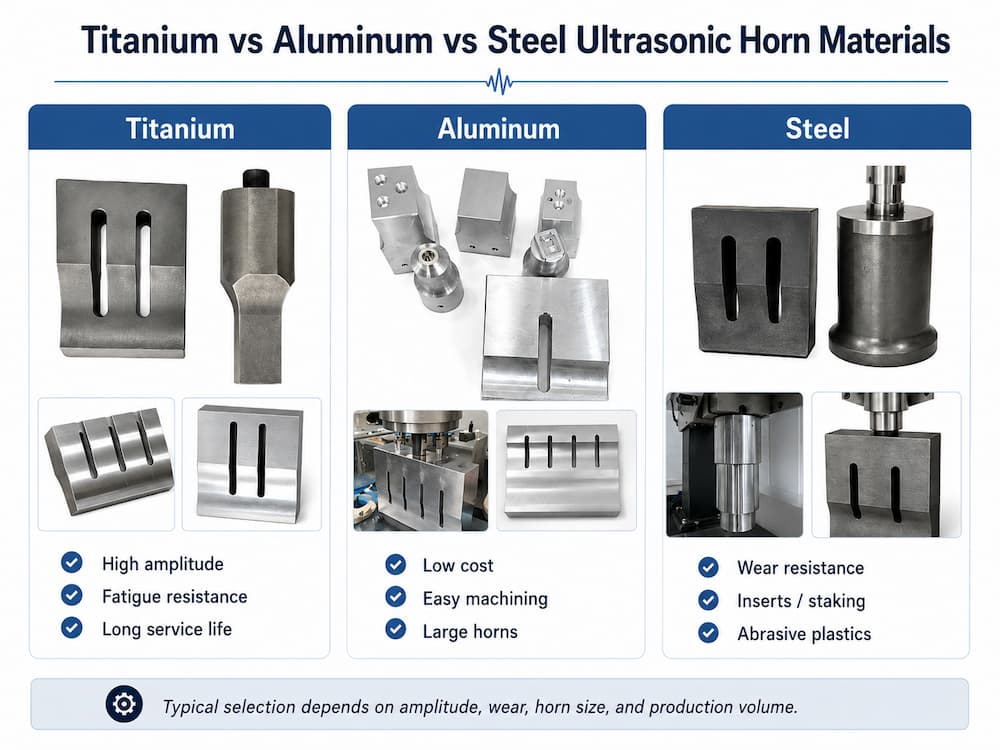
| Factor | Titanium | Aluminium | Steel |
| Accoustic Performance | Excellent | Excellent | Moderate |
| Fatigue Resistance | Excellent | Moderate | Lower at high amplitude |
| Wear Resistance | Good | Low without treatment | Excellent |
| Surface Hardness | Good | Low | Excellent after heat treatment |
| Horn Weight | Medium | Low | High |
| Machining Cost | High | Low | Medium |
| Complex Maching | Moderate | Excellent | Moederate |
| Large Horn Suitability | Medium | Excellent | Limited |
| High-amplitude Usage | Excellent | Application-dependent | Usually not preferred |
| Continuous production | Excellent | Depends on stress and wear | Mainly lower amplitude processes |
| Abrasive Plastics | Good with treament | Limited without treatment | Excellent |
| Corrosion Resistance | Excellent | Good with treatment | Depends on steel grade |
| Relative Cost | High | Low | Medium |
| Typical Application | High-volume Welding | Prototypes and large horns | Insertion, staking and wear-resistant tips |
This comparison should be used as an initial guide. The final material cannot be selected independently
from horn geometry, frequency, amplitude gain, contact area, and plastic material.
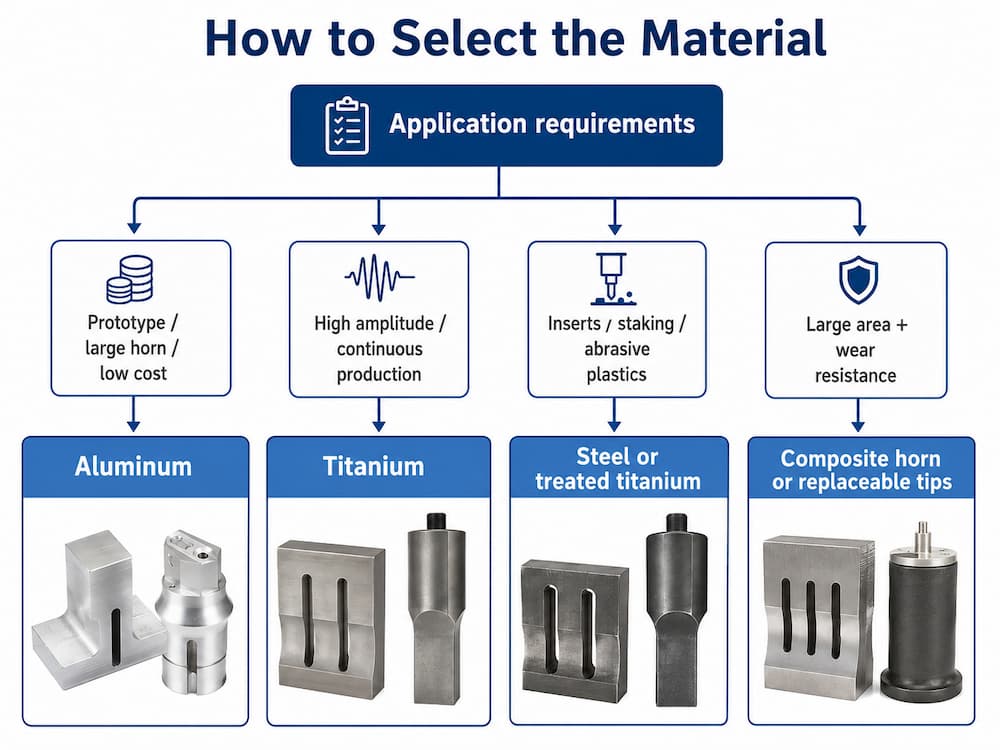
The most reliable selection method is to start with the actual production conditions.
Horn material should not be evaluated separately from the welding interface. A well-tuned titanium horn may
still produce unstable results if the energy director is too small, the joint is poorly aligned, or the part cannot
retain molten plastic during welding. The ultrasonic welding joint design must therefore be reviewed together
with horn material, amplitude, and fixture support.
Aluminum is normally the most economical option for sample testing, prototype development,
and small production batches.
It can be machined quickly and modified more easily if the welding joint or part design changes.
For non-abrasive plastics and moderate amplitude, an aluminum horn may also provide acceptable
service life in regular production.
TIMEAST evaluates horn material as part of the complete ultrasonic welding process.
Before recommending titanium, aluminum, steel, or a composite structure, our engineers review:
ultrasonic operating frequency
required welding amplitude
horn dimensions and contact area
plastic resin and filler content
welding joint design
production volume and cycle time
cosmetic surface requirements
expected wear location
tooling budget and maintenance requirements
Material selection is then evaluated together with horn gain, slot structure, stress distribution, frequency tuning,
fixture support, and welding parameters.
For example, a large aluminum horn may be more suitable than titanium for a low-wear application with a broad
welding area. In contrast, untreated aluminum may wear prematurely when used against glass-filled plastic.
Hardened steel may provide excellent wear resistance for an insertion tool but may not be appropriate for
a large high-amplitude welding horn.
Before mass production, the horn should be tuned and tested with actual plastic parts. TIMEAST’s ultrasonic
welding sample testing is used to verify material weldability, horn contact, welding strength, surface appearance,
fixture support, and machine suitability before the final tooling structure is confirmed.
Depending on the product requirements, validation may include pull testing, peel testing, leak testing, dimensional
inspection, or functional testing. The selected method should reflect the actual product requirement rather than
relying only on visual inspection.
Conclusion
Titanium is generally preferred for high-amplitude, high-volume, and fatigue-critical welding. Aluminum
is suitable for prototypes, complex machining, and large low-wear horns. Hardened steel is best for insertion,
staking, cutting, reinforced plastics, and severe surface wear.
When a large horn also requires strong wear resistance, a composite structure or replaceable tip design may
provide the best balance of acoustic performance, tool weight, service life, and manufacturing cost.
Customers developing a new application can send TIMEAST their part drawings, plastic information,
production volume, and welding requirements for horn material and tooling evaluation.
Phone: +86-15989541416
E-mail: sales@sztimeast.com
Whatsapp:+86-15989541416
Add: Building 5, Huixin Intelligent Industrial Park,Guangming, Shenzhen,China 518107
We chat