
sales@sztimeast.com
+86-15989541416
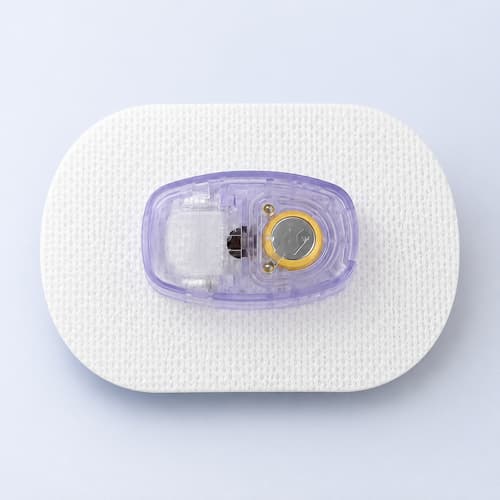
Thin-wall cosmetic housings are widely used in smart wearables, cosmetic packaging,
personal care devices, and high-end consumer electronics. However, during ultrasonic welding,
these thin plastic parts often develop whitening, stress marks, or cosmetic defects, which directly
affect appearance quality and yield.
This article explains why whitening occurs in thin-wall ultrasonic welding and provides practical,
proven solutions to help manufacturers achieve stable cosmetic quality.
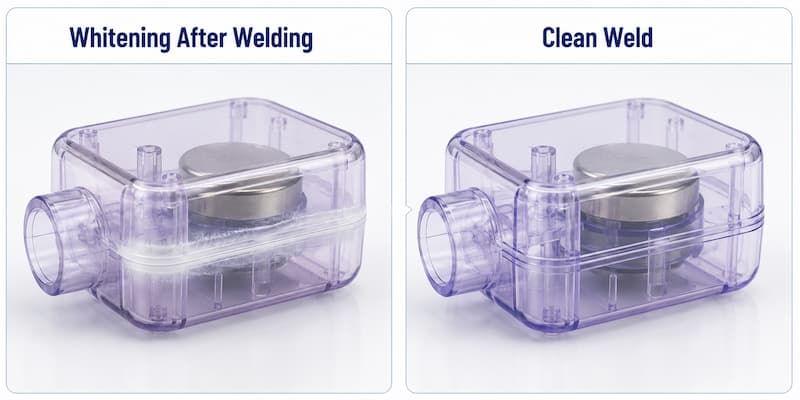
Whitening refers to the localized white or cloudy appearance that forms around
the weld seam after ultrasonic welding.
It is usually caused by excessive internal stress, plastic deformation, or micro-fractures
in the polymer structure.
For cosmetic housings, even minor whitening is unacceptable, making process control
especially critical.
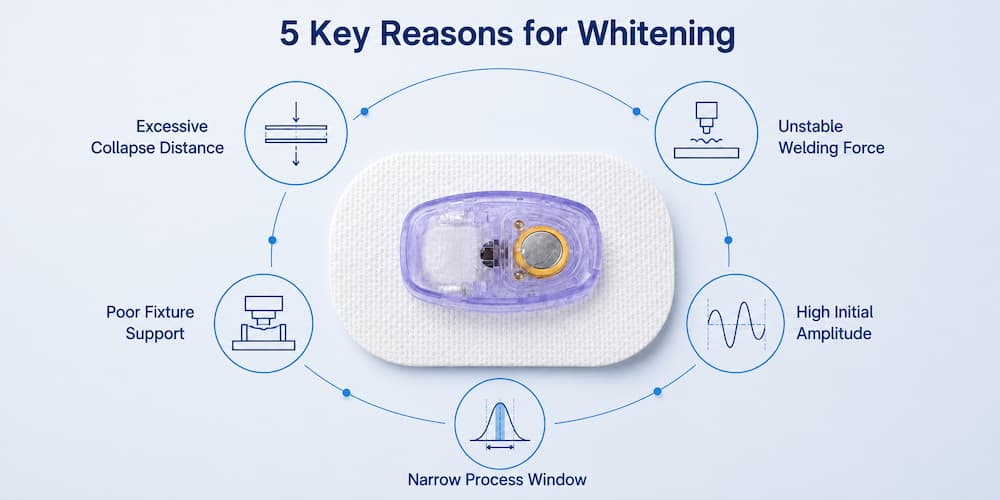
Thin-wall parts have limited material volume.
When collapse distance is not strictly controlled, the material is over-compressed,
leading to stress whitening and surface deformation.
Common issue:
Using time-based welding instead of depth-controlled welding
Traditional pneumatic systems may apply force too quickly at the start of welding.
This sudden pressure spike causes localized stress concentration, especially in thin
cosmetic shells.
Typical symptom:
Whitening appears immediately after horn contact
High amplitude at the start of welding introduces excessive vibration energy into
a fragile thin-wall structure,exceeding the plastic’s elastic limit.
Risk:
Surface micro-cracks
Loss of transparency or gloss
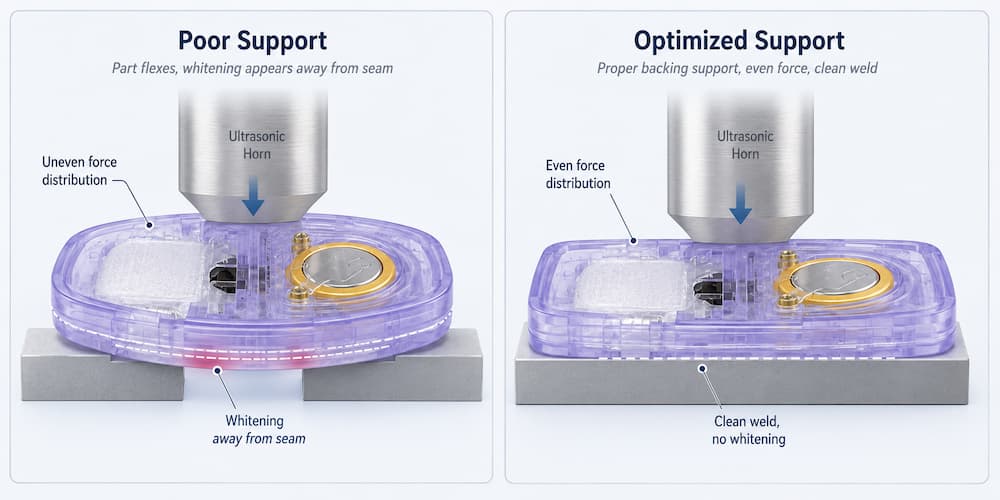
Poor fixture and horn design allows thin-wall parts to flex during welding.
This flexing amplifies stress and creates uneven energy distribution at the weld interface.
Result:
Whitening away from the actual weld seam
Thin cosmetic housings often use materials like ABS, PMMA, or PC blends, which have
tight process tolerances.Small variations in material batch or moisture content can easily
push the process outside the safe window.
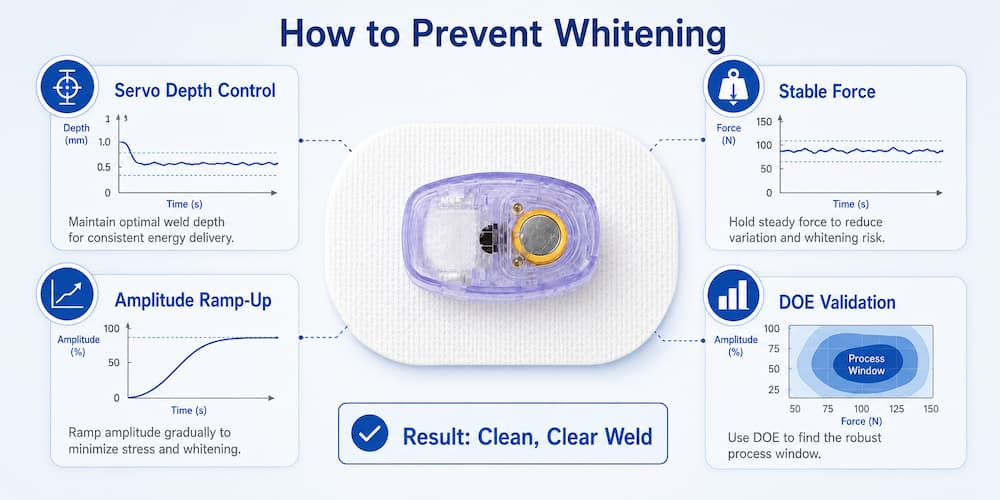
Switch from time mode to collapse distance or depth-controlled welding.
Benefits:
Prevents over-compression
Ensures consistent weld height
Significantly reduces cosmetic stress marks
Gradually increasing amplitude at the start of welding allows the material to
soften progressively.
Best practice:
Low initial amplitude
Smooth ramp to target amplitude
Avoid sudden energy spikes
Servo-driven ultrasonic welding systems provide precise and repeatable force control,
eliminating pneumatic shock.
Result:
Reduced stress whitening
Improved surface finish consistency
Fixtures should fully support thin-wall areas close to the weld seam.
Design tips:
Increase local backing support
Avoid hollow or floating areas
Match fixture geometry to part curvature
Before mass production, ultrasonic welding sample testing helps confirm whether the process window is stable.
Perform Design of Experiments (DOE) to identify the safe operating window for:
Collapse distance
Welding force
Amplitude profile
Hold time
This step is essential for mass production stability.
Compared with pneumatic systems, servo ultrasonic welding offers:
Precise collapse control
Smooth force application
Repeatable energy input
Better cosmetic surface protection
For high-end cosmetic housings and small thin-wall plastic parts, a servo ultrasonic welding machine
can significantly improve yield and visual quality.
To prevent whitening defects in thin-wall cosmetic housings:
Use depth-controlled servo welding
Avoid excessive initial amplitude
Maintain stable welding force
Improve fixture support
Validate parameters through DOE
With proper process control, ultrasonic welding can achieve strong joints without compromising
cosmetic appearance.
If you are experiencing whitening or cosmetic defects in thin-wall plastic housings, our application
engineers can help you:
Analyze your current welding process
Recommend suitable servo ultrasonic welding systems
Optimize parameters for cosmetic quality
Send us your part drawings or samples,Get a free evaluation.
Free technical evaluation | Customized solutions | Fast response within 24 hours
Phone: +86-15989541416
E-mail: sales@sztimeast.com
Whatsapp:+86-15989541416
Add: Building 5, Huixin Intelligent Industrial Park,Guangming, Shenzhen,China 518107
We chat