
sales@sztimeast.com
+86-15989541416
Ultrasonic welding is widely used to join plastic components quickly and efficiently.
It creates strong, clean joints without adhesives or fasteners, making it ideal for automotive,
medical, and consumer product applications. However, a welded joint that looks perfect does
not always guarantee airtight sealing. This is why air leak testing has become an essential
quality inspection step after ultrasonic welding.
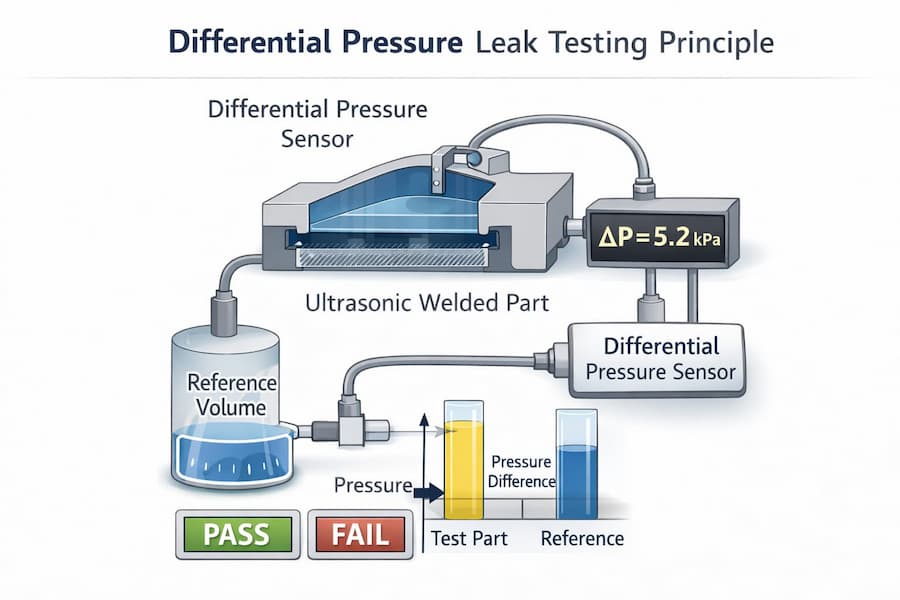
Ultrasonic welding relies on high-frequency vibration to melt and fuse thermoplastic
materials at the joint interface. While the process is highly repeatable, several factors
can still affect sealing performance:
Material inconsistency
Weld energy or pressure variation
Part tolerance or deformation
Complex joint geometry
Even microscopic defects along the weld line can lead to leakage that is invisible to
visual inspection.
For applications involving fluids, pressure, or sensitive internal components, these
micro-leaks can cause functional failure over time.
After ultrasonic welding, operators often rely on visual checks or destructive testing.
These methods have clear limitations:
Visual inspection cannot detect micro-leaks
Destructive testing cannot be applied to 100% production
Sampling methods may miss defective parts
As production volumes increase, manufacturers need a non-destructive, reliable,
and repeatable inspection method. This is where air leak testing becomes critical.
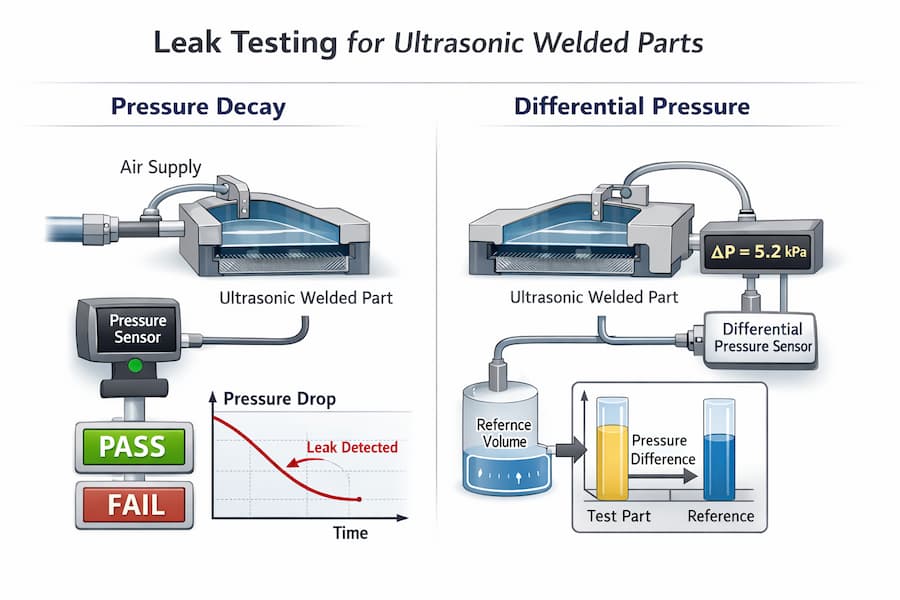
How Air Leak Testing Verifies Weld Integrity?An air leak tester evaluates the sealing performance of a welded part by monitorin
g pressure behavior after air is introduced into the internal cavity.
A typical test process includes:
Filling the welded part with compressed air
Allowing pressure stabilization
Measuring pressure decay over a set time
Automatically judging PASS or FAIL
If the ultrasonic weld is incomplete or has micro-gaps, pressure loss will exceed
the allowable limit, indicating a leak.This method provides objective, quantitative
verification of weld quality.
1. Detects Micro-Leaks at the Weld Line
Air leak testing can identify extremely small leaks that cannot be detected by sight
or touch.
2. Non-Destructive and Production-Friendly
Every welded part can be tested without damage, making it suitable for in-line inspection.
3. Improves Process Stability
Leak test data helps engineers optimize ultrasonic welding parameters such as energy,
amplitude, and pressure.
4. Ensures Compliance and Reliability
Many industries require proof of sealing performance, especially for safety-critical
or regulated products.
Air leak testing after ultrasonic welding is commonly used for:
In high-volume production, multi-station air leak testing machines are often used to
maintain cycle time efficiency.
For manufacturers using ultrasonic welding, leak testing should not be treated as a separate
process, but as part of a complete quality control strategy.
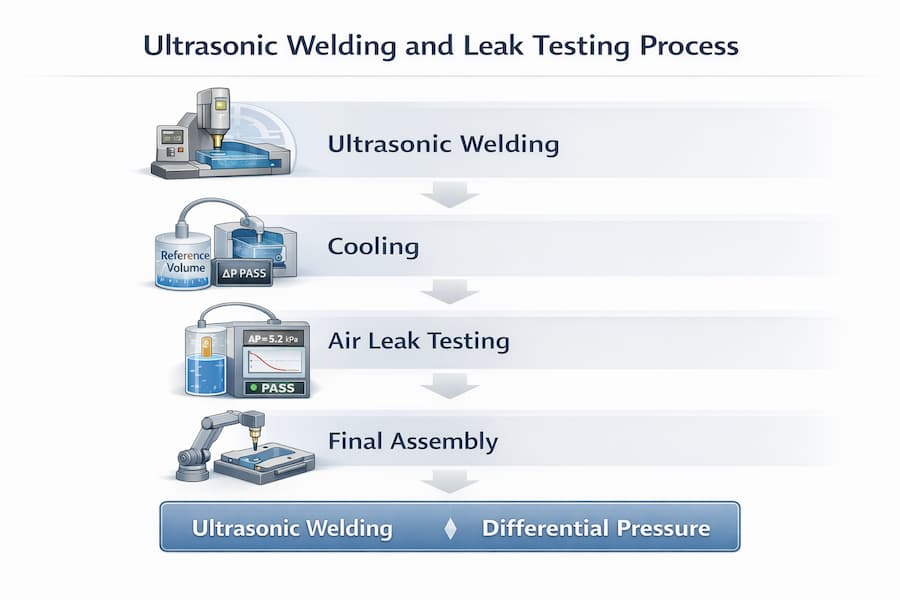
A typical workflow looks like this:
Ultrasonic Welding → Cooling → Air Leak Testing → Final Assembly
By integrating air leak testing directly after welding, defective parts can be identified early,
reducing rework, scrap, and downstream failures.
Ultrasonic welding delivers fast and clean joints, but air leak testing is essential to verify
sealing integrity—especially for parts where leakage is unacceptable.
Combining ultrasonic welding with precision air leak testing allows manufacturers to achieve
higher product reliability, consistent quality, and greater confidence in mass production.
Phone: +86-15989541416
E-mail: sales@sztimeast.com
Whatsapp:008615989541416
Add: Building 5, Huixin Intelligent Industrial Park,Shenzhen,Guangdong,China
We chat