
sales@sztimeast.com
+86-15989541416
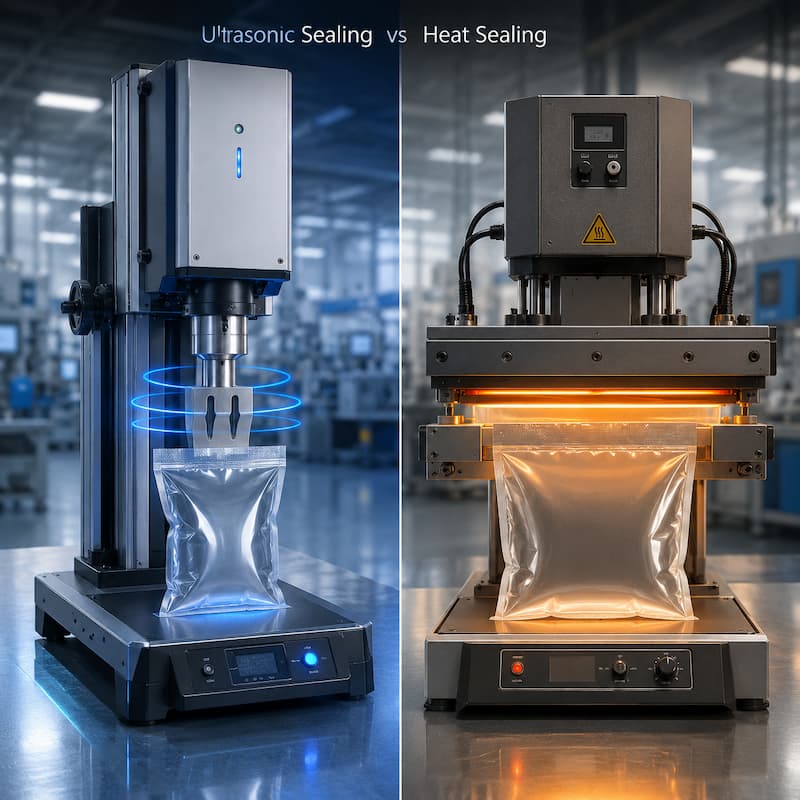
Ultrasonic sealing and heat sealing are both widely used to join thermoplastic packaging materials.
Each process can produce strong and reliable seals, but they generate heat differently and perform
differently under changing production conditions.
Heat sealing transfers thermal energy from heated jaws or sealing bars through the packaging material.
Ultrasonic sealing uses high-frequency mechanical vibration to generate localized heat at the interface
between the sealing layers.
Neither method is universally better.
The correct choice depends on:
Packaging material and layer structure
Seal geometry and required seal width
Product contamination in the sealing area
Sensitivity of the packaged product to heat
Required line speed and cycle time
Allowable energy consumption
Seal-strength and leak-rate requirements
Equipment investment and operating cost
Machine integration and maintenance capability
This guide compares the two processes so that packaging engineers, production managers and equipment buyers
can select the most suitable sealing technology for their application.
| Factor | Ultrasonic Sealing | Heat Sealing |
| Heat source | Localized heat generated by ultrasonic vibration | Heat transferred from heated jaws |
| Warm-up time | Usually no jaw warm-up required | Often requires heating and temperature stabilization |
| Contamination tolerance | Better suited to light powder, liquid or residue in the seal area | Performs best with clean sealing surfaces |
| Thermal impact | Lower heat exposure around the seal | Larger heat-affected area |
| Seal width | Narrow and precise seals | Generally wider seals |
| Material suitability | Requires an ultrasonically compatible thermoplastic layer | Suitable for a broad range of heat-sealable films |
| Process control | Energy, power, time, force and distance can be monitored | Mainly controlled by temperature, pressure and dwell time |
| Initial cost | Usually higher | Usually lower |
| Best suited for | Heat-sensitive products, contaminated seals and precision automation | Clean films, wide seals and cost-sensitive applications |
In general, ultrasonic sealing is more suitable when contamination tolerance, localized heating and process
monitoring are important. Heat sealing remains a practical choice when material compatibility, wide seals
and lower initial cost are the main priorities.
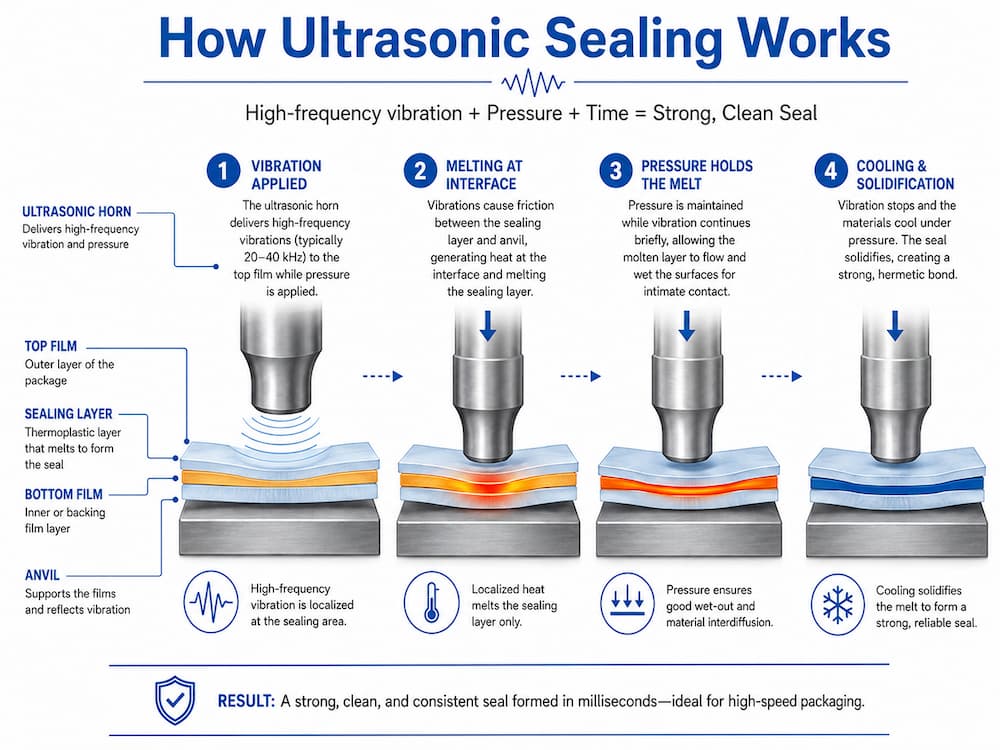
Ultrasonic sealing uses high-frequency mechanical vibration to create heat at the interface between two
thermoplastic sealing layers.
The packaging material is placed between an ultrasonic horn and an anvil. Controlled pressure holds
the layers together while the horn vibrates.
This vibration creates localized heating within the sealing area. The thermoplastic layer softens and melts,
allowing the two surfaces to fuse under pressure.
When the vibration stops, pressure is maintained briefly while the seal cools and solidifies.
A typical ultrasonic sealing system includes:
Ultrasonic generator
Converter
Booster
Ultrasonic horn
Anvil
Pneumatic or servo actuator
Process controller
Ultrasonic sealing is not a completely cold process. Heat is still required to melt the sealing layer,
but it is generated locally instead of being transferred continuously from an externally heated tool.
Important ultrasonic sealing parameters include:
Amplitude
Sealing force
Sealing time
Welding energy
Peak power
Trigger force
Collapse distance
Important ultrasonic sealing parameters include amplitude, sealing force, sealing time, energy,
peak power and collapse distance. These values become more useful when they are combined
with suitable upper and lower acceptance limits. Our guide to ultrasonic welding control modes
explains how time, energy, distance and peak-power control affect production consistency.
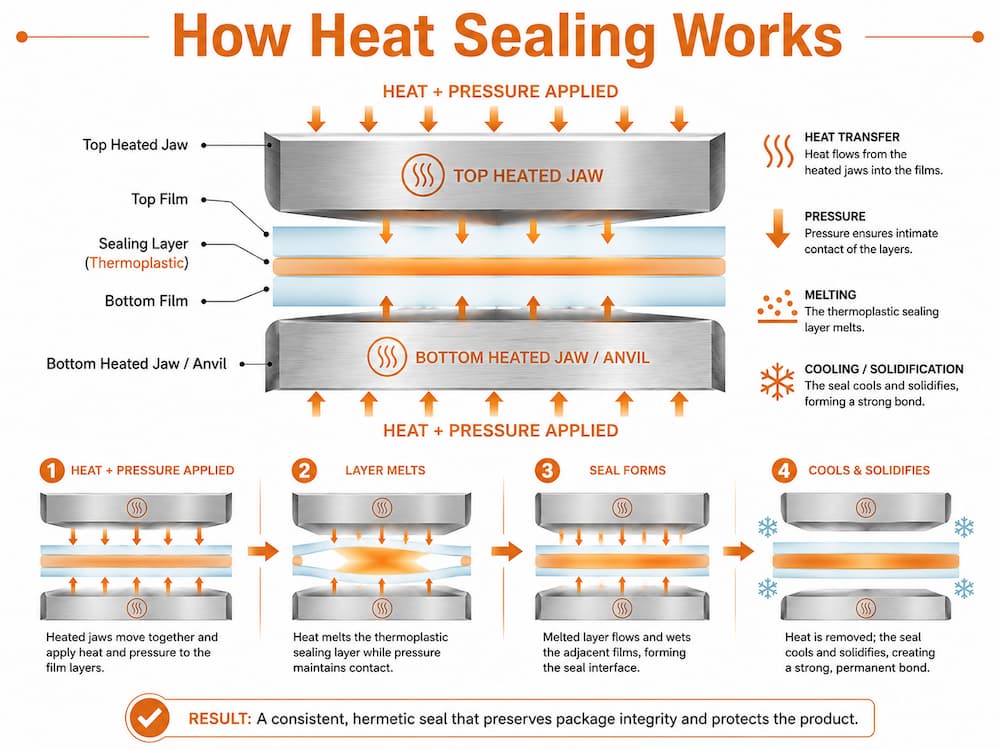
Heat sealing uses externally heated jaws, bars or bands to transfer heat through the packaging material.
The sealing layers are pressed together while the heat softens or melts the sealant layer. Pressure and
temperature are maintained for a controlled dwell time, after which the material cools and forms a seal.
The main process variables are:
Temperature
Pressure
Dwell time
Cooling time
Jaw alignment
Film thickness
Sealant-layer composition
Common heat-sealing systems include:
Constant-heat sealers
Impulse sealers
Hot-bar sealers
Continuous band sealers
Rotary heat-sealing systems
Heat sealing is well established and compatible with many flexible packaging materials. It is especially
effective when the sealing area is clean and the material has a stable heat-seal window.
Ultrasonic sealing generates heat close to the sealing interface through vibration.
Heat sealing transfers heat from an external jaw through the packaging material.
Because the heat in ultrasonic sealing is more localized, the surrounding material and packaged product
may experience less thermal exposure.
Ultrasonic sealing normally does not require a heated jaw to reach a stable operating temperature.
Constant-heat sealing systems require warm-up and temperature stabilization before production.
This can make ultrasonic equipment more suitable for production lines with frequent stops and restarts.
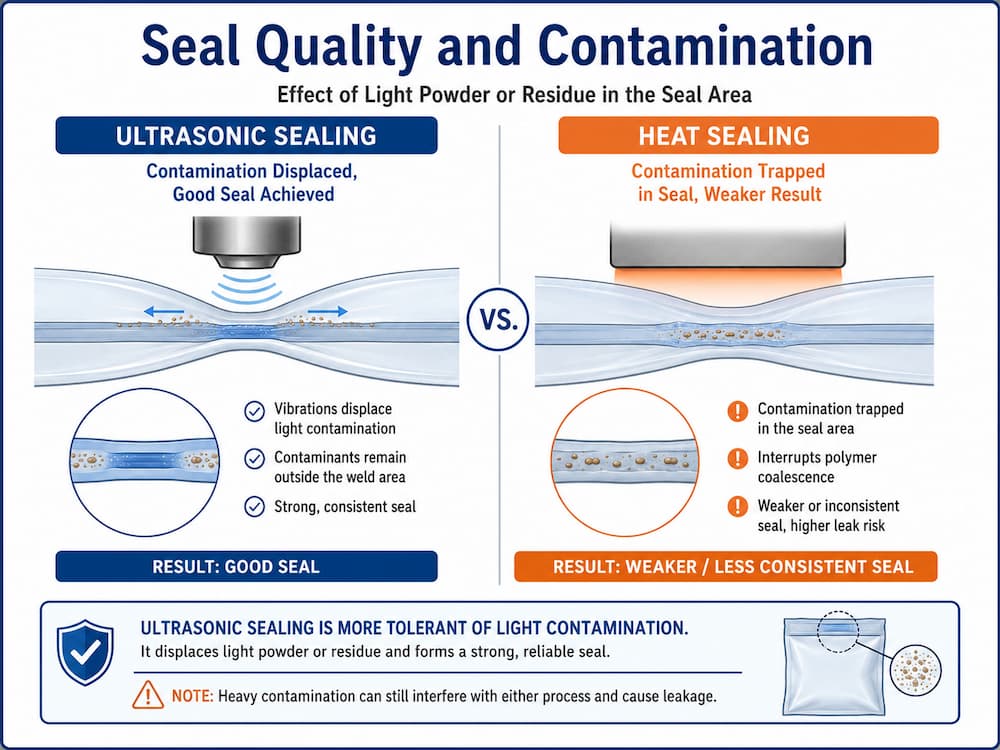
Ultrasonic vibration can sometimes displace light contamination from the active sealing path.
This may improve sealing consistency when small amounts of the following materials are present:
Powder
Fine particles
Liquid
Oil
Product residue
However, ultrasonic sealing cannot overcome every contaminated condition. Heavy residue,
large particles, fibers or film folds can still create leakage.
Heat sealing usually performs best when the sealing surfaces are clean and flat.
The localized heating of ultrasonic sealing can be useful for:
Heat-sensitive products
Thin packaging films
Seals located close to the product
Printed or coated outer layers
Packaging that may distort under prolonged heat
Heat sealing exposes a wider area to elevated temperature and may require careful
control of dwell time and jaw temperature.
Ultrasonic sealing can create a relatively narrow and accurately positioned seal.
This may help reduce flange width and packaging material, although any material-saving claim
should be verified through actual package redesign.
Heat sealing commonly creates wider seals and may be more suitable when a broad sealing area is required.
Ultrasonic systems can monitor production data such as:
Energy
Power
Sealing time
Force
Distance
Final position
Upper and lower limits can be established to identify abnormal sealing cycles.
Heat-sealing systems can also monitor temperature, pressure and dwell time, but these parameters
do not always indicate whether contamination or folds are present inside the seal.
Seal appearance alone does not confirm seal integrity.
Both ultrasonic and heat-sealed packages can contain:
Microchannels
Incomplete fusion
Wrinkles
Trapped particles
Thin sealing areas
Delamination
Punctures
Ultrasonic sealing is often considered when occasional contamination is difficult to prevent
during filling.
Mechanical vibration may help move a thin layer of powder or liquid away from the sealing path
before the material fully melts.The result depends on:
Contamination type
Contamination quantity
Particle size
Film structure
Horn and anvil design
Applied force
Ultrasonic amplitude
Seal geometry
Filled-package testing is therefore essential.
Typical seal-verification methods include:
Peel-strength testing
Burst testing
Bubble testing
Pressure-decay testing
Vacuum-decay testing
Dye-penetration testing
Visual inspection
The acceptance standard should be based on the packaged product, storage conditions and required shelf life.
Seal appearance alone cannot confirm package integrity. When seal performance must be measured rather than
judged visually, peel, burst and leakage results should be compared under consistent test conditions. The methods
described in our ultrasonic weld strength testing guide provide a useful starting point for establishing measurable
acceptance criteria.
Materials Suitable for Each Process
Heat sealing is compatible with a broad range of conventional heat-sealable films and laminates.
Ultrasonic sealing requires a thermoplastic layer that can respond effectively to high-frequency vibration.
Common materials may include:
PE-based sealing layers
PP-based sealing layers
Thermoplastic-coated paper
Multilayer flexible films
Plastic tubes
Thermoplastic lids and containers
The full material structure must be evaluated.
For example, two films described as PE may seal differently because of differences in:
Density
Thickness
Additives
Coatings
Printing
Recycled content
Laminate construction
For multilayer packaging, the ultrasonic energy must reach the thermoplastic sealing layer
without damaging the outer barrier, printed or paper layer.
Actual samples should be tested before selecting equipment or finalizing tooling.
The polymer name alone is not enough to predict sealing performance. Film thickness, additives,
coatings, recycled content and laminate construction can all change how the material responds to
ultrasonic vibration. For a broader explanation of material behavior, see our guide to
plastics suitable for ultrasonic welding.
Ultrasonic sealing can complete the active sealing stage quickly because energy is
concentrated at the joint.
However, total line speed also depends on:
Product feeding
Film positioning
Clamping
Cutting
Cooling
Package discharge
Modern heat-sealing systems can also operate at high speed, particularly rotary and
continuous systems.
Cycle time should therefore be compared using actual package trials rather than general claims.
Ultrasonic systems mainly consume sealing energy during the active welding cycle.
Constant-heat systems use energy to heat the jaws and maintain the required temperature
during operation and idle periods.
Ultrasonic sealing may reduce process energy in suitable applications, but the complete machine
must be evaluated.
Ultrasonic systems require inspection of:
Horn
Anvil
Converter
Booster
Frequency tuning
Heat-sealing systems may require replacement or maintenance of:
Heating elements
Thermocouples
PTFE covers
Silicone pads
Sealing tapes
Jaw coatings
Maintenance cost depends on the machine design, production environment and tooling condition.
Cost Comparison
Heat-sealing equipment usually has a lower initial purchase cost, especially for simple manual
or semi-automatic applications.
Ultrasonic sealing normally requires a higher initial investment because the system includes a generator,
converter, booster, horn, anvil and controlled actuator.
However, equipment price is only one part of the decision.
The complete comparison should include:
Production speed
Energy use
Reject rate
Film consumption
Product loss
Maintenance
Cleaning time
Downtime
Seal inspection
Customer complaints
Ultrasonic sealing may provide a better return when it reduces leakage, contamination-related rejects
or packaging material.
Heat sealing may remain the more economical option when it already provides stable results with
clean, compatible films.
When to Choose Ultrasonic Sealing
Ultrasonic sealing should be considered when:
Light powder or liquid may enter the sealing area
The packaged product is sensitive to heat
A narrow sealing path is required
The machine frequently starts and stops
Process data and traceability are important
Conventional heat sealing produces inconsistent leaks
Precision automation is required
Typical applications include powder packaging, frozen foods, dairy products, medical packaging,
flexible pouches, plastic tubes and coated thermoplastic packaging.
For production lines that require localized heating, light-contamination tolerance and sealing-process data,
a packaging-specific ultrasonic system may provide advantages over a conventional heated-jaw process.
See TIMEAST’s ultrasonic sealing solutions for packaging for typical films, pouches, containers and
automation options.
Heat sealing may be the better choice when:
The film has a stable heat-seal window
The sealing area remains clean
A wide seal is preferred
Initial equipment cost must be minimized
Production volume is relatively low
Existing heat-sealing equipment already performs reliably
The material is not suitable for ultrasonic sealing
Heat sealing is a mature and effective process. It should not be replaced unless ultrasonic sealing
provides a measurable technical or financial advantage.
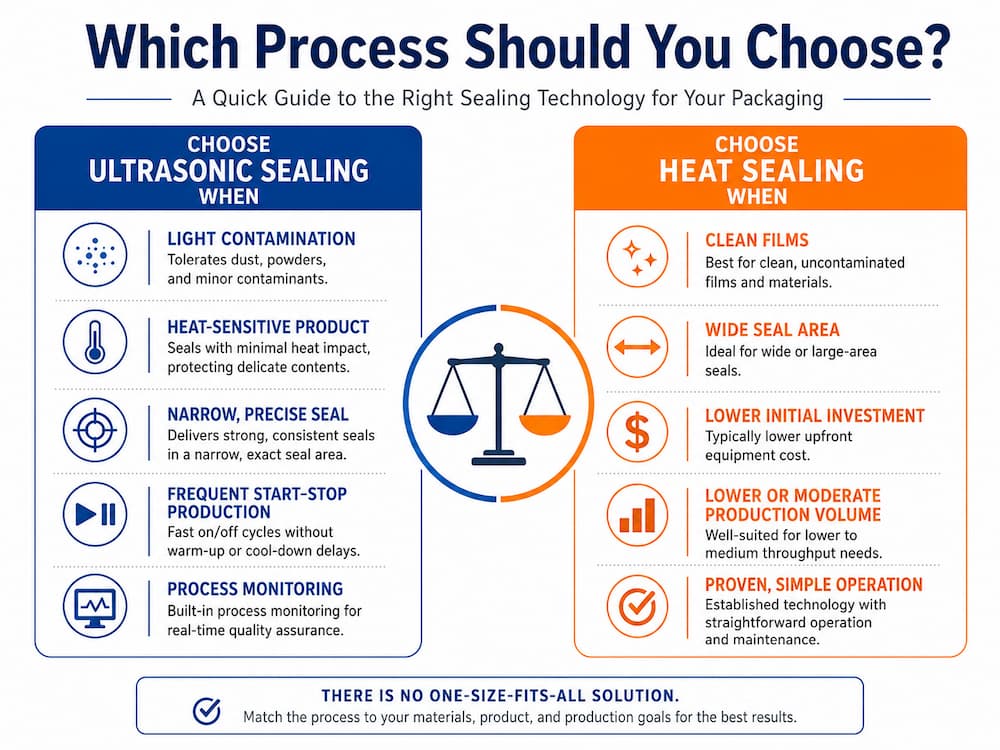
Choose ultrasonic sealing when localized heating, light-contamination tolerance, narrow seals
and process monitoring are important.
Choose heat sealing when broad material compatibility, wide seals, simple operation and lower
initial equipment cost are the main priorities.
The final decision should be based on actual production materials and filled-package testing.
Compare both processes using:
Seal strength
Leakage
Appearance
Cycle time
Contamination tolerance
Reject rate
Energy use
Tooling cost
Before selecting equipment, both processes should be evaluated using the actual packaging film,
filled product and expected contamination conditions. This helps confirm seal strength, appearance,
leakage, cycle time and process stability before tooling is finalized. Our ultrasonic welding validation guide
explains the main points that should be checked before equipment investment.
A: No. Ultrasonic sealing generates localized heat at the sealing interface through mechanical vibration.
It does not use continuously heated sealing jaws.
A: It can be more tolerant of light powder, liquid or product residue. Heavy contamination, large particles
or folded film can still cause leakage.
A: The active ultrasonic cycle can be very short, but total production speed depends on material handling,
cutting, cooling and machine integration. Both methods can support high-speed production.
A: Ultrasonic sealing may use less process energy because power is mainly applied during the sealing cycle.
Actual consumption depends on the complete equipment and production conditions.
A: Yes, in suitable applications. Material compatibility, seal geometry, production speed and contamination
conditions must be tested before changing the process.
Ultrasonic sealing and heat sealing can both produce reliable packaging seals.
Ultrasonic sealing is more suitable when the application requires:
Localized heating
Better tolerance of light contamination
Narrow sealing areas
Process monitoring
Fast start-stop production
Heat sealing is more suitable when the application requires:
Broad film compatibility
Wide sealing areas
Lower initial investment
Simple and established operation
Send TIMEAST your packaging material, product information, seal dimensions, required production
speed and representative samples.
Our engineers can help evaluate:
Film and sealing-layer compatibility
Ultrasonic sealing feasibility
Horn and anvil requirements
Contamination tolerance
Seal strength and leakage
Suitable frequency and power
Packaging-line integration
You can also send your materials for ultrasonic sealing sample testing before selecting the final machine
and tooling configuration.
Phone: +86-15989541416
E-mail: sales@sztimeast.com
Whatsapp:+86-15989541416
Add: Building 5, Huixin Intelligent Industrial Park,Guangming, Shenzhen,China 518107
We chat