
sales@sztimeast.com
+86-15989541416
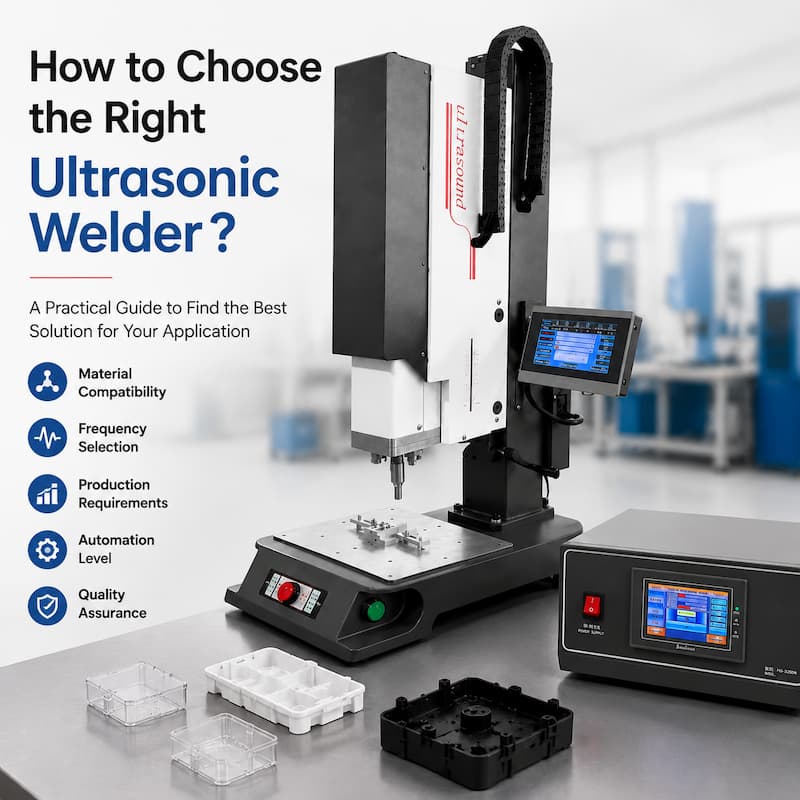
Buying an ultrasonic welding machine is a long-term investment rather than a simple
equipment purchase. The right system influences product quality, manufacturing efficiency,
maintenance cost and future production expansion. Many manufacturers compare only
price or power output, but successful projects depend on matching the machine to the product
and production process. This guide explains how engineers evaluate ultrasonic welding
applications and provides a practical roadmap for selecting the right solution.
Higher power does not automatically produce better welds. Excessive energy may damage
thin parts while insufficient power can create weak joints. The best machine balances frequency,
amplitude, tooling, fixture design and process control. Looking at the complete manufacturing
process always delivers better long-term performance than choosing equipment by specification alone.
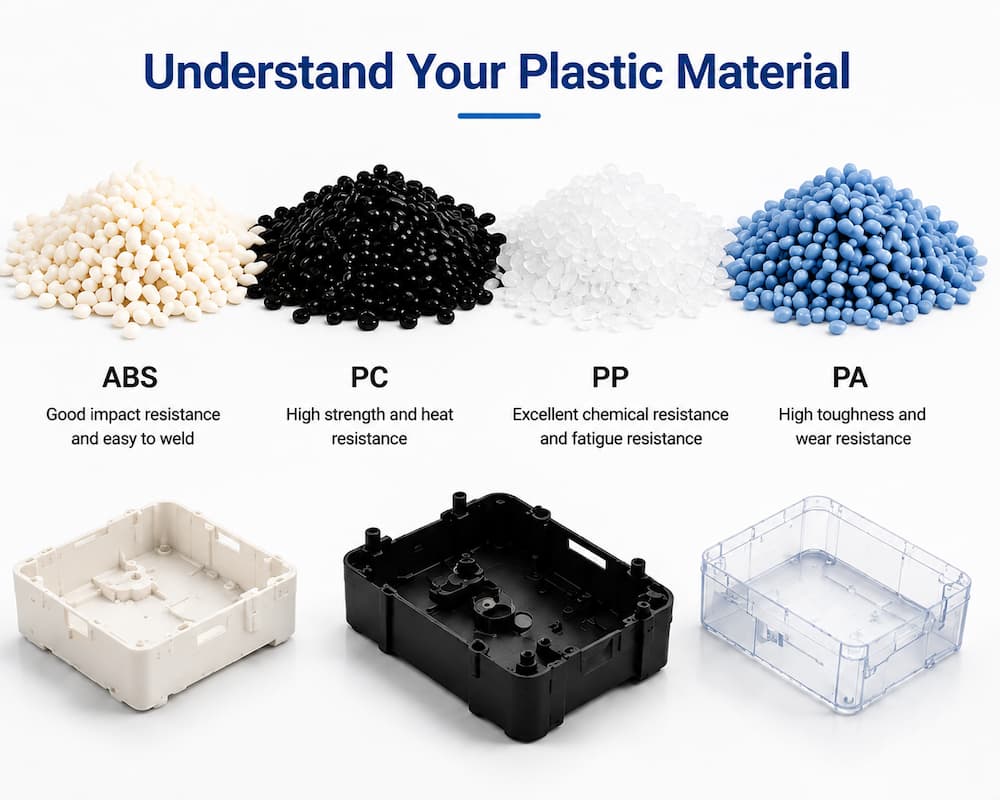
Plastic material is the foundation of ultrasonic welding. ABS, PC and PS are generally easier to
weld than semi-crystalline materials such as PP and PE. Glass-filled materials, flame-retardant
grades and recycled plastics require additional evaluation. Before selecting equipment, identify
the resin type, wall thickness, additives and expected mechanical requirements. Sample welding
is strongly recommended whenever material behavior is uncertain.
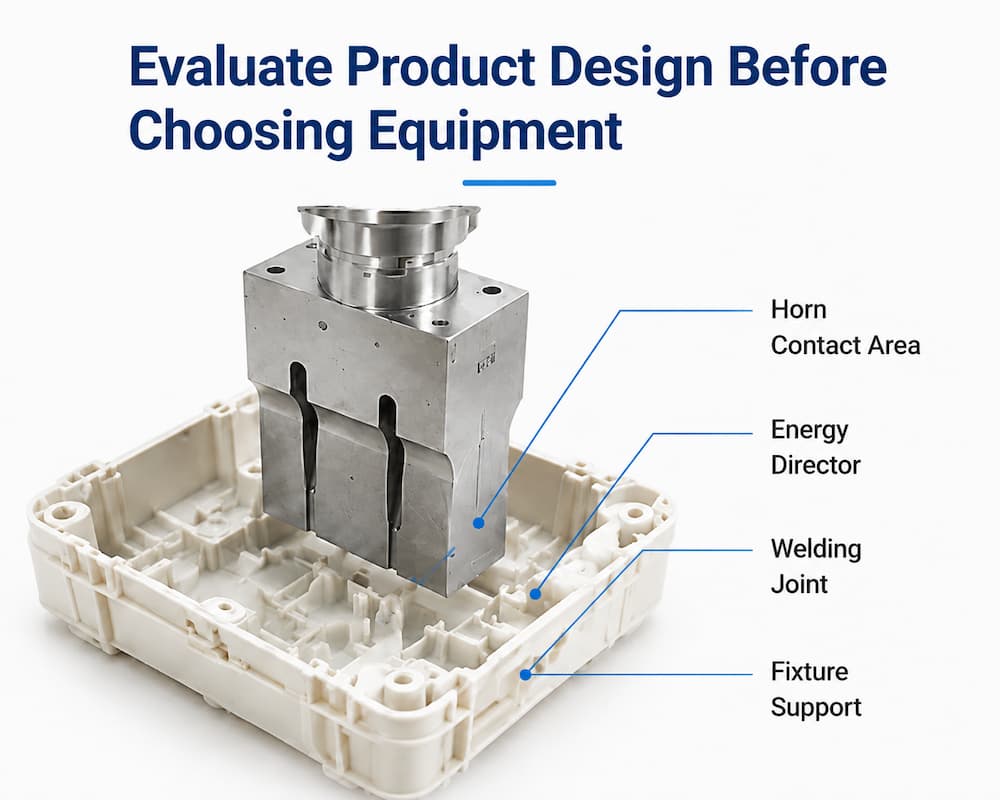
Product geometry affects energy transmission. Engineers should review wall thickness, ribs,
bosses, inserts, energy directors, weld joints and cosmetic requirements. Proper ultrasonic welding fixtures
prevent deformation, while a well-designed ultrasonic welding horn distributes vibration evenly across
the welding area.
Investing in good tooling often improves consistency more than increasing machine power.
Prototype production may only require a manual bench-top machine. Medium-volume manufacturing
often benefits from semi-automatic fixtures. High-volume production usually justifies rotary indexing
ultrasonic welding systems, robotic loading or complete automation. Selecting equipment with future
expansion capability helps reduce long-term investment.
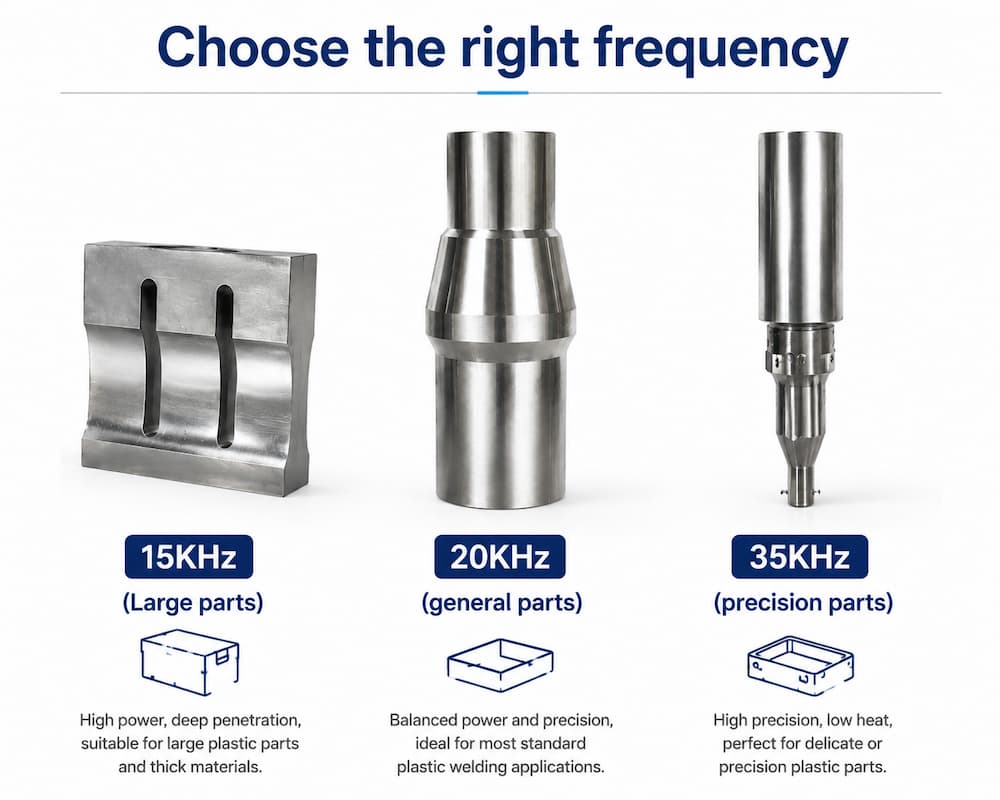
As a general guideline, 35 kHz is suitable for small precision components, 20 kHz covers most
industrial plastic welding applications and 15 kHz provides higher amplitude for larger parts.
Frequency selection should always be evaluated together with horn size, product dimensions
and material characteristics.
Step 5 – Servo or Pneumatic?
Pneumatic ultrasonic welding machines remain an economical solution for many standard
plastic welding applications. Servo ultrasonic welding machines offer higher precision,
programmable welding profiles and improved process monitoring.
Industries such as medical devices, electronics and precision automotive components often benefit
from servo technology.
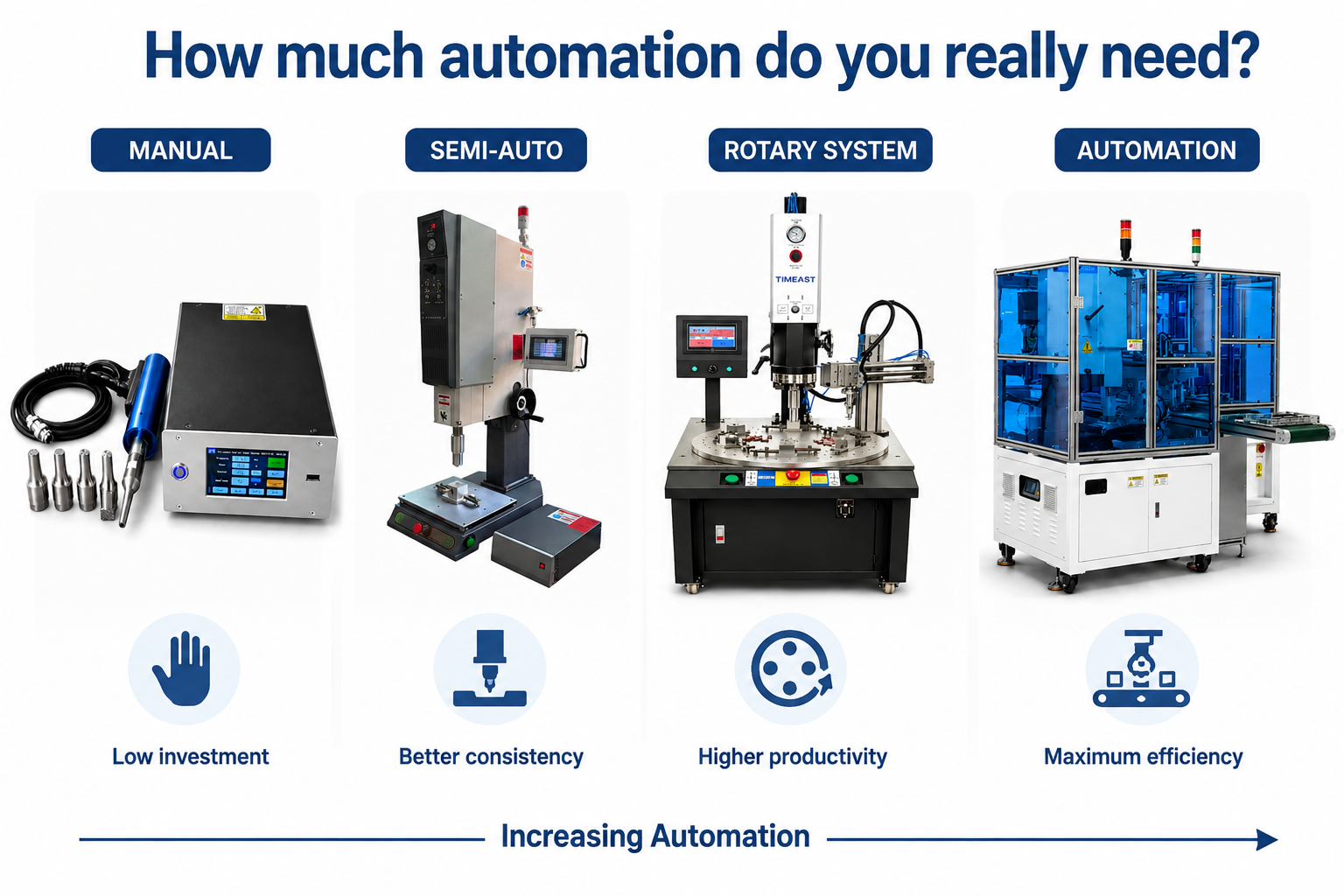
Automation should match production demand. Manual systems are ideal for development and
small batches. Semi-automatic workstations improve repeatability. Fully automated ultrasonic welding automation lines
can integrate part feeding, vision inspection, leak testing, laser marking, robotic handling and production data collection.
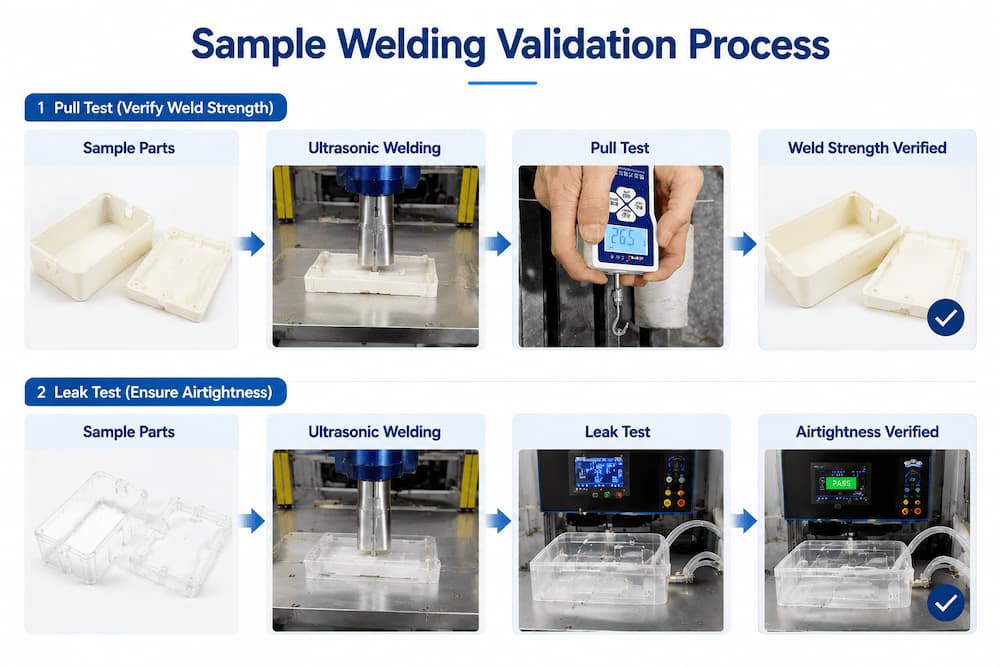
Quality validation extends beyond achieving a successful weld. Manufacturers should evaluate
weld appearance, dimensional accuracy, pull strength, leak performance and process repeatability.
Ultrasonic welding sample testing, destructive testing and air leak testing help evaluate weld strength,
appearance, sealing performance and process repeatability before equipment selection and mass production.
Before purchasing equipment, confirm plastic material, product dimensions, annual output, cosmetic
requirements, leak-proof requirements, available factory utilities, future expansion plans and automation
expectations. A structured checklist avoids costly purchasing mistakes.
Typical mistakes include choosing equipment only by price, ignoring fixture design, selecting the wrong
frequency, overlooking future capacity, skipping sample validation and purchasing standard equipment
for highly customized products. Engineering consultation usually saves more money than the lowest quotation.
Validate Your Parts Before Selecting Equipment
Not sure which ultrasonic welding machine is suitable for your application? Send us your part photos,
material information, drawings and performance requirements. We can evaluate welding feasibility,
tooling requirements and the appropriate equipment configuration before you make a purchasing decision.
Phone: +86-15989541416
E-mail: sales@sztimeast.com
Whatsapp:+86-15989541416
Add: Building 5, Huixin Intelligent Industrial Park,Guangming, Shenzhen,China 518107
We chat