
sales@sztimeast.com
+86-15989541416

A US automotive aftermarket components manufacturer required a customized automation solution
for assembling and ultrasonic welding plastic end caps with felt components, with the additional
requirement of engraving traceable text or codes directly onto the end caps using laser marking.
The customer needed a production system that could automatically feed felt components,
position plastic end caps, perform ultrasonic welding, apply laser marking, and unload finished parts
with stable and repeatable performance.
TIMEAST developed a custom ultrasonic welding automation line based on the customer's product
structure, production requirements, and factory layout. The system used a vibratory bowl feeding
solution for felt components, helping the customer improve production consistency while reducing
manual handling, while also integrating a laser marking system for end cap traceability.
The customer required an automation system that could:
Automatically feed felt components
Position plastic end caps accurately
Perform stable ultrasonic welding
Apply laser marking for traceability on each end cap
Reduce manual loading and unloading
Maintain consistent production quality
Fit within the customer's available production space
Repeatability and process stability were critical due to the application for automotive
aftermarket components.
The main challenge was to create a compact, reliable automation line for end cap and
felt assembly with integrated laser marking. Manual or semi-automatic production
posed several issues:
Felt components may be difficult to feed consistently
Manual placement can create positioning variation
Welding results may become unstable if components are not accurately located
Laser marking required precise alignment and timing to avoid slowing production
Operator involvement increased labor dependency
Production output was difficult to keep consistent over long shifts
The customer required a system that could address these challenges while supporting
continuous production.
TIMEAST designed a fully integrated automation line combining:
Vibratory bowl feeder for felt components
Automatic transfer and positioning mechanism for end caps and felt
Dedicated fixtures for accurate assembly
Ultrasonic welding station
Integrated laser marking system for engraving text or serial codes on end caps
Vision inspection system to verify assembly and marking quality
PLC-controlled operation with HMI interface for monitoring and adjustment
Automatic unloading structure
Safety guarding and emergency stop protection
This design allowed the customer to complete the assembly, welding, marking, and
inspection processes with minimal manual intervention.
Felt components were supplied through a vibratory bowl feeding system, providing:
Continuous and reliable feeding
Stable orientation for accurate assembly
Compact layout suitable for the customer’s factory
Reduced manual handling
Easy integration with welding and laser marking stations
The feeding system was customized based on the felt component size and shape to ensure
smooth operation.
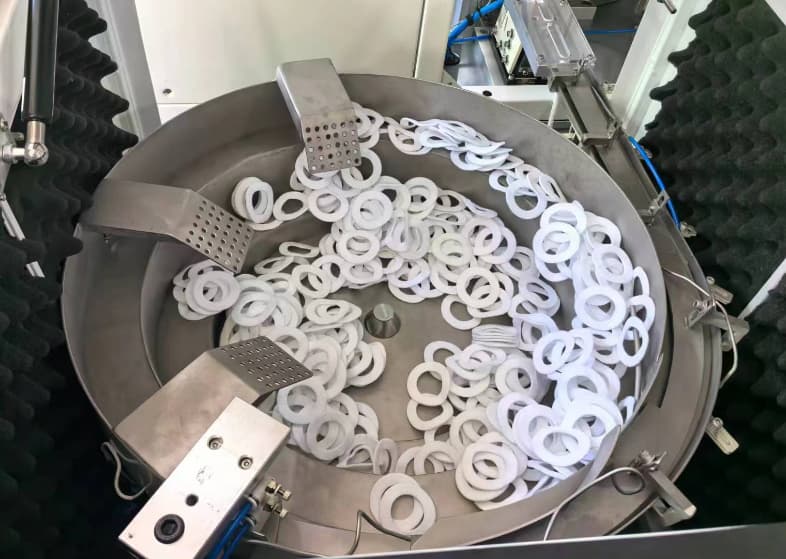
Felt components are automatically supplied through the vibratory bowl feeder and delivered to
the pick-up position.
Plastic end caps are positioned inside dedicated fixtures to ensure accurate alignment before
welding and marking.
The automation mechanism places the felt component onto the plastic end cap in the fixture.
The ultrasonic welding station bonds the felt to the end cap under controlled parameters for
repeatable quality.
A laser marking system engraves text, serial numbers, or batch codes directly onto the end cap.
The vision system verifies assembly, welding, and marking. Defective parts are automatically
sorted into NG bins while qualified parts are collected in OK bins.
Finished and inspected components are discharged to collection bins for packaging or further processing.
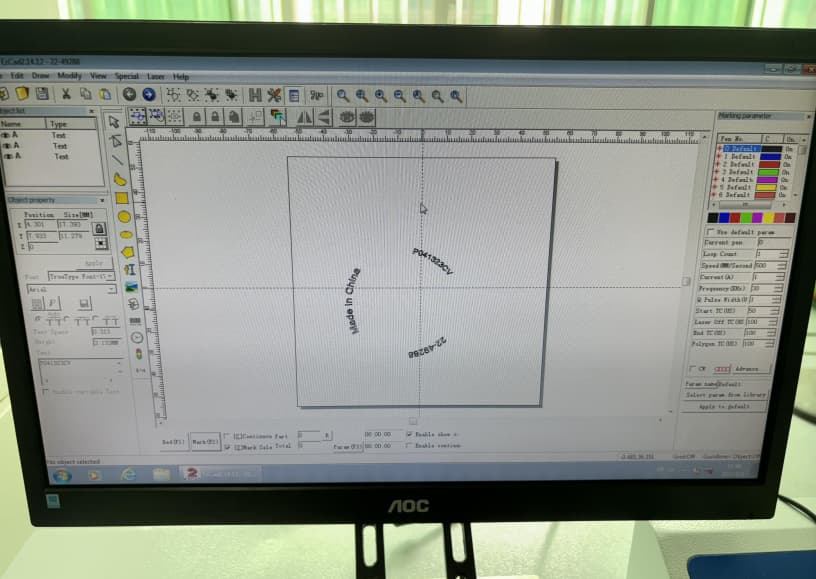
To support part identification and production traceability, the automation line was equipped with
an integrated laser marking system.After the end cap and felt are assembled and welded, the laser
marking unit engraves required information directly onto the plastic end cap. The marked information
can be used for product identification, batch management, replacement part recognition, or
customer-specific coding requirements.
Typical marking content may include:
Part number
Batch code
Production date
Customer code
Product identification text
The laser marking process is completed automatically within the production cycle, without requiring
additional manual handling. This helps the customer improve product identification while maintaining
stable automated production.
The automation line provided the customer with:
Stable and continuous felt feeding
Accurate end cap and felt positioning
Consistent ultrasonic welding quality
Traceable laser-marked end caps
Reduced labor and operator dependency
Improved production continuity and repeatability
Compact, integrated solution suitable for limited factory space
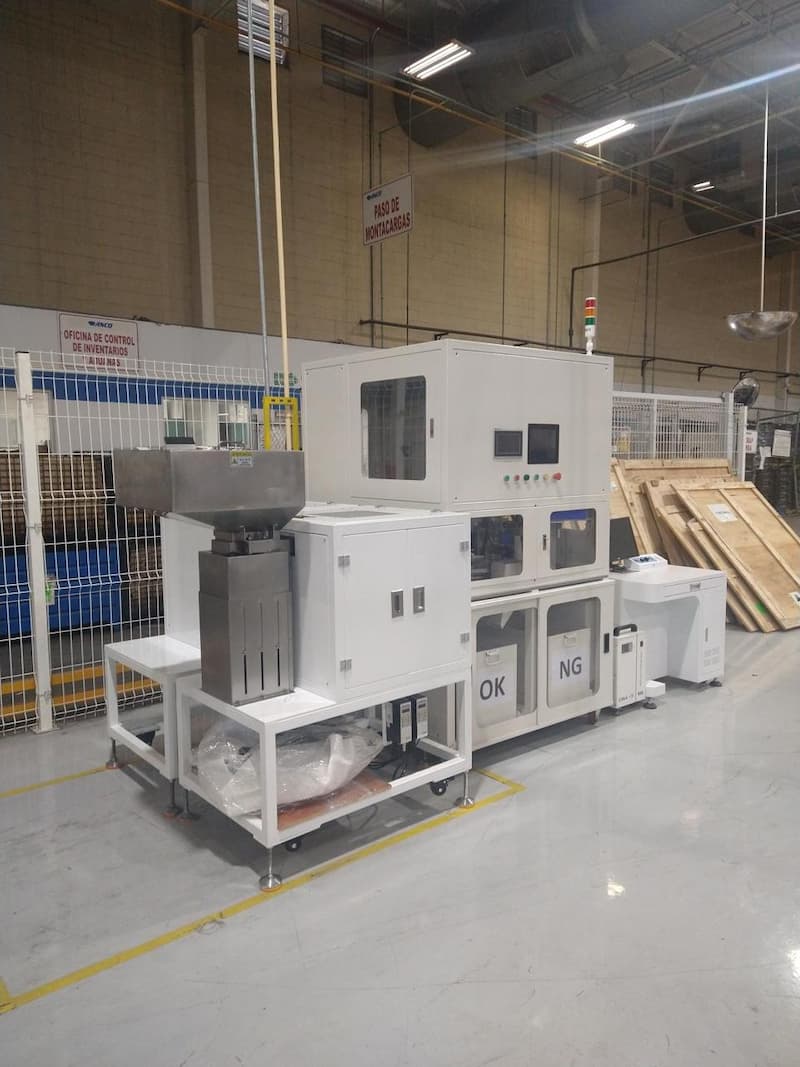
After factory acceptance testing, the automation line was shipped to the customer's facility
and successfully commissioned for production. The system now supports stable assembly,
ultrasonic welding, laser marking, and quality inspection of automotive aftermarket components.
This project demonstrates how a custom ultrasonic welding automation line with vibratory bowl feeding
and laser marking can help a US automotive aftermarket components manufacturer achieve consistent
assembly quality, traceable marking, and high production efficiency.
By integrating felt feeding, end cap positioning, ultrasonic welding, laser marking, vision inspection,
and automatic unloading, the system reduced manual handling, improved repeatability, and provided
a compact solution adaptable to future production requirements.
Phone: +86-15989541416
E-mail: sales@sztimeast.com
Whatsapp:+86-15989541416
Add: Building 5, Huixin Intelligent Industrial Park,Guangming, Shenzhen,China 518107
We chat