
sales@sztimeast.com
+86-15989541416
Ultrasonic plastic welding is a widely used joining technology for thermoplastic materials.
The process uses high-frequency ultrasonic vibrations to generate localized heat at the
interface of plastic parts, allowing them to melt and bond together without adhesives,
screws, or additional fastening components.
Compared with traditional joining methods such as adhesives, heat staking, or mechanical
fastening,ultrasonic welding offers several advantages including faster cycle times, clean
welding results, and strong structural bonds. For this reason, it has become an important
manufacturing process in industries such as automotive, electronics, medical devices,
consumer products, and packaging.
As production volumes increase, manufacturers often need higher efficiency and faster
cycle times. In many cases, a double heads ultrasonic welding machine provides an ideal
solution for improving production output and welding consistency.
This article explains how dual-head ultrasonic welding machines work, their advantages,
and when manufacturers should consider using this type of equipment.
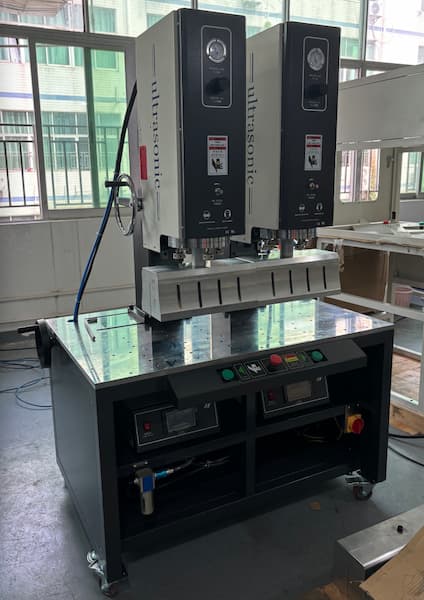
A double heads ultrasonic welding machine is an ultrasonic welding system equipped with
two welding heads operating on the same machine frame.Unlike standard ultrasonic welders
that use a single horn, this machine design allows two welding points to be completed at the
same time. The two welding heads can work simultaneously or independently depending on
the design of the equipment and the welding requirements.
The dual-head structure is particularly useful when:
a product requires welding at two separate locations
production speed must be increased
large plastic parts require balanced welding forces
Because two welds can be completed within the same cycle, manufacturers can significantly
improve productivity without increasing production space or labor.
1. Increased Production Efficiency
One of the biggest advantages of a double-head ultrasonic welding machine is its ability
to increase production speed.
Since two welding heads operate simultaneously, two weld joints can be completed in a
single cycle. Compared with traditional single-head machines, this can greatly improve
production throughput, making the equipment ideal for high-volume manufacturing
environments.
For example, if a plastic component requires welding at two positions, a single-head
machine would require two separate welding cycles. A dual-head system can complete
both welds at once, reducing total cycle time.
2. Better Welding Stability for Large Parts
Some plastic products are large or require welding at multiple points to ensure structural
strength.If welding is performed sequentially with a single welding head, uneven stress
or slight misalignment may occur. A dual-head welding system can apply ultrasonic energy
to both locations simultaneously, ensuring balanced welding pressure and consistent weld
quality.This is especially important for applications such as plastic housings, automotive
parts, and electronic enclosures.
3. Reduced Manufacturing Costs
Although dual-head ultrasonic welding machines may require a higher initial investment,
they can reduce overall production costs in the long run.
Key cost advantages include:
fewer production cycles
reduced labor requirements
higher production output
improved product consistency
For manufacturers producing large quantities of plastic components, these efficiency
improvements can significantly reduce the cost per unit.
4. Easy Integration with Automation Systems
Modern manufacturing environments increasingly rely on automation to improve
efficiency and maintain stable production.
Double heads ultrasonic welding machines can easily integrate with:
automatic feeding systems
rotary indexing tables
robotic loading systems
conveyor production lines
automated inspection systems
These integrations allow manufacturers to create fully automated plastic welding
production lines.
Dual-head ultrasonic welding systems are widely used across various industries that
require reliable and efficient plastic joining.
Automotive Industry
The automotive industry uses ultrasonic welding extensively for assembling plastic
components that require high strength and reliability.
Typical applications include:
automotive sensor housings
interior plastic components
automotive lighting assemblies
plastic brackets and connectors
Because automotive production often involves high volumes, dual-head welding machines
help improve production efficiency while maintaining consistent weld quality.
In the electronics industry, many products contain small plastic housings and connectors
that require precise welding.
Common applications include:
electronic connectors
battery housings
plastic electronic enclosures
consumer electronics components
Ultrasonic welding provides a clean and reliable joining method without damaging
sensitive electronic components.
Medical devices often require precise and clean assembly processes.
Ultrasonic welding is suitable for medical manufacturing because it does not require
adhesives or solvents that may contaminate the product.
Typical applications include:
disposable medical devices
plastic laboratory components
medical housings
diagnostic equipment components
Ultrasonic welding is also used in packaging production for sealing and assembling plastic
packaging components.
Examples include:
blister packaging
plastic containers
cosmetic packaging
consumer product packaging
Dual-head machines allow manufacturers to increase packaging production speed.
When selecting a dual-head ultrasonic welding machine, manufacturers should evaluate
several important factors.
1. Plastic Material Type
Different thermoplastics respond differently to ultrasonic welding. Common materials
suitable for ultrasonic welding include: ABS,PP,PE,PC,PVC,PS.
Understanding the material characteristics is essential for selecting the correct welding
parameters.
2. Product Size and Design
The geometry of the product and the number of welding points will determine whether
a dual-head machine is required.Products with symmetrical welding points or multiple
welding locations are ideal candidates for dual-head welding systems.
3. Production Volume
Manufacturers with high production volumes often benefit the most from dual-head
welding machines because they can significantly increase manufacturing efficiency.
4. Automation Requirements
If the welding process will be integrated into a fully automated production line, the
machine should be compatible with automated feeding, robotic handling, and inspection
systems.
TIMEAST provides industrial ultrasonic welding equipment designed for high-efficiency
plastic welding applications.
Double Heads Ultrasonic Welding Machine is designed for manufacturers who require
faster production speed and reliable multi-point welding solutions.
Key features include:
dual ultrasonic welding heads
stable welding performance
customizable tooling and fixtures
compatibility with automated production systems
suitable for various thermoplastic materials
This machine can be customized according to specific product designs and production
requirements.
As manufacturing industries continue to pursue higher productivity and better product
quality,ultrasonic welding technology plays an increasingly important role in plastic
assembly.A double heads ultrasonic welding machine provides an effective solution
for manufacturers who need faster production speeds, multi-point welding capabilities,
and improved welding consistency.
By implementing dual-head ultrasonic welding technology, companies can significantly
enhance production efficiency while maintaining reliable welding performance.
Phone: +86-15989541416
E-mail: sales@sztimeast.com
Whatsapp:+86-15989541416
Add: Building 5, Huixin Intelligent Industrial Park,Guangming, Shenzhen,China 518107
We chat