
sales@sztimeast.com
+86-15989541416
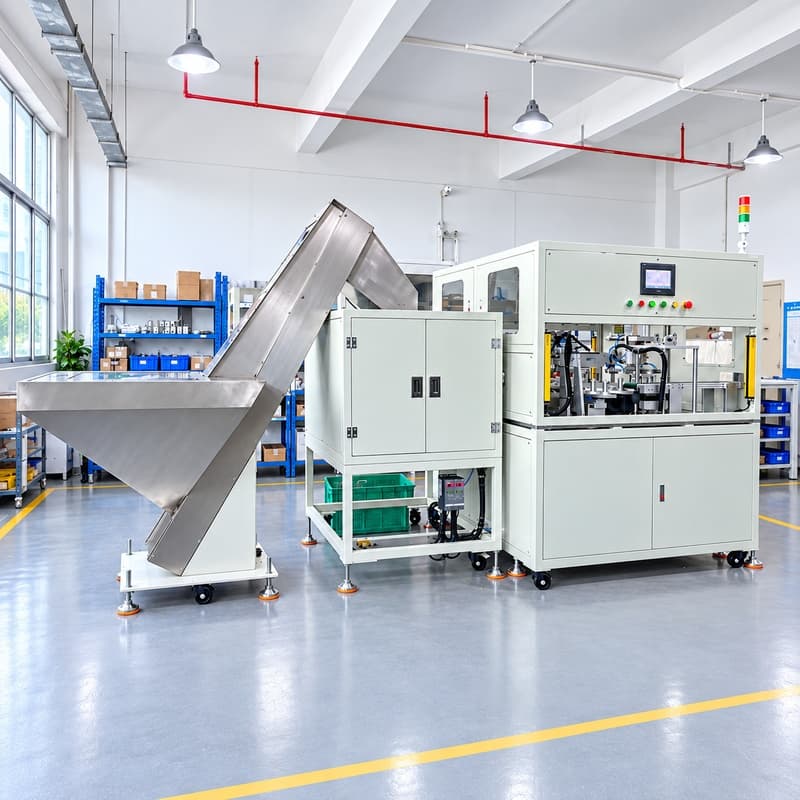
TIMEAST developed this custom automation system for an automotive molded gasket that
requires both the center molding gate and surrounding outer flash to be removed after molding.
Instead of handling trimming as a separate manual process, the machine combines automatic feeding,
part orientation,4-piece transfer, rotary indexing, part clamping, gate and flash removal, scrap collection
and finished-part unloading into one continuous process.The system is designed for a production capacity
of up to 2,000 pcs/hour.
Project Item | Specification |
Application | Automotive Molded Gasket |
Process | Center Gate + Outer Flash Removal |
Feeding | Elevator Hopper + Vibratory Bowl Feeder |
Part Handling | 4 pcs per transfer |
Main Process | Gripping + Pulling + Rotation + Blade-Assisted Cutting |
Indexing | Multi-Station Rotary Table |
Scrap Handling | Automatic Waste Collection |
Finished Part | TransferConveyor |
Production Capacity | Up to 2,000 pcs/hour |
Control | PLC + HMI |
Machine Color | RAL 9002 |
The molded gasket comes out of the molding process with a center gate and excess material around
the outer edge.Both areas must be removed before the finished gasket can move to the next production stage.
The customer wanted to replace manual handling with an automated process capable of continuously feeding,
positioning and trimming the molded parts while maintaining stable production.
The challenge was therefore not only how to remove the gate and flash.
The feeding direction, part orientation, gripping position, trimming direction, waste separation, transfer method
and production speed all had to be considered as part of one automation system.

The molded part enters the machine with the center gate and surrounding flash still attached.
During the automatic trimming process, the gasket is held in a controlled position while separate
mechanisms remove the center gate and outer excess material.
The finished gasket is then automatically transferred to the discharge conveyor.

For this project, TIMEAST designed a complete automatic handling and trimming system rather than only
a standalone cutting station.
The machine integrates an elevator hopper, vibratory bowl feeder, intermediate sliding transfer station,
4-piece grippers, multi-station rotary indexing table, custom trimming mechanisms, waste collection system
and finished-part conveyor.
Each part of the machine was designed around the actual gasket structure and production process.
Four parts are transferred together between key stations, while loading, trimming and unloading operations
are performed at different rotary-table positions.
This allows multiple operations to run in parallel and reduces unnecessary waiting between individual steps.
Molded gaskets are loaded into the elevator hopper.
The lifting system automatically supplies parts to the vibratory bowl feeder, reducing the need
for frequent manual replenishment.
The vibratory bowl feeder sorts and orients the molded parts.
Correctly positioned parts are transferred through the feeding track to the defined pickup position.
A pickup gripper collects four parts at the same time from the feeding position.
The four gaskets are placed onto the positioning fixtures of the intermediate sliding station.
The slide moves the four parts from the feeding side to the rotary-table loading position.
A second pickup mechanism then collects all four parts from the intermediate station.
The four gaskets are placed into dedicated fixtures on the multi-station rotary indexing table.
The rotary table indexes to the next working position according to the PLC program.
Before trimming starts, dedicated hold-down clamps move downward and secure the molded gaskets.
Stable positioning is important because the center gate and surrounding flash are removed by controlled
mechanical movement.
The upper rotating gripper grips the center molding gate.
The gripping and pulling movement is controlled according to the product structure so that the center gate
can be separated from the gasket.
A lower gripping mechanism engages the outer excess material.
The machine combines controlled gripping, rotation and pulling with blade-assisted cutting to separate
the outer flash from the finished gasket.
Removed center gates and flash are separated from the finished parts.
The waste material is released into a dedicated scrap collection bin located inside the lower machine frame.
After trimming is completed, the rotary table indexes to the unloading station.
The unloading gripper picks the finished gaskets from the rotary fixtures and places them onto the discharge
conveyor.
The conveyor transfers the finished parts to a collection container or directly to the customer's next
production process.All stations operate according to the programmed PLC sequence to complete
one continuous automatic production cycle.
Watch the complete process from automatic feeding and 4-piece transfer to gate and flash removal,
scrap collection and finished-part unloading.
The required production capacity could not be achieved efficiently by performing feeding, trimming
and unloading one operation at a time.
For this reason, the system uses a multi-station rotary indexing table combined with 4-piece handling.
While one group of parts is being trimmed, another station can perform loading or unloading.
This overlap between stations reduces idle time and allows the machine to reach a production capacity of:
Up to 2,000 pcs/hour
The rotary layout also provides dedicated positions for loading, trimming and unloading, making it easier
to control part positioning and coordinate the different mechanisms.

The trimming mechanism was developed specifically for the structure of this molded gasket.
The machine does not rely on only one blade to cut the excess material.
Instead, the process combines:
part clamping + center gate gripping + outer flash gripping + controlled rotation +
pulling + blade-assisted cutting
This allows the unwanted molding material to be removed automatically while the finished
gasket remains securely positioned.
The gripping method, trimming direction, fixture design and cutting mechanism can be changed
for other products according to the actual: gate position, flash structure, product geometry,
material and required trimming result.
This is one of the key differences between a standard trimming machine and a custom automation system.
The complete production sequence is coordinated through the PLC.
The control system manages the elevator hopper, vibratory feeder, transfer slides, pneumatic cylinders,
grippers, rotary table, trimming mechanisms, sensors, scrap discharge and finished-part conveyor.
The HMI allows the operator to run the machine, monitor operating status and handle machine alarms
from one interface.The different mechanisms are programmed to work together instead of completing
each process as an isolated movement.
This coordination is especially important in a multi-station machine where feeding, loading, trimming
and unloading may occur at the same time.
The electrical and pneumatic configuration was selected according to the customer's equipment
requirements.
Component | Brand |
PLC | Mitsubishi |
HMI | Mitsubishi |
Pneumatic Cylinders | SMC |
Pneumatic Slides | SMC |
Pressure Components | SMC |
Solid Relays | Schneider |
Power Supply | Schneider |
Sensors | Omron |
Using established industrial components also makes replacement parts, maintenance and
troubleshooting easier for the customer's production team.
Component brands can be adjusted for other automation projects according to the
customer's approved supplier list or factory standard.
Operator safety is integrated into the machine design.
The system is equipped with an emergency stop, three-color warning light, safety light curtain and
safety-door interlock.
If the safety door is opened or the light curtain is interrupted during operation, the corresponding
machine operation is stopped according to the safety control logic.
The machine enclosure and frame were finished in RAL 9002, according to the customer's requested
equipment color specification.
This machine was not built by simply adding a trimming mechanism to a standard platform.
The automation layout was developed around the customer's actual molded gasket, trimming
requirements and production target.
For this project, TIMEAST customized the feeding method, bowl feeder tooling, 4-piece pickup
mechanism, intermediate transfer station, rotary-table fixtures, part hold-down system, center gate gripper,
outer flash removal mechanism, cutting tooling, waste collection system, unloading mechanism,
PLC sequence and safety configuration.
The result is not simply a gate removal station.It is a complete automatic process covering:
bulk part feeding → orientation → positioning → trimming → scrap separation → finished-part unloading
This type of project is also a good example of how we approach custom automation: the equipment is designed
around the customer's product and production process rather than forcing the product into a fixed standard machine.
Yes.
The machine shown in this case was developed specifically for an automotive molded gasket,
but the same automation approaccan be applied to other molded plastic or elastomer components
requiring automatic post-molding processing.
Depending on the product, the system can be designed for:
automatic gate removal, degating, flash removal, trimming, part separation, orientation,
inspection, assembly and downstream transfer.
The final machine structure does not need to be identical to this project.
The feeding system, grippers, fixtures, trimming mechanism, number of parts handled per cycle
and downstream process can all be designed according to the actual application.
To evaluate an automatic gate or flash removal application, we normally need the customer's part samples or drawings,
material information, gate and flash condition, current trimming method, required production capacity and downstream
production process.
A video showing the current manual operation is also useful because it helps our engineers understand how the unwanted
material is currently separated from the finished part.
Based on this information, we can evaluate the feeding method, positioning, gripping, trimming process and overall
automation concept.
Yes. In this project, separate mechanisms are used to handle the center gate and surrounding flash.
The final removal method combines gripping, pulling, rotation and blade-assisted cutting.
No. The achievable production capacity depends on the product structure, feeding stability, trimming method,
number of parts handled at one time and any additional inspection or downstream processes.
For this automotive gasket project, the system was designed for an output of up to 2,000 pcs/hour.
Yes. The trimming mechanism is designed according to the actual molded part. The gripping position,
pulling direction, cutting method and fixtures can be changed for different products.
Yes. The discharge conveyor can transfer finished products to a collection bin or connect with
downstream assembly, inspection, marking or packaging equipment.
Yes. Components can be selected according to the customer's factory standard or approved supplier list.
For this project, Mitsubishi, SMC, Schneider Electric and Omron components were used according to
the specified configuration.
Part samples or drawings are the most useful starting point. We also recommend providing the part material,
gate and flash details, current trimming process, required production capacity and any downstream process
requirements.
If your molded parts still require manual gate removal, flash trimming or part separation after molding,
send us the actual product information.
Our engineering team can evaluate the complete process from feeding and positioning to trimming and
finished-part transfer.
Please send us:
part samples or drawings, photos of the gate and flash, material information, current process video and
required production capacity.
Discuss Your Automation Project
Engineering Support:engineering@sztimeast.com
Phone: +86-15989541416
E-mail: sales@sztimeast.com
Whatsapp:+86-15989541416
Add: Building 5, Huixin Intelligent Industrial Park,Guangming, Shenzhen,China 518107
We chat