
sales@sztimeast.com
+86-15989541416
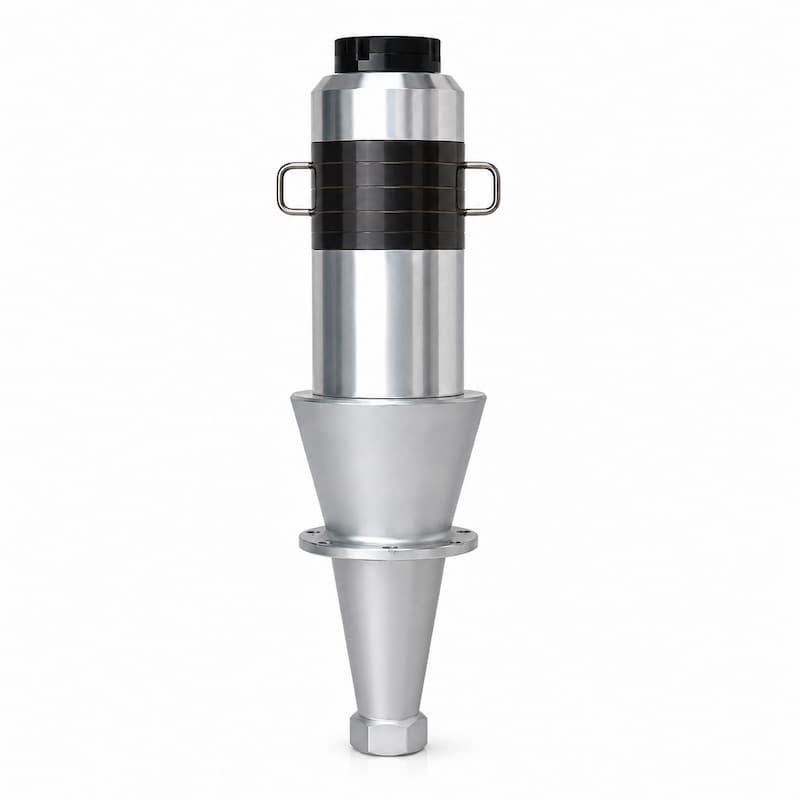
Stable and durable ultrasonic transducer for welding systems.
✔ High conversion efficiency for consistent output
✔ Long service life for industrial applications
✔ Compatible with 15kHz and 20kHz systems
Get the right transducer for your machine.
Ultrasonic transducers, also known as converters, are the core components of
ultrasonic welding systems. They convert electrical energy into high-frequency
mechanical vibrations, which are then transmitted to the welding interface through the horn.
The performance of the transducer directly affects welding stability, energy efficiency,
and weld quality, making it a critical factor in plastic welding applications.
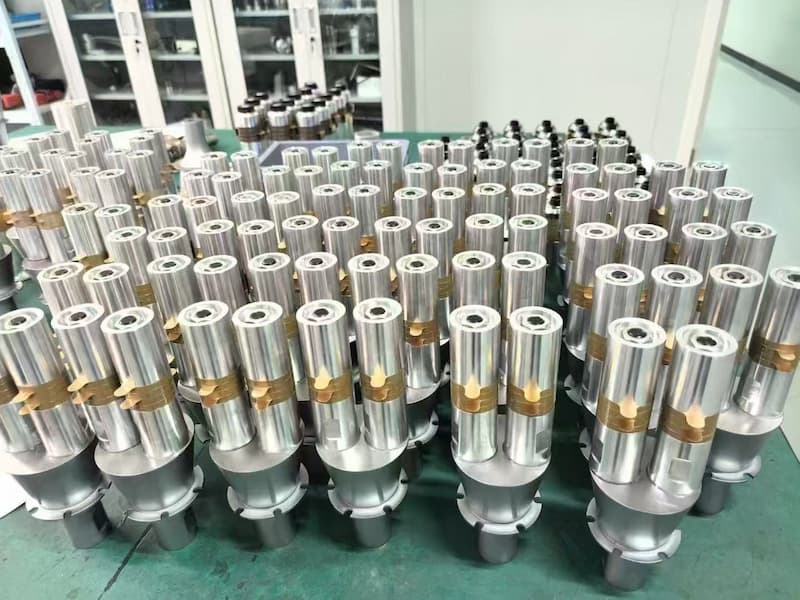
Our ultrasonic transducer is compatible with a range of ultrasonic horns and generators
to deliver precision welding for plastic components.
Watch the video below to view a batch of ultrasonic welding transducers manufactured for
industrial ultrasonic systems.
Available for various ultrasonic welding applications and frequency configurations.
Multi-Frequency Capability
Our ultrasonic transducers are available in multiple frequency options, including
15kHz, 20kHz, 28kHz, 35kHz, and 40kHz, ensuring compatibility with a wide range
of ultrasonic welding systems.
Each transducer is precisely designed and tuned to deliver stable amplitude output,
efficient energy conversion, and reliable long-term performance across different
plastic welding applications.
High energy conversion efficiency
Stable amplitude output for consistent welding quality
Available in multiple frequency ranges (15kHz–40kHz)
Durable structure for long service life
Optimized for industrial plastic welding applications
Reliable performance in continuous operation
Each transducer is assembled and tuned to meet welding system requirements and
reliability expectations for long-term operation.
This transducer is suitable for ultrasonic welding in industries such as:
Automotive plastic components
Electronics housings and connectors
Medical device plastic parts
Household appliance assemblies
Customized ultrasonic automation systems
It can be integrated into both stand-alone welding machines and automated
production lines.
Compatibility & Integration
This ultrasonic transducer is compatible with a wide range of ultrasonic welding machines,
including standard pneumatic systems, high-precision welding equipment, and automated
production lines.
20kHz (Standard)
Recommended for most ultrasonic plastic welding applications with balanced
performance and wide system compatibility.
15kHz (High-Power Option)
Designed for high-energy welding tasks where stronger output and deeper vibration
transmission are required.
35kHz (On Request)
Available for precision welding needs such as small parts, fine features, and certain
electronics/medical applications.
Note: 20kHz and 15kHz are the primary configurations used in most industrial
welding systems. 35kHz availability depends on application requirements.
The 15kHz ultrasonic transducer configuration is widely used for high-power ultrasonic
welding where greater welding energy and deeper vibration penetration are necessary.
Compared with standard 20kHz systems,the 15kHz option typically provides higher
mechanical force output, which is especially helpful for welding:
Thick-wall plastic parts
Large-size components or larger welding areas
High-strength or rigid thermoplastics
Applications requiring high joint strength
If your parts are difficult to weld or require higher energy input, the 15kHz option
can be a better engineering choice.
Choose 15kHz when you need:
Higher power output for thick/large parts
Deeper energy transmission through the joint area
Stronger weld strength for structural components
Choose 20kHz when you need:
Standard industrial plastic welding performance
Broad compatibility with general welding setups
Typical applications with small to medium part sizes
TIMEAST can assist with selecting the frequency and matching the full welding
system configuration.
The transducer can be matched with:
Ultrasonic generators
Boosters and sonotrodes (horns)
Servo or pneumatic ultrasonic welding machines
Customized automation welding systems by TIMEAST
To improve welding stability and energy transfer efficiency, we provide
system-level matching and tuning support(transducer + booster + horn + generator).
Frequency and impedance testing before delivery
Stable performance under continuous industrial operation
Strict material selection and controlled assembly process
Designed for long service life and consistent output
TIMEAST focuses on engineering-grade reliability for industrial manufacturing needs.
FQA
Q1. What is an ultrasonic transducer?
A: It is the component that converts electrical energy into mechanical vibration
in ultrasonic welding systems.
Q2. What frequency options are available?
A:15kHz, 20kHz, 28kHz, 35kHz, and 40kHz are available depending on application
requirements.
Q3. How do I choose the right frequency?
A: Lower frequencies are suitable for high-power applications, while higher frequencies
are ideal for precision welding.
Q4. Is customization available?
A: Yes, transducers can be designed and tuned according to specific system and application
requirements.
Looking for the perfect transducer for your ultrasonic welding system?
Explore our ultrasonic welding components or contact our engineering team for customized solutions
tailored to your application.
Phone: +86-15989541416
E-mail: sales@sztimeast.com
Whatsapp:+86-15989541416
Add: Building 5, Huixin Intelligent Industrial Park,Guangming, Shenzhen,China 518107
We chat