
michael@sztimeast.com
+86-15989541416
Choosing the right ultrasonic welding system is critical for achieving consistent quality,
especially when welding high-precision or thin-wall plastic parts.
Many manufacturers struggle to decide between servo driven ultrasonic welding and
traditional pneumatic ultrasonic welding.Although both technologies are widely used,
they serve very different application requirements.
In this article, we compare servo driven vs pneumatic ultrasonic welders, explain their
working principles, and help you determine which solution is best for your plastic
welding application.
What Is Pneumatic Ultrasonic Welding?
A pneumatic ultrasonic welder uses compressed air to drive the welding head downward.
The welding force and movement are controlled by air pressure and mechanical stops.
Key Characteristics of Pneumatic Ultrasonic Welding
Cost-effective solution
Simple structure and easy maintenance
Suitable for thick or structural plastic parts
Limited control over exact welding depth and force
Sensitive to air pressure fluctuations
Pneumatic ultrasonic welding is commonly used for general-purpose plastic welding, where
cosmetic appearance and micron-level accuracy are not critical.
What Is Servo Driven Ultrasonic Welding?
A servo driven ultrasonic welder uses an electrical servo motor instead of compressed air to control
the welding movement.This allows closed-loop control of: Position,Speed,Force,Welding depth
As a result, servo ultrasonic welding delivers higher repeatability and precision, even when
part tolerances vary.
Key Differences: Servo Driven vs Pneumatic Ultrasonic Welding
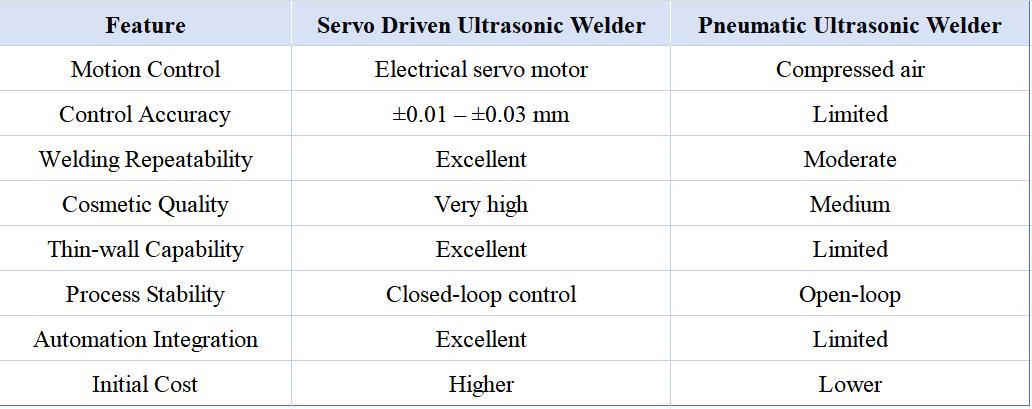
When Should You Choose a Servo Driven Ultrasonic Welder?
A servo driven ultrasonic welding machine is the better choice if your application involves:
1. Thin-Wall Plastic Parts
Servo control minimizes deformation, flash, and whitening, which is critical for thin or cosmetic parts.
2. High Precision & Tight Tolerances
Closed-loop position control ensures consistent welding depth across parts.
3. Cosmetic or Visible Components
Improves surface appearance and reduces post-processing.
4. Medical & Electronics Applications
Where repeatability, traceability, and process control are required.
5. Automated Production Lines
Servo ultrasonic welders integrate easily with PLC, MES, and robotic systems.
When Is Pneumatic Ultrasonic Welding Still a Good Option?
Pneumatic ultrasonic welding may still be suitable if:
Parts are thick and structural
Cosmetic appearance is not critical
Budget is the main concern
Process variation is acceptable
In these cases, pneumatic systems provide a cost-effective and reliable solution.
Why Servo Driven Ultrasonic Welding Improves Production Consistency
Servo driven systems maintain constant welding parameters, regardless of:
Material variation
Part dimensional changes
Environmental conditions
This leads to:
Lower scrap rate
Reduced rework
Higher yield
Better long-term quality control
For manufacturers focused on high-value plastic products, servo ultrasonic welding delivers measurable ROI.
Conclusion: Which Ultrasonic Welding Technology Is Right for You?
There is no single “best” ultrasonic welding technology — the right choice depends on your product design,
quality requirements, and production goals.
For general plastic welding → Pneumatic ultrasonic welding
For precision, thin-wall, cosmetic or automated applications → Servo driven ultrasonic welding
Need Help Selecting the Right Ultrasonic Welding Solution?
If you are working with high-precision plastic parts and are unsure whether servo driven ultrasonic welding
is suitable for your application:
Send us your part drawings or samples
Get a free welding evaluation from our engineers
Learn more about our Electrical Servo Driven Ultrasonic Welder
Phone: +86-15989541416
E-mail: michael@sztimeast.com
Whatsapp:+86-15989541416
Add: 3/F, Building 5,Huixin Intelligent Industrial Park, Xinhu, Guangming, Shenzhen,China 518107