
michael@sztimeast.com
+86-15989541416
Ultrasonic welding is widely used to seal plastic components, but many manufacturers still encounter
leak test failures even when the weld looks perfect.
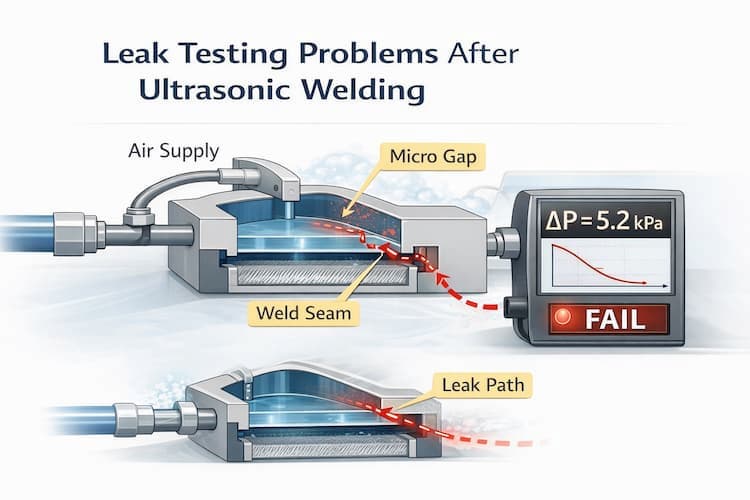
In this FAQ-style guide, we answer the most common leak testing problems after ultrasonic welding,
explain why they occur, and show how proper air leak testing helps identify and solve them.
FAQ 1: Why Do Welded Parts Fail Leak Tests Even When the Weld Looks Good?
Short answer:
Because visual inspection cannot detect micro-leaks.
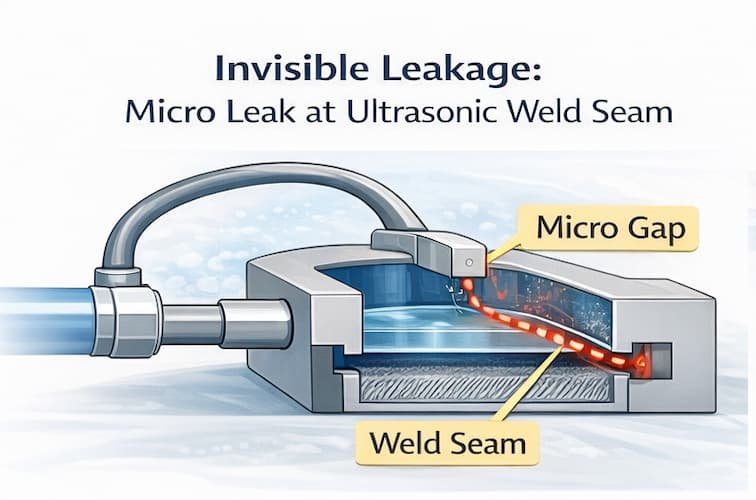
Common causes include:
Incomplete energy transfer at the weld interface
Material shrinkage after cooling
Internal stress causing micro-gaps along the weld line
Even tiny defects invisible to the eye can cause pressure loss during leak testing.
Solution:
Use air leak testing (pressure decay or differential pressure) to objectively verify sealing integrity.
FAQ 2: What Is the Most Common Leak Location After Ultrasonic Welding?
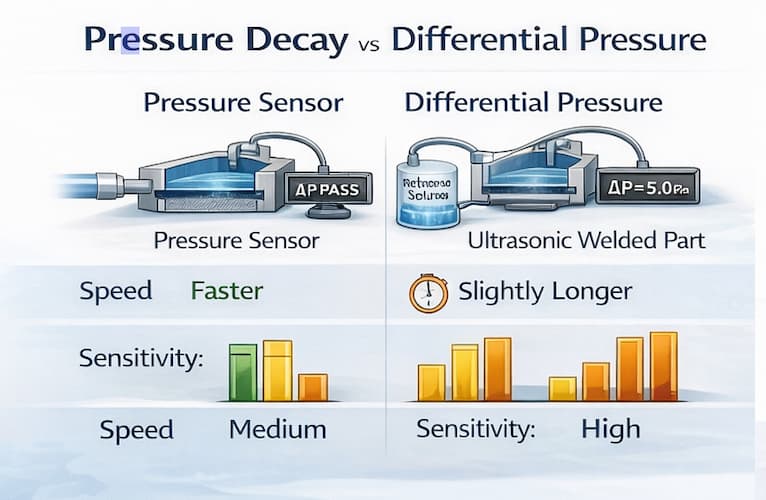
Most leaks occur at:
The weld seam
Corners and sharp transitions
Areas with uneven wall thickness
These areas are sensitive to welding parameter variation and part tolerance.
Tip:
Leak test data can help identify recurring weak points and guide weld parameter optimization.
FAQ 3: Why Are Leak Test Results Unstable or Inconsistent?
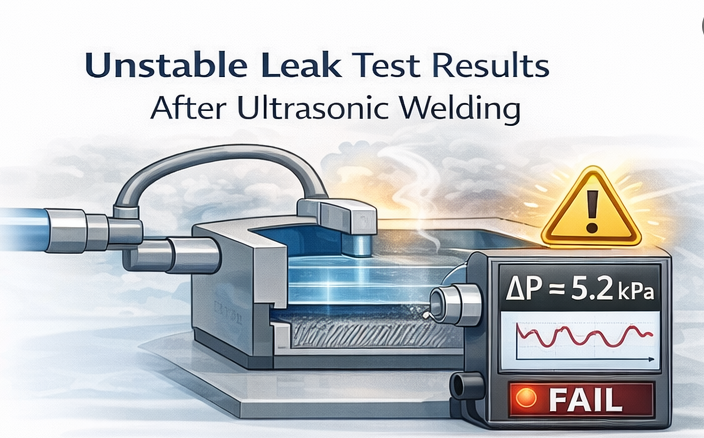
Unstable results are often caused by:
Insufficient pressure stabilization time
Temperature variation after welding
Fixture leakage instead of part leakage
Part deformation during clamping
Solution:
Allow proper cooling before testing
Optimize stabilization and detection time
Use well-sealed, customized fixtures
FAQ 4: Pressure Decay or Differential Pressure—Which Is Better After Welding?
It depends on your application:
1 Pressure Decay Testing
Faster and simpler
Suitable for most welded plastic parts
2 Differential Pressure Testing
Higher sensitivity
Ideal for micro-leak detection and small volumes
Many manufacturers start with pressure decay and upgrade to differential testing when
higher precision is required.
FAQ 5: Can Leak Testing Help Improve the Ultrasonic Welding Process?
Yes—this is often overlooked.
Leak testing is not only a pass/fail inspection, but also a process optimization tool:
Identifies unstable welding parameters
Confirms consistency across production batches
Reduces scrap and rework
When leak testing is integrated directly after ultrasonic welding, quality issues are detected early.
FAQ 6: How Can Leak Testing Be Integrated Into a Production Line?
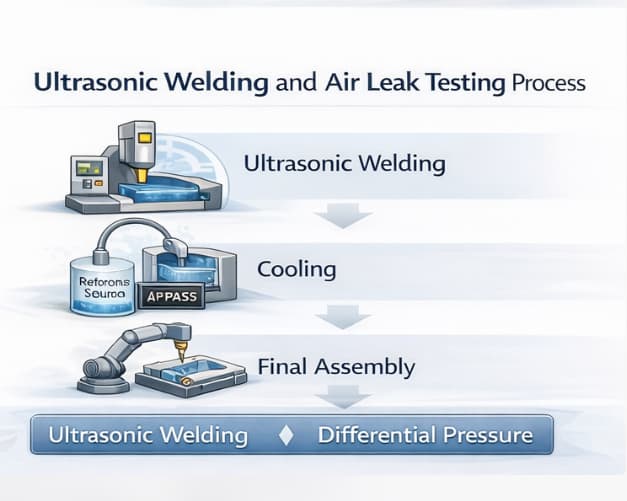
A typical workflow is:
Ultrasonic Welding → Cooling → Air Leak Testing → Final Assembly
Modern air leak testing machines support:
Multi-station testing
Automatic judgement
Data logging and traceability
This makes them suitable for inline inspection in mass production.
Conclusion
Leak test failures after ultrasonic welding are common—but they are also preventable.
By understanding typical leak problems and applying the right air leak testing method, manufacturers
can significantly improve weld quality, reduce defects, and ensure reliable sealing performance.
Phone: +86-15989541416
E-mail: michael@sztimeast.com
Whatsapp:+86-15989541416
Add: 3/F, Building 5,Huixin Intelligent Industrial Park, Xinhu, Guangming, Shenzhen,China 518107